Did you ever wonder why Jesus instructed us to ask for “daily” bread? Why not ask for a lifetime supply of bread? Couldn’t God do that? Couldn’t God by His infinite power simply provide for all of our material needs?
And material needs we have. Because we are creatures who exist in bodies, these bodies are in constant need: food, water, shelter, fire, etc. We are in a constant state of neediness.
Why would a God, whose bounty is infinite, leave us in such a state that we are constantly worried about our material well-being? Why doesn’t he make us more comfortable in this world?
I think the answer is in the question.
Prosperity in this world is perilous to the soul. Christ never said that it was a sin to have wealth, but he always warned of its dangers. Yes, you can be rich and be a saint. But there seems to be a higher degree of difficulty in achieving holiness when you have prosperity.
I don't know, but this seems like an even more pointless remake than the Ghostbusters movie. And they seem to be really downplaying the religious component of the movie. The original title of the novel is Ben-Hur: a Tale of the Christ.
The race looks like it could be exciting, but why would you want to try to step into Charlton Heston's sandals.
Thank you again for your incredible patience. I know I have been lax in getting updates in. The family member who has been having health problems took a sudden turn last Monday evening and was taken back to the ER.
Praise God we hope things have stabilized a bit and we are hopeful that we can avoid more setbacks. But when we are not at the hospital, I am at school directing a play that opens this weekend and I am grading projects for the end of the academic quarter.
I am hopeful that I will be able to get back on our regularly scheduled blogging program.
Again, thank you for all of your prayers and support.
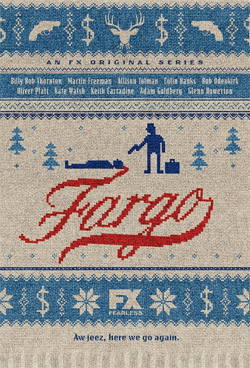
There are many people who would place the movie Fargo on their lists of greatest films of all time. They would point to the sharp writing, the stunning cinematography, the fantastic performances, and the thematic richness.
I am not one of those people. When it comes to Fargo the movie, I am lukewarm at best. I can understand how people can see all of the above positive qualities in the movie, but it mostly goes over my head. The film, to me, is to meandering and empty of any real heart or depth. So when they announced a Fargo TV show, I had little to no interest. It wasn't until a good friend of my, who I will call here the FullMetal Alchemist, spoke to me about the technical achievement of the show. So I checked it out.
That first season of Fargo is one of the greatest things I have ever seen on television.
All of the hyperbole that people attach to the film should be applied to this show. You may think it strange that a show with only 2 seasons under its belt should rank so highly. But trust me when I say that it is well deserved.
Each season of Fargo is its own story only loosely connected to each other. The first season centers around Lester Nygaard (Martin Freeman), a sad-sack, put-upon insurance salesman who has a chance encounter with a deadly hitman Lorne Malvo (Billy Bob Thorton). Lester has just been humiliated by an old bully from high school. Malvo offers to kill the bully for Lester. What follows is a brilliant character study and morality tale. Also key to this story is Deputy Molly Solverson (Allison Tolman) and Gus Grimly (Colin Hanks) who work together to set right an injustice. The second season takes place at the end of the '70's where State Trooper Lou Solverson (Patrick Wilson) tries to solve a murder in the middle of a Mid-West mob war.
This show has some of the best television acting you will see. Freeman and Thorton gives the best performances of their careers, and that is saying a lot. Watching Lester's transformation is stunning. And Thorton completely owns the Malvo character and becomes one of the scariest TV villains I have seen. Every look and gesture is packed with malice and danger. Tolman and Hanks, as well as the entire supporting cast, give it everything that it's worth.
The directing is also beautiful. Even when the acts on screen are atrocious, the directing finds the right way to let it pierce your heart and mind. So many movies today feel lazy in terms of visual storytelling. Fargo pushes the limits and creates a true cinematic experience on the small screen.
But the thing that breaks this into the stratosphere are the writing and the themes therein.
The writers have been able to craft 2 seasons of stories that build the tension to an almost unbearable level. I remember towards the end of the first season I was so emotionally involved that I shouted an expletive at the TV screen, as if that would change the outcome. I felt real panic and fear in my stomach for the characters.
But beyond that, Fargo is ultimately about morality. Good and evil are clearly on display in this show. Nowadays when it is more cutting edge and "artistic" to embrace either nihilism or relativism, Fargo plants its flag firmly on the side of traditional morality. Not only that, but the show is ultimately a testament to the goodness and value of ordinary people, ordinary love, and ordinary life. Whereas most shows mock the people in fly-over country, the people of Fargo have many dimensions. Some embrace evil. Others turn to goodness. Things aren't always easy or simple, but the choice between the two is clear and the show does an amazing job of making goodness look and feel attractive. There is no need to give the heroes of the show a dark backstory in order to create internal conflict. Our heroes are just decent people trying their best to be good in a violent world.
TV THRESHOLD
"The Crocodile's Dilemma"
(1x01)
The pilot episode brought all of the show's strength at once. It is incredible who quickly we identify with Lester as he is unjustly bullied and reviled by his wife, his family, his work, and his neighbors. At once we empathize with him. And even when he makes horrible decisions, our empathy lingers for a long time, maybe longer than it should. But the story that unfolds begins slowly but you cannot take your eyes off it. I never thought I would say that Billy Bob Thorton was charismatic, but I'll be darned if he did not command the screen. And once that first episode is done, if you are not all in you never will be.
JUMP THE SHARK
N/A
WORST EPISODE
"Buridian's Ass"
(1x06)
Like a lot of TV shows, the beginnings and endings are strong, but the middles sometimes suffer. Unfortunately Fargo is no exception. The writers placed in the story an ultimately pointless subplot involving a millionaire named Milos (Oliver Platt) that finally came to its rather unconnected conclusion in this episode. That storyline was meant as a tether to the movie Fargo, but it did little to further the story and it was the first time the show really felt like it was treading water, waiting for the good stuff.
BEST EPISODE
"Morton's Fork"
(1x10)
The entire first season builds to this final confrontation. I cannot write too much without spoiling it, except to say that it is an edge-of-your-seat episode from start to finish with such a thematically rich finally that I was filled with an immense sense of satisfaction.
OVERALL
I was worried that Season 2 would lose the greatness, but it was just as good. I am looking forward to the next season. While the show sometimes gets a bit too graphic with their depictions of sex and violence, it is not nearly as bad as some other basic cable shows. It is so refreshing to find a show that is edgy, violent, and thrilling while at the same time being ultimately wholesome in nature.
I am trying to be open-minded, but here are a few thoughts I had:
1. A Tough Act To Follow.
No matter what, this movie is going to suffer by comparison to the original. That already puts them at an unfair disadvantage. Having said that, if you are going to try and fill Babe Ruth's shoes, you better knock it out of the park.
2. Paul Feig is no Ivan Reitman.
I have become less and less enthusiastic about Paul Feig sense of humor. He lets awkward jokes play out way too long and doesn't seem to understand that brevity is the soul of wit. Something tells me this movie is going to feel a bit bloated.
3. Gross Does Not Equal Funny.
The slime in the original Ghostbusters was gross. But if you remember, you never see Venkman get slimed. In the new one, slime is essentially ghost-puke. I am not sure how that is funnier. But I think that this is the level of humor that we will deal with.
4. Caricature is not Character.
The actors in both the original and the remake had a significant background in sketch comedy. But the original Ghostbusters felt like tangible characters. From what I saw in the trailer, these new Ghostbusters feel like some kind of Saturday Night Live parody of Ghostbusters. I obviously could be wrong, but they seem to be playing personalities, not persons. If that's all you have, then there can be no strong emotional connection. Think about Winston and Ray's conversation about judgment day or Venkman saying, "See you on the other side, Ray." Those moments have weight because though they were often silly, the Ghostbusters felt real. I'm not getting that from these new ones.
5. What is the Point of Ghostbusters without a Venkman?
Everyone in the original Ghostbusters was great. But let's be honest: it was Bill Murray's show. But beyond his comedic genius, Venkman served an important story function: he was they guy who knew that this story was silly. He was the pressure release valve for the audience. And he made Ghostbusting cool. Look at the characters in this new one: 3 geeks and a tough chick. Not one of them appears to be trying to ascend the Murray throne. Maybe that's intentional to avoid the unflattering comparison. But again, if they wanted to avoid that, they shouldn't have made the movie in the first place.
At one time I was contemplating the priestly and religious life. I considered what it would be like to take on the three vows of poverty, chastity, and obedience. I remember having a conversation with someone at the time who asked if I could handle a life with no or little material possessions and never having physical intimacy. I said that that might be a struggle. But the real problem for me would have been the obedience.
Growing up was not an overly rebellious child. I did not act out against my parents in ways beyond the typical teenage tropes. But I will say that, as my mother puts it, I marched to the beat of a different drum. Or to put it more plainly: I was weird. When I became obsessed with Billy the Kid, I wore toy six-shooters wherever I went in public, even when my parents took me shopping (I should mention I was older than you are probably imagining). Once at a junior high dance while everyone else was acting normally, I decided to start a game of tag with my friends instead. When my mother insisted that I didn’t wear sneakers to go see The Nutcracker, I put on dress shoes: one brown one and one black one.
My point is that I very much like to do things my way and in my time. I don’t think that I am unique in this, but doing simply because I am told has never been my thing. That is why the thought of religious life was such a challenge. In my studies of the saints, they would often be told to do things by their superiors that were downright stupid. But they would have to obey.
I remember reading the story of one saint in a convent who had a nun in higher authority who did not like her. So, the superior ordered her to sit on a table while the older superior nun cleaned the kitchen. The sitting nun was forbidden to explain that she had been ordered to sit and do nothing under the constraint of obedience. When other nuns walked by they saw a scene of what appeared to be a young, able-bodied woman watching uncaringly at her much elder fellow sister humbly laboring. The older nun wanted to make the younger nun look badly and wanted to make herself look humble and selfless.
This story filled me with indignation. I don’t think I could endure such a shaming. But the young nun who went on to become a saint burned with charity for the older nun. She prayed for her, not in a judgmental way, but in a sincere desire to deliver her from her false humility. And the saintly nun was grateful to the Lord for the opportunity to exercise obedience.
When evaluating someone from the religious life for possible canonization for sainthood, they look at how they followed the vow of obedience. If there is a case of unrepentant disobedience to a superior, the cause of canonization is thrown out. This is how seriously obedience is taken.
But why? Are we not meant to think for ourselves and choose for ourselves? Is that not why God gave us a free will?This objection makes a great deal of sense. That is, it makes a great deal of sense if we ignore the reality of Original Sin.
Because of Original Sin, our nature has been broken. Our hearts and souls are corrupted, not beyond redemption, but corrupted nonetheless. I am turned inward and begin to worship my own ego, the self. I place myself on the throne where God should sit.
If my compass is broken, how can I expect it to lead me in the right direction? If my heart is broken, how can following it get me where I need to go?
As I said, were are not completely depraved as John Calvin thought. We still are made in God’s image, though the imaged has been scarred. And we have His voice in us through the presence of the conscience. But the draw to selfish, rather than Godly, ends is often too strong.
If you tell a child to do whatever he or she wants at all times, do you think that child will grow to be a happy adult? Probably not. Because children need guidance from those who are wiser. As adults we think we are the wise ones, but we must remember Wisdom Itself is with God alone.
And so we have to give over our will to God. We must surrender.