ReasonForOurHope

Showing posts with label Essays. Show all posts

Thursday, July 24, 2025

Reflections on the Stage

 As I have mentioned on my blog already, I am in the process of Diaconate Formation.  This means that God-willing I will be ordained a deacon in a little less than three years.

With that in mind, I realized that what I call my free time is going to be given more and more in service to God's service.  That means that there is a narrow window of opportunity for certain things that I will have to give up permanently.

One of these things is acting.

I have not acted on the stage in decades, but I always thought in the back of my head that I would one day return.  I don't know that I am very good, but theater was such an important part of my life and finding my voice that I've always felt the desire to return.

This summer, I auditioned for a musical and I got a nice supporting role.  We open in the next few days and I was thinking back on the experience and had a few reflections.


1. Homework

I had forgotten how much homework is involved in acting.  Even though I've directed a number of shows and I tell my actors to work at home, the reality of it hits differently.  Even though I only have a supporting part, you feel like you have pressure to learn everything right away and it always feels impossible.

I am an audio learner, so my method was to record all of the lines and to listen to them over and over again, speaking along with the audio until I had them down.

Even still, I am gripped with the fear that I am going to forget something so I am constantly reviewing.  My poor wife has to listen to me as I walk down the hallways of our home constantly repeating lines over and over again.

But it strikes me that even though it seems impossible at first, there is a strong sense of accomplishment when are able to internalize them.  Yet part of me thinks that all of this is punishment for the times I had my actors memorize Shakespeare.


2. Fear

There were several times throughout this process I had the same thought cross my mind: 

"What was I thinking?"

I am not a young man any more and even taking the steps up the stage is done with more care than most of my cast mates who bound directly of the stage into the audience.  Trying to keep up with my fellow actors reminds me that even though I used to do this all the time, I am not that same man.

Every time I forget a line in rehearsal or hit a sour note, all of my anxieties fall on my head.  When you are on stage in front of a live audience, there is nowhere to hide.  

Though I will say this fear has pushed me to work harder than I had anticipated.  To increase my energy and stamina, I even joined a gym.  Exercising most days has given me more strength to keep up.  

But as the opening gets closer, that gnawing pit in my stomach grows.  This is typical for me, as I recall.  But as a good friend of mine reminded me: "You're not nervous, you're excited."  Thinking of it this way helps.


3.  Neediness

I am actually not a person with a great deal of self-confidence.  But acting on the stage reminds me of this fact more than most things.  During rehearsal, you try different things in terms of performance.  Improvisation, by nature, is mostly terrible.  While rehearsing I tried, different accents, voices, improvised lines... anything I could do to get a laugh.  

The problem is that most of the time, I have no idea if it looks good or awful.  I found myself walking up to the production staff after rehearsals pestering them for feedback.

I wonder if this behavior is caused by insecurity or is only enhanced by the experience.  I also wonder if one of the reasons I gravitated toward acting when I was young was because I could get direct feedback as to how I was presenting myself.


4. Community

I had a former student who is in the cast say "I'm so glad that we got to act together on stage."  I understood what this person was saying.  Even though we had done shows together as director/actor, there is something different about being in the trenches of the performance.  

One of the things that I always loved about theater is that you find a community of people.  It is true that there is often a lot of drama in the drama.  But, as one student once described it, theater is where some people find their "forever people."  Going through the intense experience can bond you together in a way that few things can.  We come to rely on each other on that stage.  If someone doesn't do their job, we all begin to fall apart.  

And then when all is said and done, you know that no one else will ever have that experience.  People may put on the same show, but it won't be with those same people.  And you have created something you unique, something that only this small group of people will understand.


5. The Art in You

Stanislavski once said "Don't love you in the art, love the art in you."  

As nervous and as needy as I can get, there is something special about standing on that stage and entering into the art.  Athletes talk about being "in the zone," which is an apt description as any.  All of the rehearsal makes the words and actions second-nature, but there is a life that it takes on all on its own.  

Part of you feels like you are taken out of yourself and you become someone else and yet you are still you.  You transform and remain.  It is such a difficult thing to explain, but in losing yourself on stage, you find yourself again.  

This is something I have missed for many years.  And I am grateful to have the opportunity once again.


If I am eventually ordained a deacon, then I believe this door will be closed to me forever.  

But for now, the show must go on.

Wednesday, February 14, 2024

A Valentine of Ashes

I'm sure that it has happened before, but this is the first time I can recall where Ash Wednesday fell on Valentine's Day.

Traditionally a day to celebrate romantic love, we often express this with cards, candy, and special dinners.  But today is a day of fast, abstinences, and ashes.

But rather than being a downer, I think that this is a wonderful confluence ideas.  That isn't to say that romantic love is all dower and serious, although it can be.  Ash Wednesday is a day where we remember to die to ourselves.  We put away the person we were before and we take up the cross to follow Christ where He leads.

One of my favorite parts of the wedding ceremony is the unity candle.  It is a large candle with two smaller candles on the side. This is a symbol of death.  When I got married, I invited all of my students to my wedding.  I pitched it as: "Come and watch me die."  And I was completely serious about this point.  Marriage is a kind of death.

In the unity candle, the smaller candles are lit with the large one in the center unlit.  After the vows are exchanged, the bride and groom take these smaller candles in hand.  The smaller candles represent their individual lives.  Together, they light the large candle.  This represents their new life together.  But then they each blow out their individual candles.  This represents the death of their old lives.

At a wedding, the bride looks at the groom and says, "I love you so much that I give my life for you." And she dies.

The groom looks at the bride and says, "I love you so much that I give my life to you."  And he dies.

And then Christ resurrects them into a new life, where the two are now one flesh.

But you cannot rise to this new life unless you die to your old one.  As a married man, I no longer live for myself.  I live for my wife.  My wants, hopes, dreams, plans, and desires no longer matter.  She must be first in my life after the Lord (and my children if we have any).  This is not one-sided.  My wife is an amazing woman and I know that one of the first things she thinks about when she wakes up is "How can I make my husband's life better today?"  

Marriage works if we follow the example of Christ: if we die to ourselves and live for each other.  

That is why today seems like a very appropriate day to reflect on romantic love.  Hopefully the love we have for each other looks less a store-bought Valentine's heart but more like our Lord's Sacred Heart.

The Sacred Heart of Jesus is a heart that burns with passionate love despite the wounds it receives.  In our relationships, we cannot help but come across hurts and slights.  Most couples have been known to have the occasional fight, even big fights.  But if we model our romantic love after that Sacred Heart, we will never light the fire of that passion dim.  

Does this seem impossible?

For human beings it is.

But nothing is impossible for God.

So today, as we celebrate romantic love on this Ash Wednesday, let the fire of our love rise again from these ashes.

Wednesday, November 8, 2023

The Empire Struck Back: Defeat Before Victory

 In the continual war against the Culture of Death, defeat is a part of the process.

In any war, there will be setbacks before final victory.  In fact, JRR Tolkien saw history as one long defeat followed by victory in the end.

During the Revolution, after the magnificent retaking of Boston, Washington was dealt a savage defeat at the Battle of Brooklyn.  

I've written before about how the Pro-Life cause was always going to lose ground in the coming years.  Since 1973, the focus of victory for the Culture of Life has been the overturning of Roe v. Wade.  With this as the end goal, many felt like final victory had been achieved.  But the Culture of Death is crafty.  As it became more and more apparent that the Supreme Court would overturn the decision, they began to work in the popular culture and in local legislatures.  

Even today someone asked, "How can abortion be legalized if Roe v. Wade was overturned?"  There was a general misunderstanding that if Roe was overturned, that abortion would become illegal.  That was not the case.  Instead, the law reverted to what it was before Roe, which is that each state made its own abortion laws.  

When Roe ended, the Culture of Death was ready, but I don't think the Culture of Life was.  That is why we lost so much ground yesterday, particularly in my state.

Mother Teresa said that a land with legalized abortion is a land without hope.  My state has abandoned hope.

I am disheartened and disgusted, but I am not despairing.

Defeat always comes before final victory.

Please forgive the following analogy, but it is the most concrete way I can explain it.

When the rebels destroyed the Death Star, that was a major win against the evil Empire.  But that single major victory was not the end.  The Empire retaliated with its full might.  The Rebellion lost the Battle of Hoth, Bespin was lost, Han was taken, and Luke was broken.  The Rebels lost so much ground after that great victory.  But they didn't give up.  They pushed forward.  They took the lessons they learned from their defeat and overcame the forces of darkness.

Now, you may think it silly or trite to compare the struggle for the unborn with a series of space movies.  But George Lucas created an enduring tale because he tapped into the mythic truths about life.  The story of Star Wars teaches us something true: defeat comes before victory.

If you are saddened by the Culture of Death's victory, I understand.  I am too.

But do not despair.

We are on the winning side, because God is Pro-Life.

It took almost half a century for the Culture of Life to overturn Roe v. Wade.  Perhaps it will take another 50 years to gain back the ground we lost.  

But we will never give up, we will never give in.  

As long as we stand strong in Him, then even through every defeat we can be assured that we are on the road to final victory.

Friday, August 18, 2023

Who I'd Be

 A number of years ago, a friend of mine gave me the following thought experiment:

"What job, fictional or not, would you have if you could?"

For example, the friend who asked told me that if you could, he would be a Ghostbuster.  He would ride around the Ecto-1 and go from location to location trapping ghosts with his proton pack and his wits.  

This opens up a whole world of possibilities that sound amazing.  I immediately let my mind go to the fantastic and the first thought that came to my mind was: super hero.

Imagine having the powers beyond ordinary men: the power to fly, super-speed, invulnerability, telepath, telekinesis, or any other flight of fancy found in comic books, cartoons and movies.  This is something I spent a good deal of time imagining and acting out as a child.

However, the more I thought about it, the less desirable this seemed.  The power would be great.  But as Spider-Man taught us: with great power comes great responsibility.  Once I had the power, I would feel the constant moral obligation to do more.  And if I take the hero part seriously, I would have dive head-long into danger time and again.  I would have to keep a secret identity to protect the people I loved.  And in the end, the only way my story could end would be in death.  A real hero has to give everything.  We honor heroes because they give everything.  While I hope that I could rise to the occasion in a crisis, I do not have the temperament to throw myself into danger the way a cop, fireman, or soldier does.  I am not a fighter, at least not in that way.  And for a super hero, the fight never ends.

I next thought about being a Jedi.  Outside of superheroes, this was my main childhood fantasy.  But once again, we have the same level of responsibility as a superhero.  Not only that, but the Jedi lifestyle of celibacy would not work for me a a married man.  I knew I did not have a vocation to the priesthood when I realized I was going to marry my girlfriend.  I guess my designs on being a Jedi go with that.

I thought about positions of great power like President or King.  But the responsibilities of those positions would not sit well.  "Heavy is the head that wears the crown."  The constant presasures of rule and governance would overwhelm me.  I believe that power is given as a means of service to the people.  When someone is in charge of the well-being of the state, the consequences of wrong decisions are enormous.  I also have no real desire to be in charge.  The thirst for political power is not something that I have ever found appealing.

Thinking about things that I do find appealing, I thought about being a successful actor or director.  I love the performing arts.  When playing a part, there is a feeling exhilaration that is difficult to describe.  There is a syncronicity between intention and performance that sings inside the soul.  Directing also gives a similar feeling.  You are able to create an entire piece of art by arranging the sounds and images that call forth an emotional response.  In addition to this, I love stand-up comedy.  If I was funnier, it would be the biggest thrill to be up on stage and move an entire auditorium to howls of laughter.

But while I find such great artistic fulfillment in my own dabbling into these arts, I don't think I would have life fulfillment.  As a man, so much of how I define myself is by what I do.  Making art is a noble thing.  But if this was the vocation of my life, I think I would find something a little hollow at the center.  I would question if I am truly making a difference with my life.  While I pray that I would bring joy and insight, I think I would need more.  The same would be true if I was a critic of the arts.  It would be a lot of fun to be paid to be something like a movie reviewer.  But also here, I would need more.  I can see this play in the lives of so many famous performers who thrust themselves into larger "important" issues in order to use their name to do something they believe is more worthwhile than their job.

I then thought about being a successful writer.  I've spent over a decade on this blog, so I obviously am in love with my own words.  I think I have something worth saying.  To keep doing this for so long without getting any financial compensation means that there is something here.  If I could make a living by the power of my words, it would be very nice.  I've written, plays, musicals, screenplays, stories, and poems.  My shallow ego imagines my pen name, WL Grayson, up there with the likes of CS Lewis and JRR Tolkien.

But even here, there is something missing.  I think if I was able to do this, I would need something more.  I would need more of the human interaction besides the ones that authors make to their readers.  I would need to know that I was making a significant difference in the lives of people in a way that would change them for the better.

That's when I realized that who I'd be is what I am: a teacher.  And not just any teacher.  I'd want to be a high school theology teacher.  My own conversion came to me just after high school, so I know how important that time is to someone's spiritual life.  While I find incredible satisfaction with my artistic endeavors, but I find my job as a theology teacher fulfilling.  

I discussed this with a fellow teacher once.  We noted how teaching is unlike most professions.  There is something very special where you make your mark in the soul of a young person that shapes them in no other way.  If we do our jobs well, we can help that person become who God destined them to be.  And this is a work that will last forever.  CS Lewis said, "You have never talked to a mere mortal. Nations, cultures, arts, civilizations - these are mortal, and their life is to ours as the life of a gnat. But it is immortals whom we joke with, work with, marry, snub and exploit - immortal horrors or everlasting splendors. "  No matter the great work done in this world, it will eventually go away.  But the person is eternal.  If we have a hand in shaping the person, we are creating permanent works of art.

Thinking too about being famous as a writer, performer, etc., I don't think this would be good for me.  I can barely deal with the temptations of daily life.  When we are elevated to celebrity, I can only imagine those vices would assail you constantly.  Someone once horribly said to Fr. Larry Richards, "You know, the devil always gets you celebrity priests."  I would venture to say that this was said out of jealousy and menace.  However, Fr. Larry had the humility to recognize some truth in that attack.  Especially if you are held up as a model of virtue, the devil knows how he can hurt the faith of others by dragging you down.  As a theology teacher, I have to do my best to live in a Christ-like way, but even in my small life, I fail often.  But when in the public spotlight, I think my faults would be even more pronounced.

Ironically, in my job as a teacher, I have been able to make movies, write and direct stage productions.  And every class is another performance for a small audience.  Each class is a show where I am able to use any storytelling skills God has given me to give Him glory.

Having reflected on this question, I can say, truly that I am blessed.  Undeservedly so, God has called me to my dream job.  That isn't to say that I am without complaints, but I would guarantee that most of them of small and petty.  It is a privilege to do what I do, and I can only pray to do it well.

And yet...

There is one more thing that has been on my heart for many years.  

For a long time now, I have prayed about a vocation to the Diaconate.  I felt this calling even before I really understood what a Deacon is.  Through a great deal of prayer, study, and guidance, I have come to learn that the Deacon is meant to be Christ the Servant in the world.  He is supposed to witness not only at the altar of God, but especially in the everyday world.  It is a life of quite service and it is a life that I deeply desire.

By God's grace I have been accepted into the Aspirancy Program for the Diaconate.  This means that starting tomorrow, I will be entering academic and spiritual formation moving towards ordination in five years.  If it is God's will and if the Church discerns me, then I will receive the sacrament of Holy Orders.  I will be a teacher and one who is anointed of the Lord.

I do not know if this path will end with ordination.  I do know that I by walking this path of discernment I am closer to God now than I have been in years, regardless of how this journey ends.

I humbly ask for your prayers, dear reader.  These next five years I am sure that I will learn a great deal about myself and the Lord, and I'm sure I will be tested along the way.  

As I said, I do not know if this is ultimately God's will.  But I am going to explore this vocation for as long as He guides me.  Because in the end, all I want to be is who He wants me to be.

And that's who I'd be.

Tuesday, July 4, 2023

The Declaration of Independence - 247 Years Ago Today

   (most of the text below is a repost from last year)

File:Writing the Declaration of Independence 1776 cph.3g09904.jpg

Below is the entire text of the Declaration of Independence.  I believe it to be one of the most
audacious and revolutionary documents in history (pun in intended).

I have always loved my country.  But as a philosopher one of the things that I marvel 
at is that  the United States is a country built on an idea.

 Ideas matter.

Freedom is in our nature.  No tyrant, no government can take that away.

I encourage you to read the entire text below on this birthday of our nation.  Particularly, I am struck by the last line:

And for the support of this Declaration, with a firm reliance on the protection of divine Providence,  we mutually pledge to each other our Lives, our Fortunes and our sacred Honor.

Those who wrote their names on that document held up as collateral for the investment in our freedom:

1.  Their Lives.  I am humbled when I remember that so many gave much more than I will
ever give so that people like me could live free.  The only way we can hold onto our freedom is if men and women are willing to pay the ultimate price.  Too often tyrants, both fearsome and soft-spoken, try to snatch away our freedom.  They depend on us to lay down our resistance and give in.  We must never do so.  The Founding Fathers gave us that pledge.

2.  Their Fortunes.  I will likely never see combat.  But how do I spend my money to
ensure freedom?  Do I take care of our wounded warriors?  Do I support laws and
representatives I believe in with my capital?  And do I take payments from those who
would make me dependent?  This pervasive bribery must lead inexorably to subtle slavery.

3.  Their Sacred Honor.  Do we even believe in honor anymore today?  Does our name mean anything?  In A Man for All Seasons, when asked why he would not take an oath of
loyalty to Henry VIII, Thomas More said, "When a man takes an oath, 
he’s holding his own self in his hands. Like water.  And if he 
opens his fingers then — he needn’t hope to find himself again." 
 We are free and we must stand by our commitments. 
 Otherwise who we are, our name, means nothing.  

These great men signed their names to this document. 
 For each of them it may have been a death sentence.
  But they signed it nevertheless.  They their day they
 took a stand against tyranny and stood for freedom.

In their day they stood as men.

Today they stand as giants.

And the challenge of today is this: could we stand with them?

Do we have what it takes to be the patriots at Valley Forge or the resistance at Boston Harbor?  Does that same noble spirit of freedom stir in us?

Or do we stand with those who try to tear down their memory to only have us remember their faults and failings and not the fact that they gave us the greatest nation that the world has ever known?

Perhaps reading this document again will renew and refresh the spirit of liberty.


File:United States Declaration of Independence.jpg

IN CONGRESS, July 4, 1776.
The unanimous Declaration of the thirteen united States of America,
When in the Course of human events, it becomes necessary for one people to dissolve the political bands which have connected them with another, and to assume among the powers of the earth, the separate and equal station to which the Laws of Nature and of Nature's God entitle them, a decent respect to the opinions of mankind requires that they should declare the causes which impel them to the separation.
We hold these truths to be self-evident, that all men are created equal, that they are endowed by their Creator with certain unalienable Rights, that among these are Life, Liberty and the pursuit of Happiness.--That to secure these rights, Governments are instituted among Men, deriving their just powers from the consent of the governed, --That whenever any Form of Government becomes destructive of these ends, it is the Right of the People to alter or to abolish it, and to institute new Government, laying its foundation on such principles and organizing its powers in such form, as to them shall seem most likely to effect their Safety and Happiness. Prudence, indeed, will dictate that Governments long established should not be changed for light and transient causes; and accordingly all experience hath shewn, that mankind are more disposed to suffer, while evils are sufferable, than to right themselves by abolishing the forms to which they are accustomed. But when a long train of abuses and usurpations, pursuing invariably the same Object evinces a design to reduce them under absolute Despotism, it is their right, it is their duty, to throw off such Government, and to provide new Guards for their future security.--Such has been the patient sufferance of these Colonies; and such is now the necessity which constrains them to alter their former Systems of Government. The history of the present King of Great Britain is a history of repeated injuries and usurpations, all having in direct object the establishment of an absolute Tyranny over these States. To prove this, let Facts be submitted to a candid world.
He has refused his Assent to Laws, the most wholesome and necessary for the public good.
He has forbidden his Governors to pass Laws of immediate and pressing importance, unless suspended in their operation till his Assent should be obtained; and when so suspended, he has utterly neglected to attend to them.
He has refused to pass other Laws for the accommodation of large districts of people, unless those people would relinquish the right of Representation in the Legislature, a right inestimable to them and formidable to tyrants only.
He has called together legislative bodies at places unusual, uncomfortable, and distant from the depository of their public Records, for the sole purpose of fatiguing them into compliance with his measures.
He has dissolved Representative Houses repeatedly, for opposing with manly firmness his invasions on the rights of the people.
He has refused for a long time, after such dissolutions, to cause others to be elected; whereby the Legislative powers, incapable of Annihilation, have returned to the People at large for their exercise; the State remaining in the mean time exposed to all the dangers of invasion from without, and convulsions within.
He has endeavoured to prevent the population of these States; for that purpose obstructing the Laws for Naturalization of Foreigners; refusing to pass others to encourage their migrations hither, and raising the conditions of new Appropriations of Lands.
He has obstructed the Administration of Justice, by refusing his Assent to Laws for establishing Judiciary powers.
He has made Judges dependent on his Will alone, for the tenure of their offices, and the amount and payment of their salaries.
He has erected a multitude of New Offices, and sent hither swarms of Officers to harrass our people, and eat out their substance.
He has kept among us, in times of peace, Standing Armies without the Consent of our legislatures.
He has affected to render the Military independent of and superior to the Civil power.
He has combined with others to subject us to a jurisdiction foreign to our constitution, and unacknowledged by our laws; giving his Assent to their Acts of pretended Legislation:
For Quartering large bodies of armed troops among us:
For protecting them, by a mock Trial, from punishment for any Murders which they should commit on the Inhabitants of these States:
For cutting off our Trade with all parts of the world:
For imposing Taxes on us without our Consent:
For depriving us in many cases, of the benefits of Trial by Jury:
For transporting us beyond Seas to be tried for pretended offences
For abolishing the free System of English Laws in a neighbouring Province, establishing therein an Arbitrary government, and enlarging its Boundaries so as to render it at once an example and fit instrument for introducing the same absolute rule into these Colonies:
For taking away our Charters, abolishing our most valuable Laws, and altering fundamentally the Forms of our Governments:
For suspending our own Legislatures, and declaring themselves invested with power to legislate for us in all cases whatsoever.
He has abdicated Government here, by declaring us out of his Protection and waging War against us.
He has plundered our seas, ravaged our Coasts, burnt our towns, and destroyed the lives of our people.
He is at this time transporting large Armies of foreign Mercenaries to compleat the works of death, desolation and tyranny, already begun with circumstances of Cruelty & perfidy scarcely paralleled in the most barbarous ages, and totally unworthy the Head of a civilized nation.
He has constrained our fellow Citizens taken Captive on the high Seas to bear Arms against their Country, to become the executioners of their friends and Brethren, or to fall themselves by their Hands.
He has excited domestic insurrections amongst us, and has endeavoured to bring on the inhabitants of our frontiers, the merciless Indian Savages, whose known rule of warfare, is an undistinguished destruction of all ages, sexes and conditions.
In every stage of these Oppressions We have Petitioned for Redress in the most humble terms: Our repeated Petitions have been answered only by repeated injury. A Prince whose character is thus marked by every act which may define a Tyrant, is unfit to be the ruler of a free people.
Nor have We been wanting in attentions to our Brittish brethren. We have warned them from time to time of attempts by their legislature to extend an unwarrantable jurisdiction over us. We have reminded them of the circumstances of our emigration and settlement here. We have appealed to their native justice and magnanimity, and we have conjured them by the ties of our common kindred to disavow these usurpations, which, would inevitably interrupt our connections and correspondence. They too have been deaf to the voice of justice and of consanguinity. We must, therefore, acquiesce in the necessity, which denounces our Separation, and hold them, as we hold the rest of mankind, Enemies in War, in Peace Friends.
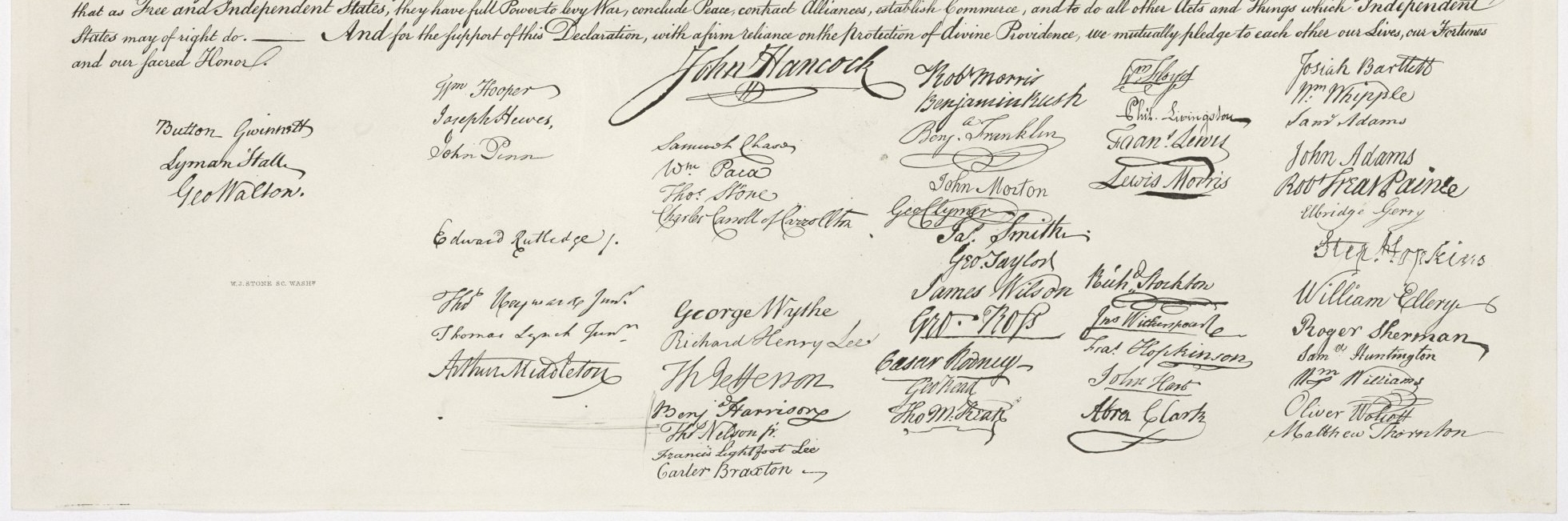
We, therefore, the Representatives of the united States of America, in General Congress, Assembled, appealing to the Supreme Judge of the world for the rectitude of our intentions, do, in the Name, and by Authority of the good People of these Colonies, solemnly publish and declare, That these United Colonies are, and of Right ought to be Free and Independent States; that they are Absolved from all Allegiance to the British Crown, and that all political connection between them and the State of Great Britain, is and ought to be totally dissolved; and that as Free and Independent States, they have full Power to levy War, conclude Peace, contract Alliances, establish Commerce, and to do all other Acts and Things which Independent States may of right do. And for the support of this Declaration, with a firm reliance on the protection of divine Providence, we mutually pledge to each other our Lives, our Fortunes and our sacred Honor.

The 56 signatures on the Declaration appear in the positions indicated:

Column 1
Georgia:
   Button Gwinnett
   Lyman Hall
   George Walton
Column 2
North Carolina:
   William Hooper
   Joseph Hewes
   John Penn
South Carolina:
   Edward Rutledge
   Thomas Heyward, Jr.
   Thomas Lynch, Jr.
   Arthur Middleton
Column 3
Massachusetts:
John Hancock
Maryland:
Samuel Chase
William Paca
Thomas Stone
Charles Carroll of Carrollton
Virginia:
George Wythe
Richard Henry Lee
Thomas Jefferson
Benjamin Harrison
Thomas Nelson, Jr.
Francis Lightfoot Lee
Carter Braxton
Column 4
Pennsylvania:
   Robert Morris
   Benjamin Rush
   Benjamin Franklin
   John Morton
   George Clymer
   James Smith
   George Taylor
   James Wilson
   George Ross
Delaware:
   Caesar Rodney
   George Read
   Thomas McKean
Column 5
New York:
   William Floyd
   Philip Livingston
   Francis Lewis
   Lewis Morris
New Jersey:
   Richard Stockton
   John Witherspoon
   Francis Hopkinson
   John Hart
   Abraham Clark
Column 6
New Hampshire:
   Josiah Bartlett
   William Whipple
Massachusetts:
   Samuel Adams
   John Adams
   Robert Treat Paine
   Elbridge Gerry
Rhode Island:
   Stephen Hopkins
   William Ellery
Connecticut:
   Roger Sherman
   Samuel Huntington
   William Williams
   Oliver Wolcott
New Hampshire:
   Matthew Thornton


Saturday, February 4, 2023

Despairing Romance in The Last of Us

 HBO has adapted the hit video game The Last Of Us into a popular TV series.  The most recent episode, its third, has garnered wide-spread critical acclaim.  It was presented as a tragic love story that left audiences deeply saddened.  When my wife and I watched this episode, I was also made to feel horribly sad.

But not for the reason the show intended.

HEAVY SPOILERS FOR THIS EPISODE AHEAD.

The show centers around Bill (Nick Offerman), a doomsday prepper who hates the government, is a gun-nut and self-sufficient man.  When Fedra comes and empties out his town, he hides in his bunker until they escape.  Now without the burden of people, Bill builds a secure oasis for himself in this tiny hamlet, surrounded by electric fences, booby traps, and containing all the niceties of life like electricity and gas.  Things change for Bill when Frank (Murray Bartlett) falls into one of Bill's traps.  Bill rescues him and feeds him.  Then Bill, who was a closeted gay man, begins a love affair with Frank that lasts for decades.  They remain in their little community, isolated, only occasionally trading with the main character of the show.  Eventually Frank gets a debilitating disease and Bill must care for him.  One morning Frank decides to commit suicide, despite Bill's protestations.  Frank tells them that they are going to get "married," Bill will cook a delicious dinner and then poison him with his pain meds in his wine.  When dinner is over, Bill puts the pain meds into Frank's wine and he drinks.  Seeing this, Bill also poisons himself, not wanting to live without Frank.  The two then go to their bed where they die.

This episode has been overwhelming praise from critics.  And I must be completely fair to their assessments.  The acting is excellent.  Particularly Offerman is superb.  I don't use that praise lightly.  He plays all of this flawed man's contradictions with perfect stoic restraint until his emotional dams all break.  It is one of the finest pieces of acting I've seen in TV all year.  The direction of the show was also top-notch.  The way this episode is filmed, it felt like a mini-movie rather than one episode of a series.

But all of this paints over a horrible darkness.

I am going to leave aside completely the fact that this romance involves a same-sex couple.  The Christian faith is already incredibly clear on the morality of such a union.  Even if this were an opposite-sex couple, there is still a pernicious world-view lurking at the bottom.

First of all, the love between these two is utterly selfish.  Now, I don't mean to say that they don't have genuine affection and care.  But this was a love that was turned inward towards each other and the rest of the world be damned.  This is always a constant temptation of romantic love.  All you do is look at the beloved.  As Tony sings in West Side Story, "I saw you and the world went away."  Everything becomes about feeding this romance.  And it is true that all friendships, romances, and familial bonds run the risk of turning tribal.  In desperate times, it makes sense to close ranks.  But Bill and Frank are not simply scrapping by to survive.  They thrive in their little island of civilization and do nothing to help save anyone else.  How many families could have been saved and lived in relative safety in their community?  Yes, this would have come with great risk, but this was not even a consideration.  The only reason that Frank is allowed to stay originally is because of Bill's attraction to him.  

Frank is particularly self-centered.  Self-murder is always wrong, even though we feel horrible sympathy for him in his seemingly fatal illness.  But there is no sense in him of anything bigger than himself.  He no longer enjoys life, so he decides to end it.  Bill seems perfectly content to take care of Frank until his passing.  But Frank dictates to Bill that he will kill himself.  He gives Bill no real time to come to terms with this decision.  They will only have hours left together and what they do will be dictated by Frank.  He even tells Bill what outfit he will wear and he can't say no.  In fact, for Frank, it would be unloving of Bill to not give into his every whim.  He asks Bill if he loves him.  When Bill says "Yes," Frank responds, "Then love me the way I want you to love me."

"Love me the way I want you to love me."

This is almost the complete inversion of agape, the completely giving, unselfish love that we find in Christ dying for us on the cross.  It is a purely gift love that gives without regard for reward.  Frank instead demands complete subservience from Bill in the name of love.  In Frank's eyes, Bill must bend his knee to his whims.  In Christian marriage, it is true that we serve each other and I do my best to serve my wife as best I can.  But if I really love her, I will not love her the way she wants to be loved.  I will love her in the way that will help her be the best person she can be.  And my wife does the same for me.  She knows that part of her vocation is to help me become a saint instead of devolving into my little cocoon of selfishness.

And even though Bill and Frank had been together for decades, it is only on the day of his death that Frank finally wants to be married.  It reminds me of the tragic death of Robert Fuller.  Fuller was a dying man who chose assisted suicide because of a fatal cancer diagnosis.  Moments before he was killed, he "married" his young romantic partner.  What struck me about this similar detail is the view of marriage from this perspective.

For Frank (and perhaps Fuller, though I am less inclined to speculate about a real-life person), marriage was the capstone to the relationship.  It was the epitaph on the tombstone.  That is such an odd view of what marriage is.  Marriage is not designed to be the final seal of approval to a romantic relationship.  It is meant to be forward-looking.  That is because marriage is the intended means by which we bring children into the world.  A husband and wife form their bond with the intention of raising the next generation.  It is partially about creating a stable and permanent bond, regardless of changing feelings, because that is the foundation on which healthy children can become prosperous adults.  But Frank seems to view marriage as the diploma at the end of the course.

But the worst part about all of this is the utter despair.  When Bill poisons himself, he says to Frank, "I'm old.  I'm satisfied."  Later in a letter from Bill, we understand that Bill's whole identity is caught up in taking care of Frank.  Without Frank, Bill does not see a purpose to his life.  This is something that Frank selfishly ignores with his decision.  But I was struck by Bill's words.  He talks about life as if it is a meal from which you partake until you've had enough.  Once again, life is viewed as something that is pointed primarily towards self-satisfaction instead of something designed to be given away.  Taking care of Frank was a kind thing to do for Bill, but it also was done because it made Bill happy.  But once Bill thought that this happiness would leave, he decided he no longer wanted to live.  He didn't consider using his remaining time to save some people in the relative safety of his village.  He didn't consider doing any other act of kindness (other than letting the main character have access to his stuff).  Bill's life had no meaning beyond his own self-satisfaction.  Life becomes a video game that you quit when you've had enough of this world.

And implicit in all of this is that there is nothing beyond this world.  Bill and Frank end their lives because it is the end of their love.  They never say this explicitly, but it seems obvious that they despair of any kind of afterlife.  They plan to go into the darkness, holding each other as they slip away.  This hopelessness that they share makes it easier to understand why they do what they do.  They want to hold onto this intense feeling as long as they can until they feel nothing at all.  On this view, suicide makes total sense.  Here, life has no meaning beyond what little happiness you can find.  And once that happiness appears to go away, I lose my reason to live.

I can see this despair all over the place.  Because there is no hope for heaven, people live in hell.  I've mention before how one of my friends who I will call Puck, once said to me "If there is no afterlife, then everyone's life is tragic."  And this true.  If there is no afterlife, then we are condemned to lose every love we've ever had.  And we will lose these loves forever.  Even the musical theme from this episode emphasizes this.  It is a song from Linda Ronstadt whose refrain is "I'm gonna love you, for a long, long time."  Notice it is not a promise to love forever, but only for a while.

How differently we view love as Christians.  In Christ, the real loves we have are things we can have for all eternity.  All the love we share, if our goal is the salvation of each other's souls, can be redeemed for all eternity.  I love my wife, my family, and my friends.  But if we really love each other, we will do our best to bring each other to God.  And then when we shuffle off this mortal coil, we will be able to hold onto those bonds of affection, not for "long, long time," but for all of eternity.

For that reason, this episode made me so sad.  Too many people embrace this despair and do not live in hope.  They turn inward towards self-satisfaction and not outward to generosity and charity.  It makes me sad that the love that Jesus shared with us is no longer being embraced as the epitome of love.

But if we hold to this view of love and reject the despair and selfishness of this modern love, then when we pass from this world, it will not be the last of us.

Thursday, November 24, 2022

Back From the Future - A Thanksgiving Day Reflection (repost 2022)

(After the loss of another close family member, I decided that it was a good time to repost this Thanksgiving Day reflection from four years ago.  I pray you find this meditation helpful to you in the way it has been helpful to me.  Happy Thanksgiving.  - Catholic Skywalker)


----


 Traditionally on this blog I repost the same essay each year on Thanksgiving.  I continue to get positive feedback on it and I am very grateful for everyone's kind words.


This year I thought I would do something a little different and share with you something a little person and a little strange.  Bear with me as I walk you through a mental habit I have acquired over the years.  I don't necessarily recommend it.  Perhaps its overall tone is too dark for you.  But I have found that it is a reflection that has born good fruit in my life. 

There is a quote attributed to the Buddhist Ajahn Chah which reads: “Do you see this glass?  I love this glass. It holds the water admirably. When the sun shines on it, it reflects the light beautifully. When I tap it, it has a lovely ring. Yet for me, this glass is already broken. When the wind knocks it over or my elbow knocks it off the shelf and it falls to the ground and shatters, I say, ‘Of course.’ But when I understand that this glass is already broken, every minute with it is precious.”


This is perfectly in line with the Buddhist philosophy of impermanence: the belief that everything in this material world is going away.  This world can be so lovely and there are so many people and things to love in it.  But this world can also be so cruel and it can take all of those people and things from our lives.  

As I've gotten older I've found that I have become more, not less attached to this world.  Perhaps this is a spiritual failing on my part.  I don't mean that I have become consumed by greed or lavish wealth, although the material comforts of life have become more appealing.  What I mean is that when I come to realize my affections for something, I have this horrible desire to hold onto it tightly and not have it leave my life.

I am a collector.  Right now I am sitting in my makeshift library surrounded by not only hundreds of books but also hundreds of DC Comics action figures organized all over my shelves.  Hal Jordan is pointing his ring right at me while Barry Allen runs on his cosmic treadmill.  Sometimes I will have my nieces and nephew over or my friends and their children.  I give them free reign to play with any of my collectibles.  I do this understanding that children are prone to breaking things.  I accept things will be lost and destroyed, although I have been pleasantly surprised by how little damage has been done.  This is in no small part to their parents' careful attention.

But when something does break, there is a part of me that hurts a little.  Most things can be repaired, but there is a tiny loss.  I know that these are small things, but they reflect the same attitude I have regarding large ones too.  

I loved my first car.  I had essentially lived in it when I was at college.  As a commuter, I would sometimes have long hours between classes.  The back seats folded into a bed and I would take naps in there while staring at the ceiling that I decorated with colorful pictures.  When it was time to give the car away, even though I was upgrading, I was filled with a strong sense of sadness.  I was losing something which had been a big part of my life.  It was just metal and upholstery, but I couldn't help how I felt.

And this story repeats over and over again throughout my life: affection followed by loss.  The only way to avoid the sense of loss, it seemed, was to withhold my affection.  Yet it seemed wrong not to open my heart to these things.  Again, these are only things, but it seems somehow wrong to not enjoy them.  But the more they are enjoyed, the greater the loss when they go away.

I thought about the above quote from Chah.  To think of the things as already broken seemed a little too dark.  To imagine these things cracked and crumbled in their present state seemed to put too much of a pallor over them.  And yet that is where they are destined to go at some future state.  And that is where my mind wandered: to this future state.

At some point in the future all the material things will be broken.  This is a certain truth.  What I could do in my imagination was go to this future and get a sense of that brokenness.  Then I could return to the present and see the thing in its present state.  This would put a concrete sense in my mind of how precious the time is and how I should cherish it.  

When I was a kid, I had a plastic Luke Skywalker lightsaber that would make sounds as the air passed through it while playing.  It has been broken and lost for a long time.  When I think about it, there is a small sense of sadness.  Part of me wishes I could go back in time, just for a moment, and hold it again.  My wife bought me a Master Replicas Luke Skywalker lightsaber.  It is one of my favorite possessions.  But I know that I cannot hold it forever.  One day it will break.  So sometimes when I have it, I close my eyes and I imagine some future date at which it is broken.  I then get in touch with that feeling of loss and the deep desire to go back in time, just once, to hold it again.  I then open my eyes and I am holding it and am filled with a deep sense of gratitude.

We are surrounded by so many blessings.  And yet I often forget to be grateful.  The old saying that you don't appreciate something until it is gone still rings true.  By doing this little reflection and imagining that it is gone, you can increase your appreciation of the thing in the here and now.

And this does not have to be only for material things.  

When I was in the hospital and couldn't walk, I felt so lost and helpless.  By God's grace I have made a full recovery.  And yet I know that time, age, and injury could steal away my mobility again.  Sometimes when I am doing simple chores around the house or walking down the long hallways at school, I close my eyes and take a moment and imagine some future date where I will be back in a wheelchair.  In that moment a feel the sorrow over the loss of my mobility and I feel the wish to go back in time just once and experience what it was like to walk again.  And then I open my eyes and am filled with gratitude that I am upright and walking with ease.

Time will take even more from us.

When I was babysitting my nieces and nephew over the course of several days I was exhausted.  Not having children of our own, the overwhelming time commitment hit my wife and I hard.  There were times all I wanted to do was crash on the couch.  But then my niece or nephew would ask to play a game with me.  As tired as I was, I would take a moment and close my eyes.  I imagined a future, not too distant I am sure, where they will be too cool to play with their uncle.  They will be more interested in hanging out with their friends and then they will be gone and grown with families of their own.  I feel how much I missed being with them as children and I wish I could go back just one more time and play one more game with them.  And then I open my eyes and I am filled with gratitude that I get to play their games.

Last year my mom got sick.  We thought she was getting better, but then she went back to the hospital and began her month-long decline towards the end.  I will never forget looking at her there in the hospital.  Her eyes were a little glassy, not with unconsciousness but with sadness and depression.  She was never going to get out of the hospital.  She would sit there so silent, so lifeless, just numbly watching TV.  We'd ask her questions and she would often just answer with a limp shrug.  It was hard to be there with her sometimes, to see her suffer in body and spirit like that.   

But then I closed my eyes and imagined the not too distant future when I would be sitting there at the funeral home looking at the casket as the closed it one last time.  It would be the last time I would ever see her face.  I was filled with an overwhelming, choking sense of loss.  I felt so deeply that I wished I could have one chance, just one chance to go back and tell her how much I loved her.

And then I opened my eyes and I was filled with gratitude that she was still here.  I held her hand and with tears streaming down my face I told her how much I loved her.  I told her I was sorry for everything I ever did that ever upset her.  I told her that I have a great life because of her.  I told her that if by God's grace I help people know the Lord and put them on the path of salvation, then it is only because she put me on that path.  All of the good things I've done in my life I owe to her for giving me life.  I told her how grateful I was to be her son.  I told her how grateful I was to be with her now.

Even now just writing that last paragraph, that moment hits me hard.  And when the time came soon after where they closed the casket for the last time I wished I could go back and have one chance, just one chance to go back and tell her all of those things again.

But I can't.  

Real time allows for no do overs.  The only time we get them is in our imagination.

As I said, this reflection may not suit your personality and is perhaps too dark.  But if you want to give it a try...

This Thanksgiving, if you are having a bad day with the kids or at work or with your spouse or in your broken down car, then close your eyes and imagine a time in the future when you will no longer have around you the kids, the job, your spouse, or that broken down car.  Let that unpleasant loss touch your heart for as long as you can stand it.  And feel yourself wish for one chance, just one chance to go back and enjoy those kids, that job, your spouse, and that wonderful broken down car.  

And maybe, just maybe you will feel a renewed sense of gratitude when you open your eyes and come back from the future.

Thursday, July 7, 2022

Aborting Aristotle


St. Thomas Aquinas is the most important Catholic philosopher.  His work was so important that during the Council of Trent, his Summa Theologiae was placed on the altar along with the Bible as the guiding documents for the philosophy of Catholicism.

To understand much of St. Thomas' ideas, you have to understand the ancient Greek philosopher Aristotle.  In Aristotle, St. Thomas found a philosophical grounding to the rational component of Christian thought.  One of the things I admire about St. Thomas is that he does not reference Aristotle as some kind of appeal to authority.  Instead, he sees that Aristotle argues St. Thomas' own positions effectively and so employs those arguments in his writing.  Joseph Pieper made clear that St. Thomas never quoted Aristotle simply to impress his readers with Aristotle's name.  He would quote Aristotle, when he thought Aristotle made a good argument.

Particularly, St. Thomas adopted much of Aristotle's metaphysics.  Metaphysics is that area of philosophy that deals with the question of what exists.  While this may sound like something that is high-falutin and unimportant to every day life, nothing could be further from the truth.  Your metaphysics will radically affect how you live.

For example, does God exist?  That is a metaphysical question.  If you see that He does, you will live a very different life than if you believe that He does not.  It is the difference between a life that is guided and governed by a good, loving, and rational Supreme Being or living in a random, purposeless, and indifferent universe.  As you can see, metaphysics matters.

This includes the questions about what this material world actually is.  Plato, Aristotle's teacher, believed that this material world was unimportant.  It was almost like what Buddhists believe that the material world is an illusion.  The goal, for the Platonist, is to rise above material things and contemplate the only real things that exist: immaterial Forms.  Why did Plato come to this conclusion?

There are many reasons.  But essentially, he saw that material things always change.  This is true.  There is nothing in this material world that stays the same.  Even the chair I am sitting in now is slowly disintegrating so that in ten million years it will be dust.  Because of this, Plato said that you could never know anything about a material thing, because it is constantly changing, it is never the same thing.  However, you can know things that don't change.  The laws of triangularity, for example, never change (e.g. the interior angles of a triangle will always equal 180 degrees).  He concluded that you could only know things like this that do not change.  And because you could know them, they had to be real.  In fact, they had to be the only real things.

Aristotle disagreed with Plato.  He did not think that the material world was unimportant.  Aristotle said that all material substances are a composite of form and matter.  All the material things in this world are composed of matter that have been shaped into some kind of form.  Together, the form and matter give us a substance.

With this in mind, Aristotle could say that would could know material things, because when we talk about my chair, we are talking about the form of the chair being expressed in this particular material.  Even as the material changes and even breaks down a bit, it is still a chair because the form gives it a unity.  It is not a random heap of changing material components.  The form makes it clear that this substance is a chair.

To be clear, Aristotle understood that the distinction between form and matter is a conceptual distinction.  It is a distinction that Aristotle makes so that we can understand how the form and the matter work together.  But, for the most part, they do not exist separately.  There is no matter that exists except in some kind of form.  The form of the chair does not exist in some idealized state, even when the chair completely disintegrates.

If that is confusing, think about words.  You can see a clear distinction between the material of a word (either printed out or stated out loud) and its meaning.  However, when you see or hear a word, the material component is always with the immaterial meaning.  It is an odd fact of the mind that once you know how to read, you cannot NOT read words when you see them.  The words you are reading now are not random pixelated matter.  Nor are they immaterial ideas.  They are material pixels and immaterial meanings together.

Okay, if you've stayed with me thus far, I thank you for your patience.  Why are we taking such a long digression into Aristotelian metaphysics?

Because Aristotle shows me a flaw in a common abortion slogan.

Too often I hear poor arguments that try to justify abortion.  One of them is something to the effect of "The life of a woman is more valuable than a clump of cells."

The implication is that you have on the one hand a fully formed human person with rights and innate value and on the other hand you have an undifferentiated material heap.

The key is this word "clump."  A "clump" implies something that is random in nature that really has no unity or specific form.  Think about when you have used this term in your life.  Maybe you made a clump of dirt, or garbage, or dirty clothes.  For the clothes, they may have some things in common in that they are all clothes, but they do not have a unity.  They are some t-shirts, a couple pairs of socks, along with your favorite hoodie.  But all of those are different substances with their own form that simply happen to be in proximity to each other.  But the clump is not really its own substance, its own being.

A clump of cells implies that there is no unity.  You have random things that are their own substance that are placed in proximity to each other.

But this is incorrect.

Recently I cam across a statement by a biologist who worked on embryos.  This person wrote "I used to work in a cell culture lab where we maintained actual clumps of cells.  A clump of cells is a disorganized, un-unified, non-developing mass of cells.  They are growing in size, but not developing.  The main difference between a clump of cells and an embryo is that the embryo is a whole human organism with goal oriented growth and development.  Clumps of cells don't do that."

The point is that a true "clump" of cells may grow.  But they don't develop in a unity.  To the naked eye, an embryo may look like a clump, just as to the naked eye an cloud may look like an elephant.  But in this case, the looks are deceiving.  The embryo will grow in a directed unity.  This is because the "clump" is not its own substance because it has no form to give it unity.  The embryo is its own substance because it has a form that gives it unity.

It is as incorrect to call the embryo a "clump" of cells as it would be to call me a "clump" of cells.  To be clear, a fully grown human and a human embryo are in different stages of development.  But we both have the same essential form of humanity that gives our substance a unity as we change.  We all experience this.  You have changed so much over the years, particularly in your material appearance.  But through it all you are still you.  That is because your form gives you a unity that makes you you through all your changes.

And you have had this form since the moment of conception.

So next time someone talks about aborting a clump of cells, keep in mind that when they say this they are also aborting the wisdom of Aristotle.

Friday, June 17, 2022

Star Wars Fandom: Hate Leads to Suffering

File:Star wars2.svg
image by Weweje; original logo by Suzy Rice, 1976.


I am a life-long Star Wars fan.

We Star Wars fans are a very peculiar bunch.  I think we come off as a tad more obsessive about our corner of fandom because of what this franchise means to us.

I don't think I'm alone when I say that Star Wars shaped a lot of my childhood, and thus also shaped much of the man I am today.  It is true that when I became a man I was called to set aside all childish things.  We in the fandom are often accused of being childish, as though our attachment to Star Wars is a sign of our arrested development.

But Star Wars was the prevailing hero myth of my childhood.

Yes, I had Batman and Robin, as well as Hulk Hogan and Ricky "The Dragon" Steamboat, along with Rambo and Bruce Lee.  But Star Wars takes up the preeminent place.  I've written previously about how as a child it radically altered my world-view about what a hero truly is.  Before I thought that a hero was the person who killed the bad guy.  After Return of the Jedi, I understood that the hero is the one who saves the villain with sacrificial love.

Mixed in with these deeper things are the nostalgia for the fun and innocence of childhood and you can understand the bond that George Lucas made between us and his creation.  In many ways, Star Wars is secularly sacred to so many people.

For that reason, the fandom is very protective of it.

This, in and of itself, is not a bad thing.  In many ways, it is a sign of how special this story is.  I do not see any levels of controversy like those found in Star Wars fandom in other franchises like Avatar.

This takes us to the Prequels.  When The Phantom Menace came out, it had been sixteen years since we had a theatrical Star Wars film.  Those of us who grew up with Star Wars were now adults and we were hungry for that same magic we experienced as children.  But in that, many made a crucial mistake: Star Wars is primarily for children.  Obviously, it can be enjoyed on an adult level.  But Lucas was telling a story to help shape the next generation.  Many of us wanted the Prequels to be about us and our more adult sensibilities.

At the time, I took a lot of flack for being a defender of the Prequels.  They are flawed to be sure, but there is still the Star Wars magic in them if you look for it.  Lucas made a number of miscalculations.  I have written an entire article about this, but a few examples are that he should have written all of the scripts in advance for consistency and payoff and he radically overestimated how fun Jar Jar would be.

The time of the Prequels brought out a lot of haters.  And they have every right to their opinion, even though I disagree.  What saddens me is that some of this hatred became targeted on people like Jake Lloyd and Ahmed Best.  I always try to avoid being critical of children in film.  Acting well is very difficult and even more so for kids.  In the case of Best, I think he gave Lucas exactly what he asked for, so any fault with the delivery of the character lay more with Lucas than Best.  Regardless, a great deal of venom was unleashed on these two.  You can read for yourselves what they've endured.  Hayden Christensen also received a great deal of blowback for his portrayal as the older Anakin.  Like Best, Christensen gave Lucas the performance he wanted and as a result, Christensen was on the receiving end of fandom's blaster fire.

This makes me think of the wisdom that is found in the Prequels about attachment.  Anakin's path to the Dark Side stems from his attachment.  Lucas was wise to show that the total detachment of the Jedi was also foolish.  But Anakin becomes selfish, self-centered, and possessive of that which he loves.  The danger for the Star Wars is that this can happen with Star Wars itself.  Fear of Star Wars not being as good as we remember or fear of it being ruined can trigger substantially negative responses and move someone from a lover to a hater.

Then after twelve years, Disney gave us the Sequel Trilogy.  If the fandom was divided over the Prequels, the Sequels led to all out civil war.

The Force Awakens was received fairly well.  There were disappointments but most was forgivable.

But everything fell apart with The Last Jedi.  As with the Prequels, I have taken a good deal of flack for my stance on this movie, which is essentially that it has some great parts to it.  For many, this movie broke the fandom and broke Star Wars itself.  

I am actually much more sympathetic to those who hate the Sequels than I am to those who hate the Prequels.  While both are flawed, the problem with the sequels (particularly The Last Jedi) is that it felt like an intentional subversion of the Original Trilogy and its heroes.  Rian Johnson is a talented filmmaker, but it is clear he was not interested in aligning his vision to Star Wars, but instead wanted to shape Star Wars in his image.  Particularly, there are many who find the degradation of Luke Skywalker as completely unforgivable.

This brings us to an interesting turn in this fandom civil war.  There is a contention of fans who try to shield current Star Wars from criticism by accusing the critics of bigotry.  Those who didn't like Rey and Admiral Holdo were accused of sexism.  Those who didn't like Rose Tico were accused of racism and sexism.  My own problem with Rey is that the story didn't let her earn her hero status on the traditional hero's journey.  Admiral Holdo was poorly written regarding her baffling motivations.  And Rose Tico was a morally insane character who was willing to doom the entire resistance because of her crush.

Accusing someone of bigotry does very little to win their affections.  The critics of the sequels felt under personal attack, especially from those in charge of Star Wars.  As a result, battle lines were drawn between the pro-Disney and anti-Disney sides.  

One of the few things that seemed to unite the fandom was The Mandalorian.  The novelty of the story along with its strong production guidance from Jon Favreau and Dave Filoni created a pop culture phenomenon, especially with Baby Yoda.  This came to a head in the finale for season 2 which gave fans a glimpse of the glory of the central character of the mythos.

And now we are witnessing the fandom fight over Obi-Wan Kenobi.  As of this writing, there is still one episode remaining.  Those of anti-Disney, anti-Last Jedi side have been tearing this show apart.  The criticism is rooted in the feeling that Obi-Wan is being treated like the Sequel version of Luke and that he is being sidelined in his own series, particularly by Reva.  The pro-Disney side has accused the critics of racism in their dislike of Reva.

I think both sides are wrong.

I will give a full review of the show later.  But I have loved it so far.  I found it to be a worthy follow-up to the Prequel trilogy and it is telling an engaging and compelling story.  To be sure there are some flaws, especially from a staging standpoint, but the good greatly outweighs the bad.  

But I also think the accusation of racism of the critics is largely unfounded.  To be sure, you will always find some nasty elements in any group or fandom.  But as a whole, the fandom does not reject characters because of their race.  This is especially true of Star Wars with characters like Lando Calrissian, Mace Windu, Moff Gideon, Fennec Shand, and Jango Fett.  Accusing the critics of racism only hardens their opposition to Disney Star Wars.

In addition, the pro-Disney side is intentionally antagonistic towards its critics.  Quentin Tarantino talked about the people who did not like The Hateful Eight and he said that he understood that the movie wasn't to everyone's tastes because the characters were so nasty.  When Rian Johnson was asked about the critics of The Last Jedi, he commented on how fanboy tears were "delicious."  I understand how you have to promote your art, but it is another thing to sound like an elitist who is above hoi poloi.

Personally, I would hope that everyone could let go of their hate.  I hope that we could celebrate what is good in anything Star Wars.  I think that a lot of people are missing out on the greatness of Obi-Wan because they are looking focusing on all the ways Disney is letting them down.  The pro-Disney side also appears to needlessly antagonize the core fanbase and to promote things that seems to disrespect the Original Trilogy.  For evidence of this last point, you can look at the Star Wars area of the theme parks as well as their Galactic Cruiser.  

All of this hatred has led to more suffering in the fandom on both sides.  I think if we all could just listen to each other, we would not be so filled with hate.

Instead, we could have a new hope.