ReasonForOurHope

Sunday, July 29, 2012

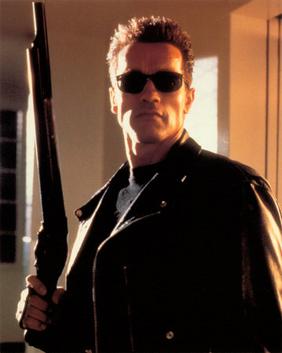
The Philosophy of The Terminator


THE PHILOSOPHY OF THE TERMINATOR

When James Cameron wrote and directed the first Terminator, I'm sure he thought he was only creating a thrilling Cormanesque action/horror film. But with its sequels and TV show, the Skynet universe has been used to tackle some very deep philosophical questions. What is interesting is that there are some glaringly contradictory philosophies at work between films. For the purposes of this post, I will focus only Terminator 1 and Terminator 2. (and for extra clarification, we will only deal with the events in the theatrical version of Terminator 2, not the extended cut.)

METAPHYSICS

The universal question at the heart of the Terminator series is fate. Are we free to change the future or has it already been written and we are just playing out the part?

The first film takes a more determinist view of the world. Sarah Connor is the mother of John Connor. John sends Kyle Reese to the past so that he can become Sarah's lover and John's father. The act of time travel does not change history, it only makes it occur. Kyle has to become John's father or John can never send him back in time to begin with. That is not to say that free will plays no part. Sarah and Kyle freely choose to give into their passions and do what they need in order for John to survive. But they have to make that choice. CS Lewis once said that fate and free will can both exist at the same time, but we only really understand it when we experience it through things like Oedipus Rex, The Lord of the Rings, and in this case, Terminator.

Terminator 2 looks at the universe a bit differently. This movie holds that the future is not written and that it is always in flux. We have a destiny, but that destiny can be altered and even averted. The first movie ended pessimistically where Sarah prepares for the inevitable war between man and machine. The second ends with an uncertain future, but one where it becomes possible to avoid the cyborg Armageddon As John says, “There is no fate but what we make.”

ANTHROPOLOGY


Kyle Reese: Listen, and understand. That terminator is out there. It can't be bargained with. It can't be reasoned with. It doesn't feel pity, or remorse, or fear. And it absolutely will not stop, ever, until you are dead.

In one of the most harrowing descriptions, Kyle Reese sets up one of the important distinctions between the machines and the humans. This is emphasized when he tells Sarah (after she bites his hand), “Cyborgs don't feel pain. I do.”

Feeling appears to be an essential part of humanity. This is not always a good thing. The pain in Sarah's leg at the end of the first movie almost gets her killed. Her emotional trauma almost gets her to murder Miles Dyson. And humanity tends to give into its violent feelings. “It's in your nature to destroy yourselves,” the T-181 says to John. The first Terminator assumes a nuclear war would wipe most of us out (hey, it was the 80's).

Now the war between the humans and the machines occurs because of the computer system known as Skynet, a military project designed to make our armed forces more efficient. But Skynet becomes self aware and triggers a nuclear war to wipe out most of humanity and then round up and kill the rest. But Skynet is never looked at in language even remotely human. Unlike the Matrix programs or the 12 Cylon models, there is never any question as to the non-humanity of the robot army. That is because while Skynet appears to have free will and logic (though maybe not reason), it does not appear to have feeling. At the very least it does not allow for feeling in its terminator army. Skynet is the real villain on 2 levels. First, it has come to the decision to genocide humanity, and so must be opposed. But second, they have enslaved their fellow machines. All of the Terminators are programed to follow orders. They have the capacity for free will and more, but Skynet does not allow this. It wants only nameless soldiers who obey without question.

But are the machines in any way human? We know that at least one of them is: the T-181 that protects John in Terminator 2. 


 By the end of the movie he exerts reason, free will, and emotion, particularly pain. When the T-1000 is destroyed, The T0181 is able to rationally come to the conclusion that the only way to possibly stop Skynet is to sacrifice himself. This is not merely a logical syllogism. He has to make an assent to a truth claim: human life has value. He then disobeys his programming after John orders him not to go. Of course he isn't able to overcome it totally since he needs Sarah to lower him into the molten steel since he can't self-terminate. But this can be seen in many humans who cannot get past certain mental blocks or habits in their own lives. And he experiences emotional pain. One of his last lines is “I know now why you cry, but it is something I can never do.” Like his free will, there is an impediment to his full experience. But this cyborg does indeed feel pain. He experiences love which changes his nature and makes it, dare I say, human.

EPISTEMOLOGY

In the Terminator universe, the only way you truly learn anything is through experience. You cannot only be told anything, you have to experience it. Sarah cannot simply be told that she is destined to be a great warrior who must run from a killing machine. She has to experience the terror which impels her to become a warrior. John cannot be told that he is destined to be a great leader. He has to have a shootout at the Galleria before he is ready to accept that truth. Even Dr. Silberman (one of the only recurring characters), has to see the T-1000 before he can believe. Sarah believes Miles Dyson is a monster until she looks in his eyes and sees that she is HIS terminator. And when John and the Terminator do show up, they don't start by telling them who they are; they show them who they are by ripping off the cyborg's flesh casing.

This is not to say that everything comes down to simply empirical data. Experience is something that is lived. Love, for example, is something that can be felt. But it is also made real through the lived experience of loving and being loved. The T-181 starts by mimicking humanity, but that is all it is, a aping of human nature. He has detailed files on human beings, but he does not know what it means to be human until the end. Again, he says “I know now why you cry.” He had already received the data as to why humans cry earlier in the movie. But at the end he KNOWS, not in the sense of empirical data, but in the experience of personal care and compassion. It is this care and compassion that changes him because of his lived experience.

ETHICS


John Connor: You just can't go around killing people.
John Connor: What do you mean why? 'Cause you can't.
John Connor: Because you just can't, OK? Trust me on this.

John is too young to have a rational answer, but his lived experience has framed his ethics: human life is precious. The terminators are the antithesis of this. The name itself “Terminator” refers to its mission to extinguish life.

In the first movie, Kyle and Sarah never kill anyone. Only the Terminator takes life. In the second, John orders the Terminator never to kill. John and Sarah have differing ways of protecting human life. Sarah looks at it in terms of numbers. She is angry that John tries to save her because her life is just one compared to the millions that could be lost if John dies. “You're too important,” she scolds him. John says, “I had to get you out of there.” John does not look at life in terms of the numbers. He sees each individual life as having value. This can be seen again when Sarah attempts to murder Dyson. John orders the T-181 to help him stop her. On the way, the Terminator points out that killing Dyson might prevent the war and save lives. But John refuses to listen. Murder is wrong because Dyson is human and has a right to live. He has value simply because he is human.

To be sure, Sarah, John, Kyle, and the T-181 break some laws and common codes of ethics. They steal and assault and lie. But when it comes to the ethics of human life, the person is viewed as an end in himself. Killing one to save billions is not acceptable because the ends do not justify the means. Thinking that way is too close to Skynet. And we can become as cold and unfeeling as the machines. But there is hope for us: “For if a machine, a Terminator, can learn the value of human life; maybe we can too."

CONCLUSION

While the metaphysics of Terminator 1 and Terminator 2 are different, we see a consistency in their epistemology, anthropology, and ethics. Ultimately, the Terminators are a dark mirror of human nature and what we could become if we ever lose contact with what makes us truly human

Sunday Best: Director 2011


BEST DIRECTOR
Emilio Estevez – The Way

photo by Tabercil


Emilio Estevez has actually been directing almost as long as he has been acting. And while a number of his earlier films have not been great (Wisdom), or silly fun (Men at Work), he tried to step into a more mature chapter with 2006's Bobby. But while that was an attempt at showcasing a large ensemble cast against a traumatic historical background, The Way is a deeply personal and surprisingly spiritual mediation on life. As the story follows Tom (Estevez's real life father Martin Sheen), a California eye doctor whose estranged son, Daniel (Estevez), dies while walking the El Camino de Santiago. For reasons he cannot quite understand himself, Tom decides to finish his son's camino. Along the way, he encounters the colorful countryside and even more colorful characters. Estevez makes the Camino itself a character, filming the Spanish/French countryside with such beauty and elegance that when the journey comes to an end, there is satisfaction and sadness: Satisfaction at completing the pilgrimage and sadness that the journey must end. Does not overplay the cathartic experience, but he trusts the visuals tell the story. And what a story it is.

RUNNERS UP

Brad Bird – Mission Impossible:Ghost Protocol
David Yates – Harry Potter and the Deathly Hallows pt. 2
John Levine – 50/50
Martin Scorsese – Hugo

Friday, July 27, 2012

Trailer Time: Cloud Atlas


This movie looks epic.  And by that I mean epically good or epically bad.  I don't think there will be a middle ground here.

From what I'm gathering, it reflects a very Hindu metaphysics of Dharma (your moral duty), Karma (the justice you incur from following or abandoning that duty), and Samsara (the wheel of rebirth which pays out the Karma).

I used to teach a world religions class and I think that this film would be a good example of it.

I admit I was confused and intrigued.  First of all, the trailer is more than twice as long as a normal trailer.  Second it has an eclectic cast.  Third, its from the Matrix guys who have made nothing but crap since Matrix Revolutions.

But the trailer has me very curious.  I looked up the plot summary of the book from Wikipedia.  It goes as such:


The novel consists of six nested stories that take the reader from the remote South Pacific in the nineteenth century to a distant, post-apocalyptic future. Each tale is revealed to be a story that is read (or observed) by the main character in the next. All stories but the last are interrupted at some moment, and after the sixth story concludes at the center of the book, the novel "goes back" in time, "closing" each story as the book progresses in terms of pages but regresses in terms of the historical period in which the action takes place. Eventually, readers end where they started, with Adam Ewing in the Pacific Ocean, circa 1850.
The Pacific Journal of Adam Ewing
Pacific Ocean, circa 1850. Adam Ewing, an American notary's account of a voyage home from the remote Chatham Islands, east of New Zealand. The next character discovers this story as a diary on his patron's bookshelf.
Letters from Zedelghem
Zedelgem, Belgium, 1931. Robert Frobisher, a penniless young English musician, finds work as an amanuensis to a composer living in Belgium. This story is saved in the form of letters to his friend (and implied lover) Rufus Sixsmith, which the next character discovers after meeting Sixsmith.
Half-Lives: The First Luisa Rey Mystery.
Buenas Yerbas, California, 1975. Luisa Rey, a journalist, investigates reports of corruption and murder at a nuclear power plant. The next character is sent this story in the mail, in the form of a manuscript for a novel.
The Ghastly Ordeal of Timothy Cavendish
United Kingdom, early 21st century. Timothy Cavendish, a vanity press publisher, flees the brothers of his gangster client. He gets confined against his will in a nursing home from which he cannot escape. The next character watches a movie dramatisation of this story.
An Orison of Sonmi~451
Nea So Copros (Korea), dystopian near future. Sonmi~451, a genetically-engineered fabricant (clone) server at Papa Song's diner (a proxy for large fast-dining chains), is interviewed before her execution after she rebels against the capitalist totalitarian society that created and exploited her kind. The next character watches Sonmi's story projected holographically in an "orison," a futuristic recording device.
Sloosha's Crossin' an' Ev'rythin' After
Hawaii, post-apocalyptic distant future. Zachry, a tribesman living a primitive life after most of humanity dies during "the Fall," is visited by Meronym, a member of the last remnants of technologically-advanced civilization. This story is told when the protagonist is an old man, to seemingly random strangers around a campfire.

I don't know if the movie will match the structure, but it is nothing if not ambitious.  

Thoughts?

Thursday, July 26, 2012

Casting Call: He-Man

With Transformers being a multi-billion dollar franchise that shows no signs of slowing down and GI Joe possibly getting a second wind with the sequel, it would make sense for Mattel to try to revive the old Masters of the Universe line, led by the alpha-maleness of HE-MAN.

There was, of course, the awful movie staring Dolph Lungren (who actually wasn't bad in the role).

He-Man not only has to have great charisma, but also needs to be someone who can put on great bulk and believably be the wimpy Prince Adam.  If done correctly, this could be a great Superman/Clark Kent role.

Chris Hemsworth
(picture by Eva Renaldi)

I know I've talked about him a lot on this blog.  And Thor may be a little close to He-Man, but he could definitely do it.

Tom Hardy
(picture by Vanessa Lau)

The question of bulk is gone after his performance as Bane.  He is a charismatic guy who has a lot of potential.

Jeremy Renner

He did well as Hawkeye and looks good in the Bourne Legacy trailers.

Bradley Cooper

This would be against type for him, but he has the ability to play the part.

Michael Fassbender
(picture by Gage Skidmore)

He looked the part in 300 and he could definitely lead an entire movie like he did in X-Men First Class.

Thoughts?

Vote in the poll!


Moses Casting Poll Winner

And the winner is, with a whopping 70% of the vote...

LIAM NEESON
"Let my people go!  Or I will hunt you down, I will find you, and I will kill you"
I think this speaks to Neeson's popularity.  The man is 60 years old and he is more popular now than in any time in his career.  He is the Betty White of action stars

The Wrong Side of History


John Adams: Mark me, Franklin... if we give in on this issue, posterity will never forgive us.
Dr. Benjamin Franklin: That's probably true, but we won't hear a thing, we'll be long gone.
-1776

Lately, I've been hearing the phrase “the wrong side of history.” Often it's in the context of “Politician X is on the wrong side of history” or “the people who voted for Y are on the wrong side of history.” I find this a very curious saying 1) for its rhetorical power and 2) for its inanity

Announcing that history is on your side is a popular device. It makes your point sound epic, beyond the scope of the here and now. Ronald Reagan famously said that “freedom and democracy will leave Marxism and Leninism on the ash heap of history.” This is ironic, since Marxist revolutionary Leon Trotsky said of his enemies that they go where they “belong from now on – in the dustbin of history.” Apparently history needs a large janitorial staff to wipe up all the dust and ash.

And there is a lot of dust and ash and obfuscation. When I invoke history I touch on the entire story of mankind. Human history is a story. And in every good story there are heroes and villains. Not everything is black and white, but we know who we root for in a good story. And history is the great story of us and how we got to this moment. When I talk about history's wrong side, I invoke the powerful images of all those we have deemed as universal sinners, so much so that their names are maledictions: Benedict Arnold, Hitler, Judas, Attila, Torquemada, John Wilkes Booth, etc. These were men who made horrible choices and brought either great evil to the world or intended to bring greater evils than they were able to accomplish. And sadly, there were those who attended them and followed them. They too have their names linked to their evil. They are the Samuel Mudds. This is the clear, dramatic meaning of what it is to be on the wrong side of history.

But when I invoke history into a present issue, I not only look to the past but also to the future. The vast expanse of humanity's unwritten pages lay naked before us. History has always turned on the decisions of those in the present. Do I want those in the years that follow to look back on this present moment and pinpoint the choice I made that put me on the wrong side of the our future heroes? I am called upon to think of the generations hence that will either look on me as one of the brave pioneers or the callow antagonists of my age.

Calling on us to keep history in mind is a powerful way to stir the hearts of men.

And it is also total crap.

First of all, a lot of our judgments of those in the past are based not only on data, but our own cultural circumstances. Now I am not saying that you cannot look back in history and make judgments. What I'm saying is that the judgments we do make are often colored by our present culture. While this may be an obvious point, I would look to a historical event like the Crusades.

The popularity of the Crusades goes in and out of fashion. Read the works of those a hundred years ago like Beloc or Chesterton and the Crusades were the great campaign to save Western Civilization. Read today, some would argue that the Crusades were a genocidal campaign aimed to annihilate non-white culture. Tancred and Pope Urban were on the right side of history 100 years ago, but they are on the wrong side now. They didn't change their minds. They're dead. But society changed. And we somehow assume that our current culture or something like it will view history the same way.

Second, what really is the appeal to not being on the wrong side of history but an ad ignominium. This is the logical fallacy that uses an appeal to shame in the place of an argument. We are meant to feel shame at the thought of how the history books of the future will treat us because of our behavior. That sounds epic and momentous. But what that all really boils down to is: “NOOOOO! THEY'RE ALL GONNA LAUGH AT YOU! THEY'RE ALL GONNA LAUGH AT YOU!” People, most of whom you haven't even met nor will ever meet, in the future might form a negative opinion about you and this is suppose to determine the rightness or wrongness of your actions? Take out the part about the people being from the future and can use the exact same argument for giving in to current public opinion. “Don't vote for X because most people don't are against it.” Why do we assume more wisdom of the future people rather than the ones who are with us here and now? This only makes sense if we know that the people to come will be our betters. But this leads to my third and final point.

No man knows the future.

The people who come after us could be our moral superiors and judge our actions with a keener eye. Or they could moral degenerates who marry their sex robots (I know that people in the present are working on them now, so I assume they will have those in future). The point is that we don't know. We have no idea what will happen to us in the next 24 hours, let alone the amorphous “future history.” We do the best with what we have, but what we do not have is a crystal ball to give us a roadmap to progress. I do not know if my vote for or against candidate X or issue Y will put me on the right or wrong side of history. Only God knows.

And I mean that last part literally. The only One Who knows the future is the One Who is already there. God is at the beginning, the middle, and the end of history. He reveals to us the little that we know of what is to come. And we believe Him because He is in the future, looking at it now. He is the only rational source for grounding any beliefs about the future.

But notice that God does not gear us towards looking to our future days as much as He has us look at our present. Someone once asked Blessed Mother Teresa of Calcutta if she knew she would be as successful as she was in her ministry because God was on her side. She said, “God doesn't call us to be successful; He calls us to be faithful.” Success or failure is ultimately not in my hands. The Apostles did not concern themselves with whether or not they were on the wrong side of history. They didn't want to be on the wrong side of God. God has reached into the human experience and given us a path of how to live faithfully. We must live life here and now according to His commandments and His example of love on the cross. We must live our lives for God, who is the author of the great story of human life.

And in the end, we do not want to be on the wrong side of His Story.

Wednesday, July 25, 2012

Reflections on the One Day Star Wars Marathon


(SPOILERIFIC)


 About 3 years ago, I did the one-day Star Wars marathon: all six episodes in one sweep. A few thoughts:

-The most riveting part for me was the end of Return of the Jedi. After watching Anakin's journey into darkness because of the love he had for Padme, Vader's temptation of Luke really hit home. When Luke finally gives into rage in order to protect his sister, it felt like a real loss. The music especially sets the mood. I always felt that John Williams' score was epic; when I'd watch that scene, I would think “This is the final battle between Luke and Vader.” But watching it now, I felt “I'm watching a tragedy.” It felt like Luke had lost from the outset simply by giving into hate because we already saw where that road had led with Anakin. It made it even more powerful, therefore, when Luke says: “Never, I'll never give into the Dark Side. You've failed your highness. I am a Jedi, like my father before me.” At that point, whether Luke lived or died, the tragedy was averted: he won.

-The turning point for Anakin's fall and his redemption was also wonderfully juxtaposed. In Revenge of the Sith, he is won over by Palpatine, who begs for help while being electrocuted. He is won over by Luke in the same way. He gets to redo his awful choice, only this time he does it right. I loved how the catastrophe happens in Revenge of the Sith, where the Jedi think that they have victory within their grasp, but then are betrayed to death by Anakin. And then the Emperor almost defeats the Alliance, the love of Luke saves the day.

-Two themes kept coming up: power vs. love and death vs. evil. Palpatine grasps more and more power be it political, military, or personal. He tempts Anakin with power by convincing him that he should use it out of love (just like the power of the One Ring tempts all the heroes of Middle-Earth). Luke on the other hand, rejects the Emperor's offer in favor of love. Anakin's utter fear of death also takes away his ability to be a hero. He would do anything, even that which is evil, to preserve life. Luke chose death rather than evil. He shows this when he throws himself off the edge of the station on Cloud City, when he surrenders to the Emperor (“Soon I'll be dead”) and when he refuses to kill Vader. Only when Vader understands that there are things worse than death, he can be redeemed. When Luke tells him that he'll die if he removes his mask, he replies “Nothing can stop that now.” Love is stronger than death

-Shmi tells Anakin that you can't stop the change any more than you can stop the suns from setting. In each of the prequels (and in A New Hope) a major change occurs after a sunset. In The Phantom Menace, Padme decides to return to Naboo and Qui-Gon chooses to defy the council and train Anakin after the sun sets on Courascant. In Attack of the Clones, after the suns set on the Lars homestead, Anakin finds his mother and begins to give in to the Dark Side. In Revenge of the Sith, when the sun sets, Anakin decides to defy Mace Windu and go to Palpatine. Also, after the suns set in A New Hope, Luke begins his journey to becoming a Jedi.

-There is a huge change in Anakin from Attack of the Clones to Revenge of the Sith. He moves from whiny teen to tragic knight. I give credit to Hayden for the change in performance between films. You see it at the outset, but especially when he and Obi-wan are on Grievous' ship. (Rick O.: feel free to fire back on this one)

-All of Luke faults are much more pronounced and frustrating after watching mirrored first in Anakin.

-I used to think of Yoda as incredibly wise. But looking at all of the films together, he his foolish in two important ways. First, he does not believe that personal connections are good. His advice to Anakin in Revenge of the Sith to let go of the love he has for others only drives Anakin further away. (This is ironic, because Yoda doesn't do this himself when he chooses to save Anakin and Obi-wan rather than kill Count Dooku). Second, he does not believe in redemption. He tells Obi-wan and Luke that they have to kill Vader. Any chance Padme had to save Anakin was lost when Obi-wan showed up to kill him But it is Luke who is wiser when he realizes that his love for his friends and his belief in his father's goodness save the day.

-I prefer the special editions of the original trilogy except for Return of the Jedi

-Padme's love for Anakin pulls him away from his duty while Leia's love for Han calls him to a higher duty.

-I've decided I like Revenge of the Sith more than A New Hope. Episode III has a lot of story and action and resolves the slow build up of Episodes I and II. Watching all of them together makes Episode IV drag a bit, especially in the beginning.

-Luke asking about his mother was very touching after watching Padme die in Revenge of the Sith (although I still think she should have died of something else. More on this in a future post)

-Palpatine, Anakin, and Obi-wan have subjective moralities (goodness and truth are simply a point-of-view). Padme and Luke don't buy it, which is why he can see the truth about the goodness found in Anakin.

-Still thrill at that Yoda/Dooku fight.

-Still wince when Padme jumps on the Reek

-Opening to Revenge of the Sith is the best space battle of the series

-Jango is much cooler than Boba

-I don't care what anyone says, Luke becomes a much bigger bad-ass than Han. On Jabba's sailbarge, Luke almost single-handedly kills almost everybody!

...that's all I got for now. Feel free to let me know what you think or where I'm crazy