ReasonForOurHope

Wednesday, July 10, 2019

Wednesday Comics: And the Dead Shall Walk No More - The Final Issue of THE WALKING DEAD


I had stopped reading The Walking Dead comic book many years ago, just before the introduction of Negan.  While I was still impressed with the quality, the darkness of the story became a little much to bear month to month.  I've seen many people say the same about the TV series as they dip in and dip out.  Regardless, The Walking Dead has been a best selling comic for Image and was moving towards its 200th issue.

And then, to everyone's shock, Robert Kirkman ended his series without warning with issue #193. 

I was so shocked that I bought a copy just to see how it all ended.

WARNING - MAJOR SPOILERS BELOW

It is almost impossible to review this issue without giving away the current storyline and what has happened to the characters since.  I will keep as much of the contents of the final issue as secret as possible for those who haven't read it.

I will say that The Walking Dead #193 is a great final issue because it give us the thing long-time fans need the most: closure.

Even with an abrupt ending, fans of any long-time series need a chance to say goodbye to the characters on the journey.  I know many people who do not like the epilogue at the end of the Harry Potter series, but I think it is one of the finest, most necessary parts of the story.  You want to know what happens to these people with whom you have spent the last few years of your life with and you hope that everything is okay.

The final issue picks up many years after the previous one.  Carl Grimes is an adult and now married to Sophia.  They have a little girl, Andrea, who they named after Carl's stepmother.  Things have been very peaceful for the last few years.  It sounds like there have not been any major human conflicts and inside of their "safe zone" there haven't been any walking dead. 

That is until the first page of this issue.  Carl finds a zombie on his farm and kills it.  This becomes a problem, because it belongs to Hershel, Maggie and Glen's son, who uses zombies as part of his travelling stage show.  This sets Carl at odds with the law.  Throughout the course of the story, Carl comes in contact with most of the surviving characters and we get a sense of what this new world is like.

Safety and stability finally seems to have taken hold in the "safe zone" which appears to be ever expanding.  In fact, their Commonwealth has grown so large that they are about to create a new continental railroad with the "western front."  Civilization seems to be back in the world, along with a sense of law and order prevailing over the wilder days.

One of the things that makes this issue work so well is that it highlights the fact that The Walking Dead has essentially been a Western in its entire run.  Men and women on the frontier of civilization who have to face wild and scary enemies both from within and without.  Without the safety net of civilization, they had to become rough and violent, but they were filled with a strong urge towards independence and learned to trust their own moral compass.  When civilization eventually came to pacify the Wild West, it was both happy and sad.  Happy in that it became a place to raise a family and children in security.  But it was sad in that there was something of that fighting spirit that went soft and went away.

In The Walking Dead Carl can see this very thing happening.  Worse yet, those who are growing up in this time have no idea what their civilization cost them.  Rick's presence throughout the book is felt.  If you were a person living at this time, you can see how someone would look backwards and want to tell Rick's story from the beginning of civilization's fall and how he was instrumental in building the new one.  Too often those of us who live under the blanket of freedom that our country gives us do not truly appreciate the sacrifice that was needed to make my ordinary life possible.  It made me think of that powerful line from Saving Private Ryan, "Earn this."

The story also reminds us about how powerful storytelling is and how it connects us to our history.  Carl laments that his daughter can be dismissive of the history that brought them here.  But he is overjoyed that she can live in a world where she doesn't have to live in constant terror and danger.  The only thing that can bridge that gap are the stories that Carl tells.

Kirkman nailed this point completely and artists Charlie Adlard and Cliff Ranthburn drive it home with those final poignant pages.

I also couldn't help thinking about Christ during this story.  Rick Grimes is hailed as a hero who saved everyone.  In that way he is most definitely a Christ-figure, though obviously not a perfect one.  Carl can see that those for whom Rick is a real person to whom they owe their lives, that they are seeing the world with the correct eyes.  I can't help but feel the same way about Our Lord.  When I was 17, I made a retreat where it really hit home for me what it cost Him to love me.  I owe everything to Him.  Once I was able to see Him in this light, the world looked completely different. 

Carl is us.  We have been given so much and because we are still here, we have a duty to bridge the gap between those who gave us this world and those who will carry it forward.  With that deep and primal theme, along with a strong sense of closing the loop on our survivors, I would say that The Walking Dead #193 is one of the best comic book finale's I have ever read.

Tuesday, July 9, 2019

Film Review: Yesterday


Sexuality/Nudity Acceptable
Violence Acceptable
Vulgarity Acceptable
Anti-Catholic Philosophy Acceptable

"Do you want to drink from the poison chalice of money and fame?"

This is the key question behind Danny Boyle's new musical dramedy: Yesterday.

Jack Malik (Himesh Patel) is a struggling musician who is living at one England, stuck in a dead-end job and going from one pathetic gig to another with the help of his life-long friend and manager Ellie (Lily James).  Just as he decides to give up the music life forever, a world-wide blackout hits and Jack is hit by a bus.  When he wakes, he discovers that no one on Earth remembers the music of the Beatles.  So Jack decides pass off the songs as his own, thus receiving acclaim and notoriety.  He eventually is brought to the Malibu home of record producer Debra Hammer (Kate McKinnon) who asks the above question about money and fame.  The movie follows Jack's rise to stardom along with its benefits and costs.

Boyle makes a movie that is pleasant, but not great.  The script by Jack Barth and Richard Curtis make our main character likeable enough even as he attempts to deceive the world with his borrowed talent.  But honestly, without the Beatles music, this movie would score lower with viewers.  I've always espoused the belief that music is a shortcut to emotion and it can cause you to respond in ways beyond the rational.  This is the reason I think a show as horribly written as Glee became so popular so quickly.  Yesterday is not horribly written, but the music gives it a much higher elevation than it would have on its own.  If you are a fan of the Beatles, which I am, you wait with eager anticipation for which song will come next.  Unlike Across the Universe, where each song was introduced with an eye-rolling non sequitur, Yesterday finds just the right song for the right place in the story.  Hearing all the songs together will renew your appreciation for the place the band has in musical history.  Even some songs I had forgotten were given a strong spotlight.  In a scene where Jack has to go into a song-writing contest with Ed Sheeran (playing himself), we are reintroduced to "The Long and Winding Road" and how poetic and lyrical it is.  I still have "O-blah-di, O-blah-da" running through my head.

The story hinges on the romance between Jack and Ellie.  From the beginning, it is clear that Ellie is head-over-heels for Jack, who is completely oblivious.  Honestly, this was the biggest problem with the story.  My suspension of disbelief can accept a world of collective amnesia for a '60's pop group, but I draw the line at a red-blooded single man putting Lilly James in the friend-zone.  It is the plot point on which all of the story rests, but it makes no sense.  The filmmakers don't even go to the stereotype of making her look a bit frumpy.  Yes, this is a trope, but it helps create the cinematic language for the story.  They could have even done a few short scenes to give any kind of reason for Jack's lack of attraction towards Ellie.  Instead, I could not invest in this central conflict of the film, because I couldn't believe it could happen.  

However, I will say that the third act takes some nice and pleasantly surprising paths.  Just when I thought I had the movie locked-down, it introduced some new perspectives.  And there is a scene at cottage by the beach (which I will not spoil here), that was so touching it actually made me let out a little gasp.

Besides the Beatles music, the other thing that raises this film out of mediocrity are the performances of the leads.  Patel is great as Jack.  He is a flawed and temperamental artist, but he gives him enough charm and humanity for us to stay with him through his great deception.  James is also great as Ellie, effortlessly showing us her emotional range and making the audience desperate for her character to find happiness.  The rest of the supporting cast is fine, but nothing too memorable.  Ed Sheeran still has much to learn as an actor, but he did a fine job of showing the fake face of admiration that is covering a seething jealousy.  

I also enjoyed the exploration of the "poison chalice" of fame.  So many of us want to be rich and famous and yet movies like this constantly warn us against it.  I couldn't help but think of Patel and how he was playing the part of a man who learns the emptiness of fame all the while the actor is hoping this movie brings him more fame.  Can you decry the decadence of stardom while being a star?  I suppose you can, but how believable will your message be?  Regardless, I love the way the movie contrasts the two worlds of celebrity and ordinary life.  As with Spider-Man: Far From Home, there is a strong pull to the beauty of the simple things of life like love and family.  But can Jack walk away from being a legend as big as the Beatles?

You'll have to see the movie to find out.

Yesterday is not as great as it wants to be.  But it is good enough that you will enjoy the time you spend watching it and being awash in nostalgia for the Fab Four.

Monday, July 8, 2019

New Evangelizers Post: The Disease of Secret Sin


I have a new article up at NewEvangelizers.com.  
In my last article I contrasted public sin and private sin. However, I felt like I wasn’t able to give proper attention to the latter as I was to the former. So allow me to expand on my reflections here.

All sin is bad and must be removed from our lives. But not all sin is the same. There are distinctions in types of sins such as mortal and venial. And we explored last time the distinction between public and private sin. Public sin carries with it the extra burden of scandal which can create significant problems in the Church. But the problem of private sin is that it tends to be secret and so it festers.

I don’t know about you, but I often find it difficult to relate to a vice that is not my own. If I don’t struggle with some temptation, it seems so foreign to me. For example, I’ve never been really tempted to drugs or alcohol. The old ‘80’s slogan “Just Say No” worked perfectly well for me and I could not understand why anyone would say “yes” to those things. But if you were to bring up the vice of laziness, I would be right there with you, understanding the compunction to sit around and not do the work God has set before me. I am not usually an angry person, so it is hard for me to feel empathy with people who struggle with their temper. My first reaction is usually “Why do you have to be so angry?” But then when my mom got sick, I was constantly filled with a rage I didn’t know where to direct. This anger would often express itself in unfair and unhealthy ways.

The reason I bring this up is that I think we sometimes feel trapped in our secret vices. We are so afraid that other people would either judge us or wouldn’t understand. In Walker Percy’s The Moviegoer, the main character, Binx, has a long conversation with his saintly brother Lonnie. While having a conversation, Lonnie talks about his deep struggles with envy. Binx cannot understand why this struggle is such a big deal for Lonnie. Perhaps we struggle with gambling but feel like no one would understand. Maybe we fall into the sin of pornography and are afraid of the judgmental stare of others.

And because of this, secret sins fester. I used the analogy of disease in my last article and it is an apt one. If we ignore the symptoms of illness, the problem will not go away. In fact, it will get worse and worse over time. There are generally two responses to persistent private sin. The first is that the person becomes consumed with guilt because they are acutely aware of their own inability to turn away from sin and live the way Christ wants us to. The second alternative is to avoid the guilt by suppressing the conscience. You can see this at large in society where things that have been considered sins for centuries are embraced as lifestyle choices.

So what is to be done?

1.Prayer
This should be the number one answer to all of our problems in life. We can do nothing without the grace of God. Prayer is the great medicine to our spiritual ill. It invites the Great Physician into our lives to cure our sickness.

Some of you may be saying to yourself, “I’ve been praying about this sin for years, but nothing has changed.” First of all, change isn’t always something which is easily seen. Perhaps prayers has prevented you from falling into the sin even worse. Or perhaps you have grown but have trouble gauging your progress. Remember, God is the one who sees all ends. Maybe he has let you struggle with this sin so that you don’t fall into worse sins. CS Lewis always points out that the chief sin is pride. I have written before about how our struggles may be teaching us humility. I wrote in a previous article “Our failures teach us that we ARE failures without God.”

Second, prayer, while necessary, is not always sufficient. There are other things that we need to do to allow God’s grace to overcome the darkness in us.

2.Habit Change
Aristotle and St. Thomas Aquinas emphasize that what we do affects who we are. In life, we must acquire virtue, which is done through developing habits good to the soul. Vices come in through bad habits. These do not have to be outward actions but can also be inward choices. For example, maybe whenever your spouse comes home from shopping and forgets something you immediately react in your mind by thinking about how this shows how little they care about you or how thoughtless they are about your needs. If you always do this, it will become second nature and it will put strain on the love in this marriage.

What we have to do is change the way we do things. In the above example, if you feel the unpleasant thoughts surfacing, take an opportunity to focus on something more positive. By no means am I suggesting that you ignore or suppress your feelings. This could lead to greater problems down the road. Instead, I am suggesting that it might be better to turn your thoughts to charity. Perhaps think of a time that you forgot something on the grocery list and imagine how you would want forgiveness.

Sometimes the changes are not of things that are bad in and of themselves, but are things that lead to badness. I found that I was gossiping with my coworkers quite a bit at lunch. I don’t fault them as much as my own need to be the focus of conversation. So now I eat lunch alone. Perhaps one day I can rejoin them if this vice gets under control. Perhaps you struggle with envy when you watch one of the Real Housewives shows. Maybe cutting that program out of your life will help. Maybe watching the news fills you with anger or despair. Maybe take a break from the media and focus on God.

3.Accountability


You can read the whole article here.

Sunday, July 7, 2019

Sunday Best: STEVEN SPIELBERG MOVIES RANKED - #35- #33

I remember I was talking to a fellow movie buff who asked me who I thought was the best director of all time.  Without hesitation I said "Steven Spileberg."  He said, "I mean, I guess he's done some good movies."  Almost in a geek rage I began to list off all of the classic films in his filmography including Jaws, Raiders of the Lost Ark, Schindler's List, Saving Private Ryan, Jurassic Park, Lincoln, Catch Me if You Can, ET, etc.   I said, "Any director would kill to make even one movie as good as those and All of these came from Spielberg.

Steven Spielberg.

There is no doubt in my mind that he is the greatest film director of all time.  I am in awe of his ability to create incredible pieces of art that also speak to the broadest possible audience.  People accuse him of being too sentimental or too emotional.  But those criticism only reveal the lack of heart in the critic.


Spielberg's movies speak to us because he is one of us.  He is a genuinely decent person from a modest American life with big dreams.  He loves his faith, he loves his family, he loves his country, and he loves his art.  All of that love is present in the best of his films and that is why they connect with us.

Last year, I completed one of my "bucket list" goals and watched every Spielberg feature film, including Amblin' and Duel.  It was fascinating to see early traces of his later style in those early films and to watch him slowly find his own voice as he experimented with so many others.  

So for the next few weeks, we are going to go through and rank Spielberg's movies from worst to best, along with my observations.  Feel free to chime in through the comments section below.

We are going to start with the "Lesser Spielberg" section and work our way up.  In a career as long and prolific as his, he was bound to have some bombs.  

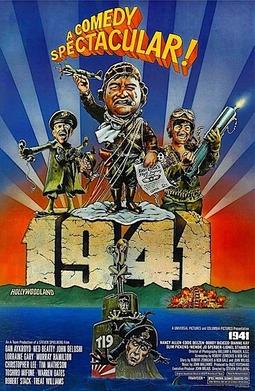
#35 - 1941 (1979)

This is without question, Steven Spielberg's worst movie.  1941 is a comedy set after Pearl Harbor where the coast of California is on high alert for another Japanese attack.  It is also primarily about some soldiers trying to have sex with the local girls.  I recall Spielberg telling the story about how he met John Wayne and asked him to be in this film.  Wayne called Spielberg back to yell at him for going forward with such a terrible film.  "I thought you were an American!" John Wayne snapped.  To be sure, the movie takes an incredibly satirical at the American military, but that isn't really the problem.  This is essentially a World War II version of Animal House, complete with recurring cast members like John Belushi.  While considered a classic, Animal House is a film I detest on many levels, not the least of which is the comedy.  However, humor being subjective, I shall put that aside.  

The story structure is awful, diverting to sequences of little consequence or enjoyment.  The pace is tedious and the characters are all universally awful.  You could tell that this was not in Spielberg's wheelhouse.  This is also the first time you see Spielberg intentionally ripping off his own work with the Jaws sequences at the opening.  I think this movie scarred him so much that he refused to reference anything he had done previously when he made Ready Player One.  If you notice, he hasn't tried to do a full out comedy since.  There are some audacious visual sequences where he tries to create something interesting and compelling from the script, but all it does is draw out the movie with greater tedium.  Everything about this movie lacks the trademark Spielberg heart and so it is the movie that has the least Spielberg in it.

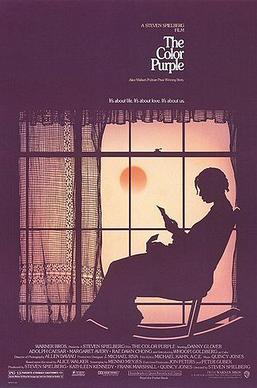
#34 - The Color Purple (1985)

I think Spielberg was the wrong fit for this movie.  Some criticized him for trying to tell the story about a social world he knew nothing about.  I don't think that was the problem.  It wasn't that Spielberg could not empathize with African-American experience in the early 1900's.  It was that The Color Purple is a deeply ugly story.  You may argue that the subject matter is ugly, so the movie must be so too.  But Spielberg proved that wasn't the case when he later filmed Schindler's List, where he captured the horrors of the holocaust without losing a single speck of artistic mastery.  But The Color Purple is a horribly written story that simply ambles as Celie (Whoopi Goldberg) endures abuse after abuse until it culminates in the most awkward family dinner in cinematic history.

In fact, that dinner scene sums up a good deal why this movie doesn't work for Spielberg.  All of the emotional catharsis occurs in this overly long scene set in a cramped dining room with a dozen cast members.  It is so overly talky and visually stunted, but Spielberg was backed into a corner because this is where the script converged the characters.  Nothing about this scene played to his strengths.  The scenes that work best are the ones where he can tell the story of the characters visually.  The scene where Celie is shaving Mister (Danny Glover) while waiting to intercept a letter is incredibly tense to watch.  But too often Spielberg is constrained by a script that is at odds with who he is as a filmmaker.  The entire movie is soaked in a dark and cynical view of the world.  When Spielberg adapted Ready Player One,  he also dealt with source material that was filled with several layers of irony.  But in that case, he adapted the material to match his strengths as a filmmaker rather than try and adapt his strengths as a filmmaker to the material.  He does the former very well, but only learned to really do the latter when he went to Schindler's List.

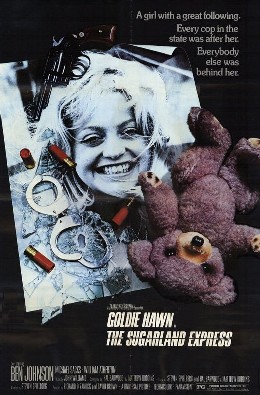
#33 - The Sugarland Express (1974)
The Sugarland Express (movie poster).jpg
This is again Spielberg trying to find himself.  Sugarland express is his first feature film and it has the tone of a modern day Bonnie and Clyde where Lou Jean (Goldie Hawn) breaks her convict husband Clovis (William Atherton) out of prison to get kidnap their son who has become a ward of the state.  This is very much a movie of the 1970's in its town and style.  It is filled with dark humor and disillusioned character.  All optimism in this movie is seen as fool-hardy.  Spielberg does learn to build up tension and extract incredible emotional drama from the character's faces.  This is best observed in a scene where Clovis is watching a Looney Tunes cartoon that should be funny, but the cartoon carnage only serves to remind him of the real-life violence he is facing.  It is a simple reflection shot, but it speaks volumes.  The problem is that the story is ultimately an empty exercise in futility, as many of the films in the 1970's were (e.g. The Conversation, The French Connection, etc.)

If Spielberg were to remain on this track, I don't think he would have become a director of any real consequence.  He would have gotten lost in the shuffle of young and gruff filmmakers of the era.  You could argue that his later films were very much of the 1980's, but there are two problems with that: 1) Most of his movies of that time transcend their era and are incredibly rewatchable over time and 2) the reason his movies feel like the 1980's is because he was THE main influence of classic 80's films.  In that era, Spielberg was not following others; others were following him.

Saturday, July 6, 2019

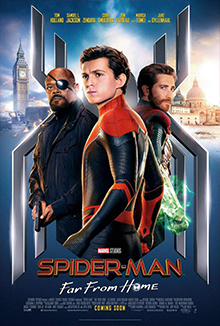
Film Review: Spider-Man - Far From Home


Sexuality/Nudity Acceptable
Violence Acceptable
Vulgarity Acceptable
Anti-Catholic Philosophy Acceptable


Back in 1991 there was a movie called If Looks Could Kill whose lead was 21 Jump Street star Richard Grieco.  It was an action comedy about a teenage boy on his high school class trip to Europe who gets pulled into an espionage adventure.  And I could not help thinking of this terrible, terrible film all while in the theater seeing the movie in this review.

Spider-Man: Far From Home is like If Looks Could Kill only good.  And with Spider-Man.

I will en devour to avoid as many spoilers as possible for Avengers: Endgame below, but it is difficult to do because this film is a direct follow up to the fallout of that film.  So read the rest of the review at your own risk if you have not seen Endgame.

The story picks up almost a year after the events of Endgame.  Spider-Man aka Peter Parker (Tom Holland) is feeling a great deal of pressure to step up his super hero game and take a leading role in the Avengers.  But Peter desperatly wants to have a normal teenage life.  He wants to go on a school trip to Europe with his best friend Ned Leeds (Jacob Batalon), ask out the girl he likes, MJ (Zendaya), while avoiding his emotional bully Flash Thompson (Tony Revolori).  Things at home are weird as Tony Starks body man Happy Hogan (Jon Favreau) has been getting very chummy with his Aunt May (Marisa Tomei).  But despite trying to get into normal teen hijinks, he is recruited by Nick Fury (Samuel L. Jackson) to help a new hero Quentin Beck (Jake Gyllenhaal), who Peter's friends nickname "Mysterio," to take down elemental monsters that threaten to destroy the Earth.  

Probably the biggest deciding factor in whether or not you will like this movie will be how invested you are in all the teenage drama.  As a comic book geek, I can tell you that my favorite Spider-Man series were Ultimate Spider-Man (written by Brian Michael Bendis) and Mary Jane/ Spider-Man Loves Mary Jane (written by Sean McKeever).  Both of these comics focused on heavily on the interpersonal relationships the characters had and made them as compelling as an attack by the Green Goblin.  Far From Home takes a similar approach.  There are long stretches of the movie where Peter barely does any super-heroics.  If you find the focus on the relationships a distraction from the main story, then this movie is not for you.  Far From Home is a movie that uses the superheroics to explore the complexities of teen life.  And I am a sucker for those "will they/won't they" stories.

Because of this, the movie should feel uneven, but it doesn't.  Director Jon Watts blends to super-hero genre and teen road trip genre together incredibly well.  Because this is a Marvel movie, the special effects are always top-notch.  There is a "nightmare" sequence in the middle of the film that visually enveloping and feels like the kind of imaginative spectacle you would get in reading a comic book.  And since this is a roadtrip film, the European vistas make for great set pieces and palate cleanses between scenes.  The writing Chris McKenna and Erik Sommers is serviceable and at times funny.  But it never loses its sense of pleasantness.  Some of the jokes fly, others sink, but the characters are endearing enough to make you overlook most of the imperfections in the writing.  A particular highlight is watching Ned with his first girlfriend Betty Brant (Angourie Rice), who play up the comedic absurdity of most teen romances.

For those who are Spider-Man comic fans, Mysterio is a character who is well-known and the story elements use him in a way that would make the comic creators proud.  The movie wants to say something about how appearances can be deceiving and how shouldn't believe everything in the news and on the Internet, but it never pushes this point too hard.  And even though it focuses on the relationships, it doesn't reach the depths that Spider-Man: Homecoming hit.  Compared to that film, Far From Home is a little closer to superficial than to profound.  But that doesn't mean the movie wasn't thoroughly enjoyable.  This movie acts as a nice light desert after the heavy meal of Endgame.

I think Holland has now become my favorite onscreen Peter Parker.  Tobey MacGuire showed us a longer and wider arc to Peter's story, portraying him going from teen to full adult.  But Holland is doing a great job as teen.  He is in that no-man's-land of wanting the freedoms of adulthood without losing the joys of teen life.  Holland's Peter is often unfocused, hormonal, emotional, but he never loses the core of his heroism and dignity.  Zendaya eleveates MJ from being one-note.  She has enough charisma and charm to make MJ's bleak and woke persona something attractive.  The script does a disservice to the characters by simply stating that Peter has a crush on MJ rather than showing it develop, since that character point was nowhere in the last film.  Holland and Zendaya have very good chemistry.  They also milk the comedy of Peter being totally terrified by the girl he likes and her icy facade slowly melting by his warmth.  I also love the fact that they wrote their relationship with all the innocent awkwardness of young romance.  

Veterans like Tomei and Favreau lay on the comic relief while sprinkling it with genuine moments of heart and gravitas.  Martin Starr and JB Smoove have a nice banter as the school chaperones.  Batalon and Rice play off of each other nicely and drew most of the laughs in the theater where I saw the movie.  Jackson's performance was a little odd at first.  He plays Fury with bit more looseness than we have seen.  At first I thought it was simply the actor adapting to the tone of the movie, but by the end I understood the structure of his performance.  Gyllenhaal does a half-great job as Mysterio.  What I mean is that his performance feels fractured down the middle.  On one side is a wonderfully sincere and restrained performance of dignity.  On the other is wide-eyed scenery chewing.  I understand the choices made here, but he just misses the mark on making it work completely.

I love the fact that the movie explores that perennial question that the hero has to face: ordinary life or heroic life.  Both options are presented as morally acceptable.  I often think about how GK Chesterton reveled in the glory of ordinary life with a sense of wonder or who St. Terese of the Little Flower saw great sanctity in ordinariness.  And yet we have the saints like Paul or Joan of Arc who are called to do mighty deeds before the whole world.  Peter is constantly caught in this dilemma.  Does being a hero mean he has to sacrifice the ordinary happiness of other teens?  Maybe part of the point of these movies is that growing up isn't about choosing between the two but learning how to balance both.

Before I went to see Far From Home, I re-watched Homecoming and I remembered how much I enjoyed hanging out with these characters.  Far From Home gave me the opportunity to spend a couple of fun hours with them and I can't wait to do so again soon.


Friday, July 5, 2019

Film Flash: Spider-Man - Far From Home


15 words or less film review (full review to follow soon)

An improved remake of If Looks Could Kill but with Spider-Man. Fun Marvel teen dramedy


Thursday, July 4, 2019

The Declaration of Independence: 243 Years Ago Today

(most of the text below is a repost from last year)
File:Writing the Declaration of Independence 1776 cph.3g09904.jpg

Below is the entire text of the Declaration of Independence.  I believe it to be one of the most
 audacious and revolutionary documents in history (pun in intended).

I have always loved my country.  But as a philosopher one of the things that I marvel at is that
 the United States is a country built on an idea.

 Ideas matter.

Freedom is in our nature.  No tyrant, no government can take that away.

I encourage you to read the entire text below on this birthday of our nation.  Particularly, I am
struck by the last line:

And for the support of this Declaration, with a firm reliance on the protection of divine Providence, 
we mutually pledge to each other our Lives, our Fortunes and our sacred Honor.

Those who wrote their names on that document held up as collateral for the investment in our freedom:

1.  Their Lives.  I am humbled when I remember that so many gave much more than I will
ever give so that people like me could live free.  The only way we can hold onto our freedom is if men and women are willing to pay the ultimate price.  Too often tyrants, both fearsome and soft-spoken, try to snatch away our freedom.  They depend on us to lay down our resistance and give in.  We must never do so.  The Founding Fathers gave us that pledge.

2.  Their Fortunes.  I will likely never see combat.  But how do I spend my money to
ensure freedom?  Do I take care of our wounded warriors?  Do I support laws and
representatives I believe in with my capital?  And do I take payments from those who
would make me dependent?  This pervasive bribery must lead inexorably to subtle slavery.

3.  Their Sacred Honor.  Do we even believe in honor anymore today?  Does our name mean anything?  In A Man for All Seasons, when asked why he would not take an oath of
loyalty to Henry VIII, Thomas More said, "When a man takes an oath, 
he’s holding his own self in his hands. Like water.  And if he 
opens his fingers then — he needn’t hope to find himself again." 
 We are free and we must stand by our commitments. 
 Otherwise who we are, our name, means nothing.  

These great men signed their names to this document. 
 For each of them it may have been a death sentence.
  But they signed it nevertheless.  They their day they
 took a stand against tyranny and stood for freedom.

In their day they stood as men.

Today they stand as giants.

And the challenge of today is this: could we stand with them?

Do we have what it takes to be the patriots at Valley Forge or the resistance at Boston Harbor?  Does that same noble spirit of freedom stir in us?

Perhaps reading this document again will renew and refresh the spirit of liberty.


File:United States Declaration of Independence.jpg

IN CONGRESS, July 4, 1776.
The unanimous Declaration of the thirteen united States of America,
When in the Course of human events, it becomes necessary for one people to dissolve the political bands which have connected them with another, and to assume among the powers of the earth, the separate and equal station to which the Laws of Nature and of Nature's God entitle them, a decent respect to the opinions of mankind requires that they should declare the causes which impel them to the separation.
We hold these truths to be self-evident, that all men are created equal, that they are endowed by their Creator with certain unalienable Rights, that among these are Life, Liberty and the pursuit of Happiness.--That to secure these rights, Governments are instituted among Men, deriving their just powers from the consent of the governed, --That whenever any Form of Government becomes destructive of these ends, it is the Right of the People to alter or to abolish it, and to institute new Government, laying its foundation on such principles and organizing its powers in such form, as to them shall seem most likely to effect their Safety and Happiness. Prudence, indeed, will dictate that Governments long established should not be changed for light and transient causes; and accordingly all experience hath shewn, that mankind are more disposed to suffer, while evils are sufferable, than to right themselves by abolishing the forms to which they are accustomed. But when a long train of abuses and usurpations, pursuing invariably the same Object evinces a design to reduce them under absolute Despotism, it is their right, it is their duty, to throw off such Government, and to provide new Guards for their future security.--Such has been the patient sufferance of these Colonies; and such is now the necessity which constrains them to alter their former Systems of Government. The history of the present King of Great Britain is a history of repeated injuries and usurpations, all having in direct object the establishment of an absolute Tyranny over these States. To prove this, let Facts be submitted to a candid world.
He has refused his Assent to Laws, the most wholesome and necessary for the public good.
He has forbidden his Governors to pass Laws of immediate and pressing importance, unless suspended in their operation till his Assent should be obtained; and when so suspended, he has utterly neglected to attend to them.
He has refused to pass other Laws for the accommodation of large districts of people, unless those people would relinquish the right of Representation in the Legislature, a right inestimable to them and formidable to tyrants only.
He has called together legislative bodies at places unusual, uncomfortable, and distant from the depository of their public Records, for the sole purpose of fatiguing them into compliance with his measures.
He has dissolved Representative Houses repeatedly, for opposing with manly firmness his invasions on the rights of the people.
He has refused for a long time, after such dissolutions, to cause others to be elected; whereby the Legislative powers, incapable of Annihilation, have returned to the People at large for their exercise; the State remaining in the mean time exposed to all the dangers of invasion from without, and convulsions within.
He has endeavoured to prevent the population of these States; for that purpose obstructing the Laws for Naturalization of Foreigners; refusing to pass others to encourage their migrations hither, and raising the conditions of new Appropriations of Lands.
He has obstructed the Administration of Justice, by refusing his Assent to Laws for establishing Judiciary powers.
He has made Judges dependent on his Will alone, for the tenure of their offices, and the amount and payment of their salaries.
He has erected a multitude of New Offices, and sent hither swarms of Officers to harrass our people, and eat out their substance.
He has kept among us, in times of peace, Standing Armies without the Consent of our legislatures.
He has affected to render the Military independent of and superior to the Civil power.
He has combined with others to subject us to a jurisdiction foreign to our constitution, and unacknowledged by our laws; giving his Assent to their Acts of pretended Legislation:
For Quartering large bodies of armed troops among us:
For protecting them, by a mock Trial, from punishment for any Murders which they should commit on the Inhabitants of these States:
For cutting off our Trade with all parts of the world:
For imposing Taxes on us without our Consent:
For depriving us in many cases, of the benefits of Trial by Jury:
For transporting us beyond Seas to be tried for pretended offences
For abolishing the free System of English Laws in a neighbouring Province, establishing therein an Arbitrary government, and enlarging its Boundaries so as to render it at once an example and fit instrument for introducing the same absolute rule into these Colonies:
For taking away our Charters, abolishing our most valuable Laws, and altering fundamentally the Forms of our Governments:
For suspending our own Legislatures, and declaring themselves invested with power to legislate for us in all cases whatsoever.
He has abdicated Government here, by declaring us out of his Protection and waging War against us.
He has plundered our seas, ravaged our Coasts, burnt our towns, and destroyed the lives of our people.
He is at this time transporting large Armies of foreign Mercenaries to compleat the works of death, desolation and tyranny, already begun with circumstances of Cruelty & perfidy scarcely paralleled in the most barbarous ages, and totally unworthy the Head of a civilized nation.
He has constrained our fellow Citizens taken Captive on the high Seas to bear Arms against their Country, to become the executioners of their friends and Brethren, or to fall themselves by their Hands.
He has excited domestic insurrections amongst us, and has endeavoured to bring on the inhabitants of our frontiers, the merciless Indian Savages, whose known rule of warfare, is an undistinguished destruction of all ages, sexes and conditions.
In every stage of these Oppressions We have Petitioned for Redress in the most humble terms: Our repeated Petitions have been answered only by repeated injury. A Prince whose character is thus marked by every act which may define a Tyrant, is unfit to be the ruler of a free people.
Nor have We been wanting in attentions to our Brittish brethren. We have warned them from time to time of attempts by their legislature to extend an unwarrantable jurisdiction over us. We have reminded them of the circumstances of our emigration and settlement here. We have appealed to their native justice and magnanimity, and we have conjured them by the ties of our common kindred to disavow these usurpations, which, would inevitably interrupt our connections and correspondence. They too have been deaf to the voice of justice and of consanguinity. We must, therefore, acquiesce in the necessity, which denounces our Separation, and hold them, as we hold the rest of mankind, Enemies in War, in Peace Friends.
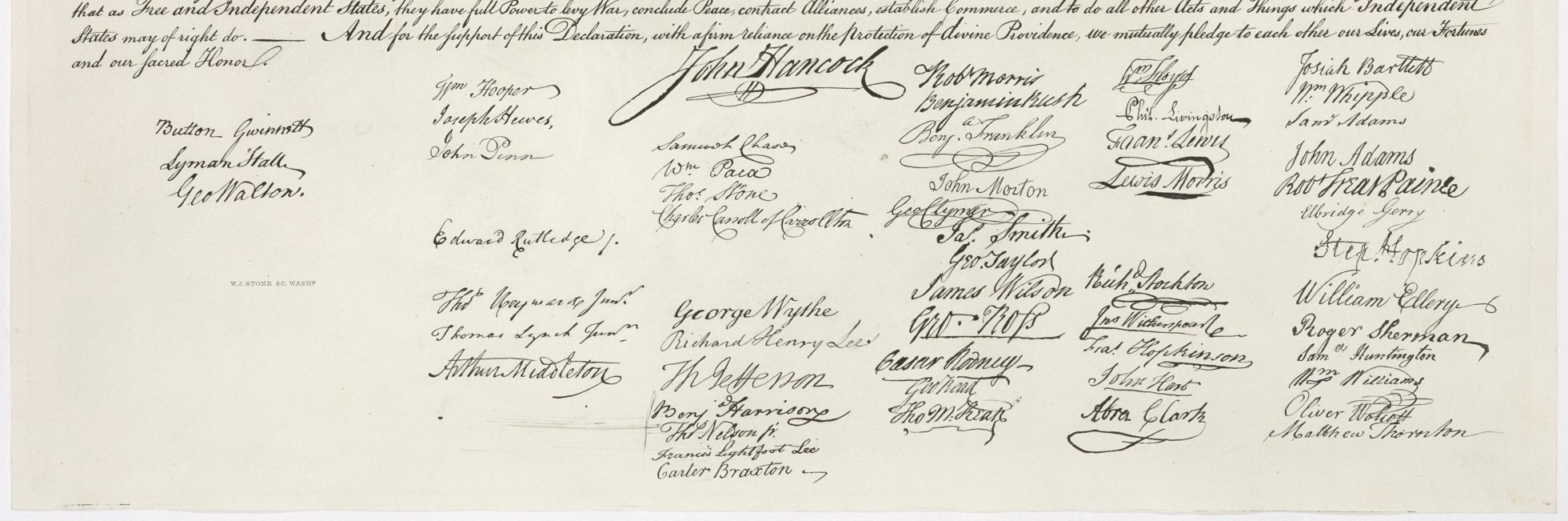
We, therefore, the Representatives of the united States of America, in General Congress, Assembled, appealing to the Supreme Judge of the world for the rectitude of our intentions, do, in the Name, and by Authority of the good People of these Colonies, solemnly publish and declare, That these United Colonies are, and of Right ought to be Free and Independent States; that they are Absolved from all Allegiance to the British Crown, and that all political connection between them and the State of Great Britain, is and ought to be totally dissolved; and that as Free and Independent States, they have full Power to levy War, conclude Peace, contract Alliances, establish Commerce, and to do all other Acts and Things which Independent States may of right do. And for the support of this Declaration, with a firm reliance on the protection of divine Providence, we mutually pledge to each other our Lives, our Fortunes and our sacred Honor.

The 56 signatures on the Declaration appear in the positions indicated:

Column 1
Georgia:
   Button Gwinnett
   Lyman Hall
   George Walton
Column 2
North Carolina:
   William Hooper
   Joseph Hewes
   John Penn
South Carolina:
   Edward Rutledge
   Thomas Heyward, Jr.
   Thomas Lynch, Jr.
   Arthur Middleton
Column 3
Massachusetts:
John Hancock
Maryland:
Samuel Chase
William Paca
Thomas Stone
Charles Carroll of Carrollton
Virginia:
George Wythe
Richard Henry Lee
Thomas Jefferson
Benjamin Harrison
Thomas Nelson, Jr.
Francis Lightfoot Lee
Carter Braxton
Column 4
Pennsylvania:
   Robert Morris
   Benjamin Rush
   Benjamin Franklin
   John Morton
   George Clymer
   James Smith
   George Taylor
   James Wilson
   George Ross
Delaware:
   Caesar Rodney
   George Read
   Thomas McKean
Column 5
New York:
   William Floyd
   Philip Livingston
   Francis Lewis
   Lewis Morris
New Jersey:
   Richard Stockton
   John Witherspoon
   Francis Hopkinson
   John Hart
   Abraham Clark
Column 6
New Hampshire:
   Josiah Bartlett
   William Whipple
Massachusetts:
   Samuel Adams
   John Adams
   Robert Treat Paine
   Elbridge Gerry
Rhode Island:
   Stephen Hopkins
   William Ellery
Connecticut:
   Roger Sherman
   Samuel Huntington
   William Williams
   Oliver Wolcott
New Hampshire:
   Matthew Thornton