ReasonForOurHope

Sunday, August 6, 2017

Sunday Best: Top 25 Superhero Movies of All Time #8 - Iron Man


There is little doubt that this is the movie that changed Hollywood franchises.

The original X-Men movie renewed interest in comic book films after the disastrous Batman and Robin.  But Iron Man changed everything.

In retrospect, you can see the brilliance of many of the choices, but so much of what was done was a gamble.

I have always maintained that at least half of the success of the entire Marvel Cinematic Marvel Universe is due to Robert Downey Jr.  Without him, I do not think you would have the MCU.

But it is important to remember what a risk he was to cast.  The studios always want to cast younger actors so that as the years go on, the heroes don't age out too quickly.  This can often have disastrous effects like Kate Boseworth as Lois Lane.  Instead, director Jon Favreau wanted Downey Jr. who was already in his 40's.  On top of that, it is important to remember that Downey Jr. had not been doing mostly supporting roles at this time or leads in smaller productions.  And don't forget about his very public issues with drugs and prison.

In addition to this, Iron Man was not one of the A-List Marvel heroes.  Director Favreau had only directed three movies up until this point, two of which had only barely made back its budget.  The studio was also opening the movie only a week an a half before the hugely anticipated (though eventually derided) Indiana Jones and the Kingdom of the Crystal Skull.

Despite all of that, Iron Man rose to the top.

The movie does something that I always advise filmmakers with unlikeable leads to do: make your leads charming.  Tony is not a likable person when the movie starts.  He is a lothario who is thoughtless, greedy, and arrogant.  If these were his only qualities, audiences would check out of the story immediately.  But Downey Jr. makes you like him despite his flaws.  The opening scene is so brilliant because it does two things:  first it makes you attach to Tony because he is the cool/funny guy who is being cool and funny with us "normal" people.  Second, he is immeadelty put into mortal danger so we feel for his safety right away.

The entire first act of Iron Man is fantastic.  Downey Jr.'s chemistry with Yinsen (Shaun Toub) is the heart of the movie.  Toub's understated and noble performance works to break through the snarky and sarcastic exterior of Tony.  Not to enter into the realm of politics, but the movie came out towards the end of the George W. Bush administration when terrorism was a primary focus.  By setting Tony's capture in the mountains of Afghanistan by radical Islamists, it struck a collective chord with a lot of people and gave us a superhero that felt like he was the enemy to our enemies.  It was the movie equivalent of the cover of Captain America #1 where he punches Hitler.

The sequence of the escape is also fantastic, as we see our hero turn the tables on the villains and use his genius to overcome them and be the architect for his own escape along with Yinsen.  After watching Tony suffer so much at the hands of these terrorists, it is a wonderfully cathartic release to see him exact justice.


But the goodbye to Yinsen always gets me.  Again, Downey Jr. needs so much credit here.  He can crank up the charm to 11, but he can also bring the proper emotion.  Watch when he says to him, "Thank you for saving me."  You can see how he means more than just saving his life.  Yinsen saved his soul.  It is a fantastic moment, not overdone or underdone.  It is a moment of man who feels overwhelming gratitude and genuine emotion but doesn't really know how to do it anymore.  His feelings are almost alien to him as he confesses his thanks.    So when Yinsen says, "Don't wast your life," you can see how it propels the rest of the movie.

It is true that the second two acts do not match the level of the first act, but there is still much to admire.  The development of the armor is fascinating to watch.  This is not an easy feat because these sequences are essentially a man in a workshop building stuff.  But Favreau makes each step of the journey fascinating to watch.  And his first flight is still a real joy to watch, you feel Tony's exhilaration as he shouts with joy.

Underneath this is a story of redemption.  Tony has been given a second chance to make his life count.  The movie is about the slow awakening of his soul.  The story wisely gives his character room to grow over the course of several films, but his first strides feel significant.  It is wonderful to watch his first "metanoia," which is a Greek word for "complete change of heart."  This happens thematically and symbolically with his Arc Light in his chest.  His past sins are killing him, but his current heroism is saving him.  But if he ever stops being a hero, he will slide back into his deadly sin.

And his first real fight in the new armor is great to watch.  Again, Iron Man is not fighting a super-villain here, but Islamist (alebiet in this case fictional) terrorists.  You get the sense of a hero touching, tangentially, the evils of the world.

The movie's biggest detriment is in its villain.  Jeff Bridges' Obediah Stane is too simple and obviously evil.  That isn't to say that Bridges doesn't do the best he has with that material.  Gwyneth Paltrow as Pepper Potts has great chemistry with Downey Jr.  Even Terrance Howard does a decent job as James Rhodes.

Also I think people forget how bold the ending is with Tony eschewing the necessity of a secret identity.  While that is standard for most Marvel movies now, it was a brand new idea.

But above all of this, Iron Man is a fun movie.  Never underestimate the power of fun entertainment.  That doesn't undercut any of the drama involved, but most people finish Iron Man and they feel charmed and exhilarated.  This movie permanently planted Robert Downey Jr. into their affections, and by association Iron Man and the entire MCU.

Nearly ten years later, Iron Man is still one of the best in the genre and deserves its place as the eight greatest superhero film of al time.

Saturday, August 5, 2017

Who Knows the Savior


So I was at a Comic Con today and got a chance to meet David Tennant.  In honor of that event, I decided to dress up like the 10th Doctor.  My wife and I waited in line for hours until we got a chance to briefly meet him face to face and then get our picture taken.

After that, we walked around the convention center looking at all of what was there.  At one place they had a life-size TARDIS and a man dressed as the Fourth Doctor (Tom Baker).  He never broke character and asked if I wanted to get a picture with him or just me and the TARDIS.  I said both and we took both pictures.

Right before I left, he said (again, never breaking character as the Fourth Doctor), "What is this medal you have around your neck?"

I grabbed my Miraculous Medal and explained what it was and showed him that I was wearing a crucifix I received when I was seventeen.

The Fourth Doctor said, "Oh!  You know, I met Jesus once.  He did something I could never do: save the world!"


Best.

Comic Con.

Ever.


Tuesday, August 1, 2017

Film Review: Dunkirk


Sexuality/Nudity No Objection 
Violence Mature
Vulgarity Mature
Anti-Catholic Philosophy Acceptable

If Christopher Nolan does not get an Oscar nomination for Best Director, nothing will.

Dunkirk is a marvel of cinematic storytelling once again proving that Nolan is one of the best artists behind the camera working today.

The movie once again uses Nolan's signature obsession with multiple and overlapping timelines to tell the story of the retreat at Dunkirk.  The Allied forces were pushed back by the Nazis all the way to the coast of France at Dunkirk.  Nearly 400, 000 men were stranded on the beaches there.  Assembling on the beach left them open to the German air force.  The large military destroyer ships were prone to attack from the air and from u-boats under the sea.  The British military held back much of its navy and air force in preparation of the inevitable Battle of Britain.  As a result, civilian ships were called in to help with the evacuation.

In this movie, Nolan interweaves three convergent storylines.

1.  Tommy (Fionn Whitehead) is a young British soldier who falls in with another soldier (Damien Bonnard) as they make several attempts to finagle their way onto any ship taking them off the beach.  During this time the encounter Commander Bolton (Kenneth Branagh) and Colonel Winnant (James D'Arcy) and come to understand how desperate their situation is.  Their story plays out over several days at Dunkirk.

2.  Mr. Dawson (Mark Rylance) is a British citizen who answers the call for rescue boats.  He sets off to Dunkirk with his son Peter (Tom Glynn-Carney) and his friend George (Barry Keoghan).  Along the way they pick up a drifting shivering soldier (Cillian Murphy) who is shell shocked and does not want to return to Dunkirk.  Their story takes place over one day.

3.  Farrier (Tom Hardy) and Collins (Jack Loweden) are RAF pilots who, with almost no other support, must fend off the German Air force threatening escaping Dunkirk.  This story takes place over the course of a single hour.

If that sounds confusion, don't worry it really isn't.  Nolan understands that the human mind longs for complexity in its stories but he also understands that the human mind doesn't want to be too frustrated.  He messes with the converging timelines primarily to create suspense and tension.

This might be Nolan's best work in terms of purely visual storytelling.  Hardly a word is said throughout most of the movie.  In fact, it wouldn't be too far off to see Dunkirk as a silent movie.  Or at the very least it carries with it the principle of telling the story with the bare minimum of dialog.  In Tommy's sequence, I don't think he or his friend say a single line for the first forty minutes.  Instead, Nolan wants you to follow them with your eyes.  Nolan is one of the few directors working at his level who trusts his audience to keep up with him.  Rather than have Tommy and his friend have a long conversation about how to sneak onto a boat, he shows us how come across an injured man on a stretcher who has been abandoned on the beach and takes it from there.

The colors of the film help set its tone.  The soldiers languish in a washed-out blue-gray purgatory of despair.  They are exposed and helpless with only the strange sea foam for cover.

And the threat is always there and impending.  Nolan takes a cue from Jaws and barely ever shows us the invading force, but they are there all the time.  We can hear them always surrounding.  While I said this movie had a silent film aesthetic, it use of sound is masterful.  Not only is the score tense and powerful, but the shock and violence of the sound effects makes us feel the oppression of that unseen fear.  And his use of the watch ticking is the most effective I've heard in a film.

Nolan traps us into his characters' perspectives in such an effective way.  One of the things that he did better than in any movie I've seen is capture the claustrophobia of air battles.  Often in films we get to stand outside and watch the exciting movements of the planes throughout the three-dimensional space in which they fight.  But Nolan forces you into that cockpit where your field of vision is so limited and you don't know if you are alone in the sky or if an enemy is closing in.

This movie does have a drawback and it is not insignificant: it lacks heart.  What I mean by this is that there is an intentional absence of all things resembling sentiment from the film.  As we saw in Interstellar, Nolan is perfectly capable of tugging at the heartstrings.  But for Dunkirk, he assiduously avoids them.  It would be wrong to say that the movie is unemotional or callous.  The emotions of fear, sadness, and desperation are powerful and intense.  Many of the soldiers on the beach at Dunkirk were strangers who fall in together for an intense experience.  But because of that, they never really form strong emotional bonds to each other.  The same is true of the audience.  You care about many of the characters on a human level, but not a personal level.  I honestly could not tell you the names of most of the main characters from memory.  And much of the dialogue was difficult to hear.

I think that Nolan wants this distance because he wants to remove these men from the audience's judgment.  Some of them do some horrible things through the course of the movie.  But Nolan never casts judgment on their horrible actions.  Instead, he simply shows you the horror they endure and reminds you that war is hell.

And that isn't to say that he doesn't show great heroism at the same time.  Rylance's Dawson has such an understated nobility that it is hard to define.  Dawson is tenacious and daring and pushes his crew because "We might be able to help!"  He is an ordinary man with extraordinary character.  Farrier also has to often put his courage to the sticking place.  And the last shot of Bolton in the movie stands as an emblem of iconic valor.  In fact, the very last shot of the film feels like a challenge to the audience to match up to the heroism displayed at Dunkirk.

The problem is that Nolan is becoming more and more like his favorite director: Stanley Kubrick.  Kubrick was a man who could create some of the most iconic images every made in cinema.  But his films had a coldness that borders on pathological.  Nolan seems to be following in his stylistic footsteps, which I think will ultimately hurt his storytelling.

All of the performances are great.  Newcomer Whitehead has to carry so much of the movie without saying anything, so all of his subtle emotion must be constantly present.  Hardy, as he did when he played Bane in Nolan's The Dark Knight Rises, must do most of his work with only his voice and his eyes.  And Rylance proves once again why he earned his Oscar a few years back.  There is absolutely nothing showy about his performance.  And yet it is so charismatic that he lingers with you long after the movie ends.  He refuses to chew scenery.  But when he says lines like "We have a job to do," it does it in a way that is so plain and firm that you cannot help but agree.

Dunkirk is a great film told by a master of the visual form.  But if he had just given his film a bit more heart, it could have been one of the greatest.

4 out of 5 stars

Monday, July 31, 2017

Film Review: Atomic Blonde


Sexuality/Nudity Objectionable 
Violence Mature
Vulgarity Mature
Anti-Catholic Philosophy Objectionable

Atomic Blonde is a movie that should be all kinds of awesome.

-director from John Wick: check.
-charismatic action lead: check.
-nifty 80's soundtrack: check.
-high-octane action throughout: check.

But when all is said and done, the whole movie feels like a waste.

Charlize Theron plays Lorraine Broughton, a member of the British Secret Service who is being sent to East Berlin right before the fall of the wall.  A Stasi informant known as Spyglass (Eddie Marsan) has a list of undercover agents that could put many lives at risk.  Her main contact is fellow Secret Service agent David Percival (James McAvoy) who has gone deep into the Berlin black market.  Along the way she encounters French spy Delpine Lasalle (Sofia Boutella) with whom she begins a love affair.  Lorraine races against the clock to find the information as she dangerously jumps across both sides of the wall several times to secure the information and find a traitorous mole code-named "Satchel."

All of that is well and good and should be fantastic fodder for the movie.  But there are several problems right off the bat.

I am not a fan of gratuitous nudity and there is plenty in the film from the beginning.  Theron first appears on screen emerging from an ice bath and then walks around nude.  I have no problem with a film capturing the physical beauty of a person.  Daniel Craig has that famous shot of him coming out of the water in Casino Royale.  But when you cross over into nudity, it goes from appreciation of physical beauty to objectification.  And there is a good deal of R-Rated female-female sex depicted which acts as a complete distraction.  I think the point was to make Broughton as sexually adventurous as 007, but nothing in Bond has ever been this graphic.

Also, the very first moment you meet McAvoy's Percival, he utters a completely vulgar and baffling blasphemy of the Virgin Mary.  I found myself lingering on that moment long after it had passed and it kept me from engaging in parts of the movie.  In fact, his entire character is a problem for the entire film.  I'm not sure if my distaste for McAvoy is coloring my dislike of his performance, so I want to be fair.  He has a great deal of energy, but he comes off as so off-putting that I could never engage with him.

Narratively, the movie is strangely ineffective.  I enjoy complicated and complex plots, but I couldn't follow a good deal of what was happening or rather why it was happening.  A number of the villains make such a feeble impression that I had trouble remembering who they were.  Also the movie does a lot to remove a lot of the important tension.  Most of the movie is told by Broughton in flashback so we have no fear that she will survive her several deadly encounters.  The movie builds towards the fall of the Berlin Wall as some kind of ticking clock, but all it does is make us feel that this conflict is ultimately pointless.  Also the story reveals WAY too early that someone is a traitor.  Because of that we don't get to really revel in the paranoia of potential betrayal.  And when the betrayal does happen it comes with so little shock that you come to realize that you had been watching this movie impatiently waiting to reveal something to you that you already knew.  This makes the overall affair boring and tedious.

On a side note, Boutella's Delphine may be the stupidest spy ever on film.  When she realizes that her life is in mortal danger does she flee Berlin?  No.  She CALLS UP the person who is her biggest threat and yells at him for NO REASON.  After that, does she run away?  Set a trap?  No.  She puts on a pair of noise cancelling head phones and wanders around her unsecure apartment in her underwear.  The sequence is so pointless that it defied comprehension.

Theron is actually fairly good in her role.  While her character's cold exterior never thaws enough for us to see the character underneath, her performance is on par with Craig's first Bond film.

The action sequences are also excellent.  There is a much-talked-about sequence in an abandoned building that seems like one continuous take.  It is brutal and raw and the absolute best part of the movie.  It is a scene that deserves to be in a better movie.  Director David Leitch knows how to make these parts of the movie watchable.  But because we lack a strong connection to the story I actually wish they were shorter.  And he throws in some funky camera moves that seem to serve no other purpose than to be funky.

The film also makes decent use of the music and styles of the era, but never to their full effect.  Although the film wisely uses Queen's and Bowie's "Under Pressure" in the final sequence which hits the end with just the right sense of cool and awesome.

On a last note, the movie has a terrible title.  There is nothing "atomic" related to the story and the focus on her being "blonde" also has nothing to do with the story.  I know that its supposed to be a clever play on the phrase "atomic bomb" but it really isn't clever.  In a movie that tries to insist on the strength and independence of its main heroine, the title is strangely objectifying.  I couldn't imagine that one of the potential titles for John Wick was Nuclear Brunette.

But a bad title is the least of the problems found in Atomic Blonde.  With a movie like this, you should leave the theater feeling exhilarated, not bored.

1 and 1/2 out of 5 stars.


Sunday, July 30, 2017

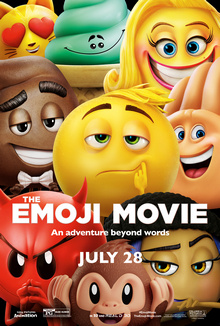
Film Flash: The Emoji Movie


15 words or less film review (full review to follow soon)

👎 🚮 ✌️😱4️⃣👦👧 🚫👀☮️🅾️💩🎥 ⭐️⭐️/⭐️⭐️⭐️⭐️

Sunday Best: Top 25 Superhero Movies of All Time #9 - The Incredibles


This is the greatest Fantastic Four movie ever made.

And make no mistake: this is the Fantastic Four.  Even the most casual observer of Marvel's first family can see the parallels.  In power you have the stretchy one, the invisible one, and the strong guy.  They substitute out speed for fire, but both imply impulsivity.  And the personality dynamic is on display as well: there is the father-figure, the mother-figure, the one who tries to hide, and the hot-head.  Do I side-by-side comparison of the uniforms (NO CAPES!) and it is even more apparent.
The Incredibles are the Fantastic Four.   But it goes even further than that:

The Incredibles are a BETTER Fantastic Four.

First of all, writer-director Brad Bird needs to be given an great deal of credit for this film: it is gorgeous in that visually stunning PIXAR way.  There is a lot of mediocre computer animation out there, but The Incredibles draws you in so well.  The visual design with its retro-'50's aesthetic evokes a sense of innocent nostalgia while still feeling modern.  Watch Bird's use of color and shadow, especially with the color red, which creates some intense mood and emotion.

But lots of superhero films have a strong spectacle.  What sets this apart is how The Incredibles taps into something much deeper while still maintaining it as a fun adventure.  We watch the adventures of a family of "Specials."  Chesterton said  “The Iliad is only great because all life is a battle, The Odyssey because all life is a journey, The Book of Job because all life is a riddle.”
   

The Incredibles is great because all families are Specials.

Inside every family there is that primal thing in us see everyone in it like superheroes.  Dad is Mr. Incredible: even if he weighed down by age and weight, there is a Goliath lurking inside of him waiting to fight for you.  Mom is Elastagirl: she will twist and stretch herself beyond human comprehension to take care of you and protect you.  One child is Violet: shy and retreating and uncomfortable out in the world but growing increasingly alienated at home.  One child is Dash: emotional and impetuous, burning with the desire to shine.

This is one of the most pro-marriage, pro-family films made in last few years.  Mr. Incredible and Elastigirl have their problems, chief among which is that Mr. Incredible is keeping secrets.  The movie shows how secrets in a marriage eat away at its foundation.  But the love they have for each other brings them back together and gives their children a solid foundation.

It does a great job of showing that horrible transition parents must go through where they have to let go of protecting their kids and let them put themselves into harms way.  I am always moved by the scene in the cave where Elastigirl tells Violet and Dash that they are both going to be in horrible danger and that they are going to have to look out for each other.  Watching Dash's smile fade always breaks my heart because there is a small loss of innocence at that point, which is something that parents have to witness as the years go on.

But ultimately its about facing the problems of the world together as a family.  Mom and Dad will always be out there fighting for their kids, but the kids have to learn to step up and fight their battles too.  They look out for each other and have each other's backs.

The villain also is very prescient as a model of modern internet troll society.  I am amazed how much of today's social media outrage is fueled by envy.  Syndrome is someone who wants to be like Mr. Incredible but is consumed with jealousy that he is not.  Rather than work hard to raise himself up, all he can do is tear everyone else down.  He says he wants to sell normal people his Syndrome technology so that everyone will feel special but that "no one will be."  Like Lex Luthor in Batman v. Superman, Syndrome cannot stand to see anyone have advantages in life that he does not have.  The Incredibles reminds us that envy can destroy the soul and lead to utter destruction (especially if you wear a CAPE).

Even with all of the rich thematic elements, The Incredibles is still a great deal of fun.  Michael Giacchino's score reminds me like a comic book version of James Bond.  I absolutely love the moment Dash finds himself running on the water and is so tickled by it that he lets out a child-like chuckle that is absolutely perfect.

Finally, The Incredibles has the most quotable moment in any PIXAR film:


As of this writing they are developing The Incredibles 2, set to be released 14 years after the original.  If it is even half as good as this movie, it will have been worth the wait.

Wednesday, July 26, 2017

Film Review: War for the Planet Apes


Sexuality/Nudity No Objection 
Violence Mature
Vulgarity Acceptable
Anti-Catholic Philosophy Acceptable

War for the Planet of the Apes is a very good film that is engaging and exciting.  But it isn't really a war movie.

Director Matt Reeves has created an epic trilogy for which he should be very proud.  He has taken us on the journey of Caesar (the amazing Andy Serkis) from his beginning the ape revolution in Rise of the Planet of the Apes through his troubled leadership of his tribe in Dawn of the Planet of the Apes through to this finale in War for the Planet of the Apes.

The story begins five years after Dawn and fifteen after Rise.  A cult-like human Colonel (Woody Harrelson) who is leading his outpost of humans against Caesar's apes in the Redwoods.  After a devestating surgical strike on his home, Caesar pursues revenge accompanied by fellow chimp Rocket (Terry Notary), gorilla Luca (Michael Adamthwaite), and his wise counselor orangutang Maurice (Karin Konoval).  Along their perilous journey they encounter two more characters that shed light on the world-wide impact of the simian flu virus.  The first is Bad Ape (Steve Zahn), a chimp from a zoo who became intelligent as the virus spread.  The other is Nova (Amiah Miller), a mute child who appears to have mentally deteriorated into simplicity because of the mutation of the disease.  Together, these six form a unlikely bond as they forge ahead to the Colonel's base where Caesar finds more than he bargained for.  I do not want to go any further with the plot so as to not spoil some of the twists.

Reeves weaves a tale that is intricate, complicated, and emotionally complex.  The film is about the intelligent apes attempting to take their ascendancy as the dominant species.  The Colonel sees this as a holy war and that history hinges on which side wins.  In that sense, he is correct, but it is hard to root against your own species.  And yet the apes are undoubtedly persons who are want a chance at the freedoms that all persons have.

The biggest detriment that this movie has is that the second film, Dawn, was superior to this one.  With the exception of one human character in the last film, all of the men and apes were fully realized, three-dimensional characters.  You could completely understand, if not empathize, with every side of the conflict.  The problem with War is that it doesn't use that same care with the antagonistic humans.  The Colonel is made after the mold of Col. Kurtz from Apocalypse Now.  The character design, the performance, and the way he is filmed make this homage unmistakeable.  The Colonel is insane and filled with religious zealotry in his war.  And even though they give him a tragic backstory, you can never get behind him because of his cruelty.  In Dawn, I agonized for the humans and their desire for survival alongside the apes.  Because of the Colonel, that wonderful contradiction of emotion is absent from War.

As a Catholic I found the villain's religiosity a bit annoying, but I did not think it too overdone.  I'm not one that says a movie needs balance in its point of view and there have been people throughout history who have used God to glorify their fight rather than fight to glorify God.

And yet the Christological imagery in relation to Caesar is unmistakeable.  He is the leader and savior of the apes.  Their salvation rests on him.  That is not to say that he is a Christ-figure.  In fact, the whole movie is ultimately about Caesar's struggle with his own darkness.  He is always in danger of become like the evil Koba (Toby Kebbel), the ape who started the war.  And you feel the pull towards the darkness.  Caesar attempts to be rational and merciful.  But in this fallen world, mercy can have a horrible cost.  The question is whether or not the cost of a cruel soul is better or worse.  Caesar struggles with this the entire film and the outcome is always in question.

Some could read a very strong anti-human philosophy in this story.  And to be sure, the original Apes series from the 1960's had a strong nihilistic streak in it.  But once you accept that the apes are persons who share the defining trait of humanity being rational animals, then the focus becomes not apes vs. humans but on the apes will embrace moral good or moral evil.

This movie has some excellent motion-capture performances, Serkis most of all.  Every time he is on screen, Sirkis gives one of the most charismatic and tragic performances I've seen in a sci-fi character.  Zahn's Bad Ape came close to becoming a complete Jar Jar, but the character never crosses the silliness line.  Miller's Nova is heartbreakingly endearing in every scene she is in.  You can understand how she melts the hardened, frozen hearts of the apes.  Harrelson's Colonel is my least favorite performance in the film.  He does a fair job with character as written, but crazy on screen usually means that depth is lost.  You have to be horribly charismatic to make crazy engaging like Anthony Hopkins' Hannibal Lecter or Heath Ledger's Joker.  Harrelson doesn't quite make that level.

As I said earlier, the movie isn't really a war movie.  There is a good deal of violence and fighting, but there was actually a lot more action in the second film.  This movie feels more like a revenge Western and prison escape film.  In all honesty, it would have made much more sense to call the last film War for the Planet of the Apes and this current one Dawn of the Planet of the Apes.

My general feeling on trilogies is that the third film has to be the best.  If it does not, it leads to an inescapable sense of dissatisfaction.  If the third film is very good, but not the best, the dissatisfaction can be lessened but never abolished.  Unfortunately, the second film in this series is better than this film.

But Reeves has still given us a film worth watching and a fitting send off to Caesar's story.  He knows how to use the CGI technology to enhance the emotion and drama of the story rather than detract, and that is a rare thing in the blockbuster.  His minimalistic dialogue means that he has to tell the movie primarily with the visuals, which he does incredibly well.  His use of Michael Giacchino is superb and used for maximum effect.  In terms of story, he has wisely built the bonds to characters we have come to know over the last two film so that we are desperate for them to have a happy ending and our hearts break if any of them meet tragic ends.

My care for them was strong that I was actually saying to myself during a moment of peril for the main character, "Come on, Caesar!"  I yearned for Caesar to come out on top both in soul and in fact.  I will not say if he succeeds.  But Reeves and Sirkis deserve a great deal of credit for creating one of the greatest, if not the greatest, motion capture character of all time.

And for that I say: Hail, Caesar!

4 out of 5 stars.