It’s Christmas, the season when we remember the birth of our Lord. He came into this world and we are filled with joy! We remember the words of the angels: Gloria in excelsis Deo! How happy are we to remember that beautiful moment in that Bethlehem stable.
But always looming above this moment when the eyes that were opened in the manger were closed in death on the cross. Venerable Fulton Sheen once said “All men are born to live. One man was born to die.” Jesus took on human life so that He could give His life away.
It is interesting to note that Christ’s birth is not in all four Gospels. Only Matthew and Luke write about that Bethlehem event. It was not uncommon for ancient biographies to skip over the early life of their subjects. But the story of Jesus being born is filled with foreshadowing of the Passion. You can read about this more detail in books like Fr. Raymond Brown’s An Adult Christ at Christmas.
15 words or less film review (full review to follow soon) Most beautifully photographed film this year (genius use of color!) that deserves a better script. 3 and 1/2 out of 5 stars
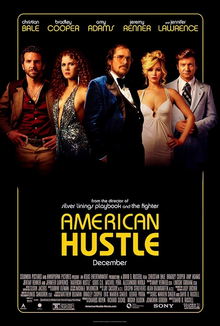
I hate the culture of the 1970's. I hate the clothes, the hair, the music, and the general attitude that came from most pop culture at the time (Jaws and Star Wars excluded). That is one of the reasons I was trepidatious about David O. Russell's American Hustle, a period drama set in Disco Decade. I was worried that I would be so distracted by my dislike that I would have a horrible time.
I was very happy to be wrong.
American Hustle is the story of the FBI Abscam sting. Russell very wisely puts the note "Some of this actually happened," before the movie beings. This allows him a lot more liberty to play around with the characters and facts to create a good dramatic story without nitpicking the historical details. The plot revolves around Irving Rosenfeld (a fantastic Christian Bale), a middle-aged, overweight urban dry-cleaning entrepreneur who also has a side business of con man. Irving falls in love with the street-wise-city-girl-from-a-small-town-wanting-more-out-of-life Sydney Prosser (Amy Adams).
Bale and Adams have great chemistry, so that even as they run scams together, you kind of root for them. Russell wisely spends time getting you invested in the relationship because, when you get down to it, the two are fairly immoral in their lying scams. But then they get caught by FBI Agent Richie DiMasso (Bradley Cooper) and are forced to use their skills to help set up crooked politicians for corruption stings. This pulls the couple into a world of danger and desperation that pulls them further apart and closer to harm.
The best thing about American Hustle is the cast. Some of the best performances I've seen this year come from this movie. Bale is at his best here as Rosenfeld. He completely takes on the persona of a low-rent con man, with all of the tacky trappings. If that had been all to his performance, that wouldn't be much. But Bale takes us past that exterior as Rosenfeld sinks into the quicksand around him. You can see his desperation as he starts running out of choices and all the ones he has left are bad. In the second half of the movie, he really grabs you through his eyes with every meaningful, potent glance.
Amy Adams is also fantastic. Her Sydney takes on a British persona "Lady Edith Greensley," and she slips in and out her accent throughout the film. At first I thought this was a flub, but then I realized what Adams was doing. Her character was so caught up in her lies that she started losing track of who she was. As her relationship strains with Rosenfeld, her mutual attraction with DiMasso grows, but you can never tell if is real or a hustle. Cooper is also perfect in his role. I really didn't care for him in Russell's Silver Linings Playbook from last year. I thought he was too full of himself and arrogant. But this works perfectly for his Agent DiMasso, who wants to take down the "bad guys" but he also wants all the fame and glory that goes along with it. And you can tell that he wants to be as good at hustling as Rosenfeld. Cooper brings just the right amount of humor and danger and vanity to the part.
Two more performances of note are Jennifer Lawrence and Jeremy Renner. Lawrence plays a put-upon, alcoholic house wife. She is as infuriating as she is vulnerable, which makes for a wonderfully conflicted combination. Speaking of conflicted, Renner's Mayor Polito is the primary target and tool of Abscam. But he comes off not as a greedy slime-ball, but a man willing to bend the rules for the good of a city about which he genuinely cares. He develops a real affection for Rosenfeld, and Bale shows how this tears him apart inside.
The script is pretty tight and moves along at a good clip adding intensity and complexity as it goes. Going back to my note on the 1970's, Russell transports you to that era and he makes it fascinating without being kitsch or glamourous. I particularly love how he lets you in the back door to see the characters with curlers in their hair or gluing their comb-overs to show you how their quaffs were ridiculous facades. He also uses the music from the time effectively not only for nostalgia but for emotional effect. I still can't get Elton John's "Goodbye, Yellowbrick Road" out of my head since I saw the movie, as Russell used in a visually beautiful and emotionally arresting scene in the middle of the film.
My biggest critique of the film is how it treats the women. I'm not prudish if art wants to explore the beauty of the female form. But the camera doesn't just linger on its female leads, it leers. I understand that the women characters use their sexuality as part of their hustle, but you can film a woman being sexy and womanly without her being (for lack of a better word) slutty. Adams' outfits are so revealing that she may as well be naked for much of movie. And this isn't simply a reflection of 70's apparel. Russell objectifies her and Lawrence even as the actresses give fantastic performances. If you are someone who is particularly susceptible to lustful temptations from movies, I would avoid this film.
The challenge of a film like this is the moral one. Movies about con artists present a moral quandary. Like Catch Me If You Can, we are amused and impressed by the main characters ability to hustle. This is partly, I think, because a part of us envies their skill to manipulate others. We want to be slicker and smarter than everyone in the room. This is a moral danger, because if the movie gets you to root too much for the humbug, it is seducing you into accepting deception as morally good. Perhaps I am being too heady here, but I think that this can be a real problem with movies like this.
In addition, all of the characters are broken in their morals in some way. Whether they lack virtue in pride, avarice, lust, wrath, envy, sloth, or gluttony, there are no saintly people in this film (except for maybe Louis CK in small but wonderfully done part). This is not in and of itself a problem if, as in movies like The Godfather, it shows how a life of sin catches up with you.
So how does American Hustle approach this problem? I can't say too much without giving away the ending. But I will say that most of the bad choices that people make have bad consequences. Lies and deception leads not to freedom and power, but deeper lies and further deception until you are lost in an invisible labyrinth of untruths. And the characters begin to realize that this life of lies is destined for destruction. For that reason, I have less of a problem with the moral faults presented in American Hustle (with the exception that marital infidelity is normalized).
American Hustle is morally complicated, but it is very well made.
We are sometimes frantic with the pressure to find just the right gift to give to those we love. We spend hours walking the malls or surfing the inter-webs until we find something that speaks to us. It must be a gift that not only shows value to the receiver, but it must also express the relationship to the giver. Gifts are a way for us to acknowledge how much we truly "get" the other person.
I remember one year my father's fiancee got me a set of Hot Wheels cars. I don't know why. I never have owned a Hot Wheels or Matchbox car in my life. Maybe she really was trying and my adolescent brain was too prejudiced against her to realize this. But my only thought was, "She has no idea who I am."
When I get gifts for my wife, I try very hard to think of things that she would enjoy or find beautiful (all of which are attainable through a Catholic school teacher's salary). And every year she outdoes me with her choices. She knows me. She gets me.
But then I started thinking about the source of all our Christmas joy: Jesus. He is the Gift from Heaven and we give gifts in turn to replicate that generosity. So we shop for or make gifts to give each other.
But what about Jesus?
He is the One Who gives. But do we give back to Him?
That's what the Magi did. They travelled from the East to give Him gifts. Of course these gifts were only tokens; they were symbols of their admiration.
But what about a gift that was not symbolic? What about a gift to the Lord that showed that we truly "get" Him.
I started thinking about it and I realized what a seemingly insurmountable problem this was. This is literally case of "What do you get for the Man Who has everything?"
I thought first about the obvious: money. I could always drop a few more coins into the collection plate. But then I thought that God doesn't need my money. To be sure His children are in constant need of charity, but Jesus doesn't need money. He was never attached to it. Throughout the Gospels he warned against being too enthralled with money. He could have chosen to be born into palatial opulence. Instead He traded a gilded cradle for a straw-filled manger.
I thought about doing some work of art for Him. After all, isn't that what the Little Drummer Boy did? (pa-rum-pum-pum-pum?) What wonderful expressions of Divine praise we have from paintings of Michaelangelo, the hymns of Thomas Aquinas, the mediations of St. Ignatius of Loyala, etc.? I know that I cannot produce anything of that grandeur, but I could do something. Yet doesn't all of my talent come from God anyway. Isn't He, like the parable says, the Giver of the talents. Any artistic ability I have is not mine, but only on loan to be from God.
I thought about simply surrendering my life, body and soul to Him. But what kind of gift would that be? He made me out of nothing. Everything I have, physical or spiritual, I have from Christ. To give Him my soul as a gift would be like giving telling someone they can keep the sandwich they just made for themselves. It already belongs to Him, which is why our rebellion is a kind of theft.
I thought about giving Him the sum of all of my good actions. But even this would be a fraudulent gift. I am powerless to be good without His grace. Every act of kindness and charity is not mine to give Him. He is Charity Itself. If I have any Charity in me, it is simply the work of His Nature acting upon this mortal man. Any good I have done could have been done by another. But Christ kindly let me work with Him. Even the good that I do is His gift to me.
So is there anything I can give Him this Christmas? Is there anything that I can lay down at His feet that is not His already?
And then it struck me. The answer is yes.
There is something that Christ does not have. There is something that only I can make. And I make it apart from any of His influence.
My sin.
The Lord gave me a will that is free and the power of action. But all of this He gave me so that I might work with Him and choose the good. But all too often I have not done so. I turn away from that Eternal Fountain of Joy and drink the poisonous bitter waters of sin. That is why I need a Savior.
That is why Christ was born on Christmas day.
There is only one thing that I can give to Jesus that He does not have. I can give Him my sin.
And here is the amazing part: that is the gift He wants from us. Those Bethlehem shepherds knelt before the Lamb of God Who takes upon Himself the sins of the world. He came to this world because we have sin. And He will not take it away from us by force. He respects our free will too much for that. Instead, we must give it to Him.
Sin must be our gift to the Lord.
I must let go of my sin and lay it down at His feet. And then, as St. Paul says, He Who knew no sin can then become sin on the cross. All sin must be punished if God is a just and fair God. Jesus does not want us to bear that punishment. He wants that burden to fall on His mighty shoulders. It is odd to think of that tender child in that stable as the bearer of all humanities horrors. But Christ is as innocent on that night as He was on the day they nailed Him to the cross.
Jesus wants to save us. To do that we have to let go of the one thing that did not come from Him. We must let Him relieve us of the burden of our sin. That is what He wants. Even when He receives He gives.
If I can do that, then maybe I can show the Lord that I really "get" Him.
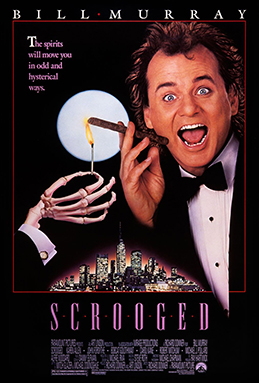
Last week when I wrote that Muppet's Christmas Carol is the best version of the Ebeneezer Scrooge story, loyal reader Rick-O asked, "What about Scrooged?"
Scrooged is like Ebeneezer's story, but it follows the journey of Frank Cross (Bill Murray) that is parallel but not exactly like A Christmas Carol.
One of the reasons Scrooged works so well is that it is hysterical. Bill Murray milks every ounce of humor from every quip and every glance. To this day, I can't help but smile as the elves go for their automatic machine guns.
And the movie is not afraid to go to dark places. The scene with Herman under the sidewalk is sad and more than a little creepy. It hits you like a stomach punch and you feel its gravity. I was surprised at how seriously that scene was taken. Murray's humor is an outlet for his guilt and rage.
But what puts this movie over the top is the closing monologue. The last 10 minutes of the movie are Murray preaching to the audience the meaning of Christmas. This should be the place where the story comes to screeching halt. The rule in movies is "show, don't tell." I don't know what the screenwriters were thinking. But it works! It works amazingly. And I credit it completely to Murray's performance. His conversion from cynicism to optimism feels real and draws you in. And you feel like you've learned something too about Christmas
And it is a special movie that can get an entire movie theater of strangers singing at the end.
#1 It's A Wonderful Life
This is not only the best Christmas movie ever made, it is also in my top ten films of all time. I don't think I can do justice to how amazing this movie is in a few short words.
A few weeks ago, my wife took me to see this movie on the big screen, something I had never done before. And even though I've seen it dozens of times, I was completely mesmerized. It is pure movie magic.
As a Catholic, I love that it starts with the collected prayers of the people of Bedford Falls. This is ultimately, the story of a man whose prayers have been answered. And I love the fact that God answers his prayers in a way that he doesn't expect. God has a knack for doing the unexpected and better thing.
If God had simply given George the $8,000, then he never would have realized what a wonderful life he was living. The point of the story is not the ending where the people give him the money (as the great John Nolte has pointed out). When he returns from seeing the alternate reality, all of George's problems remain: he's deaf in one ear, bleeding from a punch, and he's going to lose his business and his freedom. But even with all that, George is deliriously happy because he realizes that even with all of those problems, he still has a wonderful life: he has friends, he has a loving wife, and a treasure in his children.
Couple this story with a tour-de-force performance by Jimmy Stewart that runs the gambit from comical, to melodramatic, to insanity, you have a masterpiece of a film.
But the reason why it is so important is because it is still so relevant. We can relate to the problems of George Bailey, working hard making ends meet, struggling with our responsibilities to get through the day. But that is why it so important to take time, especially Christmas, to think about the gift of life God gave us and to reflect on how much we give that gift to others.
In the movie, George has a plaque underneath the picture of his father that says: "The only thing you can take with you is that which you give away." It's A Wonderful Life makes me want to be a better person.
I can't think of a better compliment to give a movie, especially the best Christmas movie of all time.
15 words or less film review (full review to follow soon) Great performances and interesting story help you stick with the moral struggles of immoral people. 3 and 1/2 out of 5 stars
The biggest complaint that The Hobbit - An Unexpected Journey received was that the beginning was too long. The follow up, The Hobbit - The Desolation of Smaug improves on that too much. Not only does it thrust you into the middle of the action (after a brief flashback), it also doesn't have an ending.
Let's back up.
The Desolation of Smaug takes place immeadiately after the events of the previous film. It starts with a flashback to a year earlier when Gandalf (Sir Ian McKellen) encounters the wandering Thorin Oakenshield (Richard Armitage) to inform him that there is a price on his head. Some dark force does not want Thorin to become "King Under The Mountain." One of the best things that these Hobbit movies are doing in terms of plot is to tie Thorin's venture in with the larger tapestry of Middle-Earth. Most of this is right from Tolkien's Appendecies, and they make an important addition to the story.
In the original book, the focus is entirely on the great treasure that the company hopes to claim from the dragon. While that is sufficient motivation for our heroes, it makes their motives more selfish than selfless. But by making the story about reclaiming a homeland and uniting against evil, without corrupting the original idea, Thorin's journey less about greed and more about reclaiming a lost home.
The main action begins as Thorin's company are still being pursued by Azog the Defiler. Along the way, they encounter the shape-changing Beorn (Mikael Persbrant). After this, they travel through the dangers of Mirkwood where they encounter all manner of dangers. This was one of my favorite parts of the film and it captured this section of the book beautifully. Afterwards they are accosted by the Woodland Elves, led by the haughty King Thranduil (Lee Pace), father of Fellowship member Legolas (Orlando Bloom). Also, we encounter a character invented for the movie, the she-elf Tauriel (Evangeline Lily ).
After a daring barrel escape (on of the silliest, but most fun sequences in the movie), they encounter Bard of Laketown (Luke Evans), who is the only honest resistance against a corrupt Master of Laketown (Stephen Fry) and his toady Alfrid (Ryan Gage). From there it is on to the Lonely Mountain to the inevitable confrontation with the dragon Smaug.
I apologize for the lengthy exposition, but this film covers so much story in the time that it has. And it is ironic that a story so long should not have an ending. Unlike the other Middle-Earth movies, there was a sense of character development, completion of story arcs, and at least some closer before the end. This film, however, stops at the height of action with so much left unresolved. I think this is a structural problem of turning a 2-Part series into a trilogy. There was no natural place to end the story and leave enough material for the 3rd movie.
Visually, I have nothing but good things to say about this film. I cannot emphasize enough - SEE THIS IN 48-FRAMES-PER-SECOND. I have seen it both in normal and high frame rate and the difference is mind-blowing. As I noted about the CGI characters in the last Hobbit movie, they felt much more tangible and real in 48-frames than in 24-frames. This is even more important because the dragon Smaug is all CG. In regular rate he look good. In 48-frames he was the best movie dragon I have seen.
Speaking of Smaug, the movie does an excellent job of not just making him an obstacle, but a force of nature. His sheer grandeur is terrifying. Benedict Cumberbatch does a fantastic job as the voice of the dragon, making him cruel and arrogant and dripping with venom. He plays with Bilbo (Martin Freeman) like a cat playing with his prey.
The last film introduced, arguably, too many characters at once. The only dwarves who stood out to me were Thorin, Balin (Ken Stott), Kili (Aidan Turner), and Bofur (James Nesbitt). This movie gives few more character moments to characters like Fili (Dean O'Gorman), who is next in line for the throne, Dori (Mark Hadlow) who acts as a medic, Gloin (Peter Hambleton) the father of Gimli and the violent Dwalin (Graham McTavish). Balin made the biggest impression on me, as he did in the book. He is the voice of wisdom and kindness and Ken Stott does an excellent job of giving the flair of a wise, old Scot.
Lily does a very good job as Tauriel and her chemistry with Turner's Kili is a welcome addition to the story. Also Evan's Bard is both kind and cunning, very reminiscent of Aragorn. And it was fascinating to watch Bloom play a much younger, more arrogant Legolas than when we saw him last.
However not every addition is good. Pace's Thanduil chews the scenery like he's one of the Volturi from Twilight. I know that we are not meant to like him, but I found his pouting distracting. Also the Master and Alfrid are there to act as comic relief. But like the Goblin King from the last film, they were not only unfunny, but they curbed away from the believability and realism Jackson has worked so hard to establish for Middle Earth.
If you've noticed, I haven't mentioned much of Bilbo. That is because he is in much less of this movie than the last. He is still in most scenes, but after Mirkwood he slips into the background until the 3rd act. This is a shame, because Freeman's Bilbo is wonderfully layered and rich. I always liked Freeman, but this series is showing his real range as an actor. Not only does he have wonderful comedic timing, but he can show great change in character with the smallest action. He does a great job of showing how the One Ring affects him and how appalled he is by its effect. I truly hope they bring him more into prominence for the final film.
While this story adds an element of silliness and humor to it that is more appropriate than in The Lord of the Rings, The Desolation of Smaug sets up some truly harrowing events in the final film. If you want to see a visual spectacle and lose yourself in Middle Earth for 3 hours, then see this film.
Just prepare yourself for the frustration of watching an incomplete story.