ReasonForOurHope

Thursday, July 11, 2024

Film Review: A Quiet Place - Day One


Sexuality/Nudity Acceptable

Violence Mature

Vulgarity Mature

Anti-Catholic Philosophy Mature


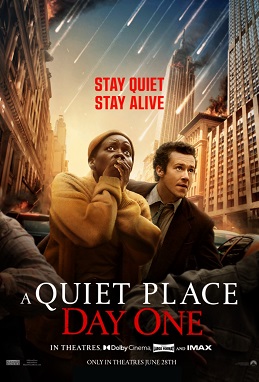
The biggest problem with A Quiet Place: Day One is that even though it is good, it suffers in comparisson to the first one.

This prequel takes place on the day of the alien invasion that destroys human civilization by the sound-hunting creatures from the previous films.  The movie centers on Samira (Lupita Nyong'o), a woman dying of cancer in a hospice.  She reluctantly takes a field trip to New York City in order to get a slice of pizza before she dies.  But then the invasion occurs.  The rest of the movie involves avoiding th monsters.  Along the way Samira comes across Eric (Joseph Quinn), a British law student who clings to her as she makes her way up North to Harlem for that last slice of pizza.  

The movie gets a lot of things right.  If you are looking for a movie with some fun thrills and some enjoyable tension, then this movie will hit the spot.  The performances are also excellent.  Nyong'o and Quinn are able to non-verbally convey the terror and rage at the situation in a way that draw you in.  Writer/Director Michael Sarnoski is able to adequetly adjust the series rural enviornments for the claustrophobic crowds of the city.  As this is Day One, it is intersting to watch the people slowly figure out how to survive.  There are also fun moments where you, as the audience, can see the sound levels getting too high without the characters realizing the danger they are in.  

The movie has two difficulties.

The first is the one mentioned at the beginning of the review.  The original film is primal in the way it approached its horror and its themes.  It struck a chord in a way few modern movies do.  This one tries to hit similar depths with its mediation on life and death with Samira's illness, but it doesn't land in the same way.  

The second involves the writing of the characters.  There was so little dialogue in the first, that the family had to be defined by their actions.  This embodied the power of the classic principle "Show, dont' tell."  But this movie begins with our charcters speaking and it feels like the writers try to get as much exposition in as possible before the silence begins.  At the beginning Samira is a mean person.  We know this not only from a mean poem she writes, but she explicitly says, "I'm a mean person."  

The character development also has issues becuase of the structure.  Eric doesn't come into the movie until about half-way through.  The actors do their best to make their connection strong, but it feels very thin.  Quinn's main job as a performer is to look terrified the entire time.  While that may make us empathetic, it doesn't give us much depth.  That isn't to say that he is a one-note coward.  We see him find his courage as he bonds to Samira.  And Nyong'o does the best she can moving through her stages of grief to acceptance, but again it feels like they could have dug a little deeper.  

Another reviewer noted that unlike the first film, we see the monsters much more clearly from the beginning.  As in the Alien franchise, the creatures are much scarier when they are shrouded in mystery.  

There are a number of nice subtle spiritual moments.  The main characters find themselves at one point in a church.  Even in the midst of this catastrophe, we can see a number of people bowing their heads in prayer.  The church also acts as a sanctuary and a place where our charcters come to realize what they are willing to risk for each other.  The other is that there is a very subtle allusion to David and Jonathan from the Bible, who exchange clothes as a sign of their friendship.  One of the most powerful non-verbal moments for me was how the two main characters clothe each other in their own garb as a way to pass on a part of each other.  I wouldn't say the movie is super Christian or pro-life, but there are some nice moments like these that are sticking with me.

If A Quiet Place: Day One had been the first in the franchise, it would still not be as good as the original.  But the comparisson does dim this movie's luster.  But taken for what it is, outside of its comparrison to the original, it is an enjoyable sci-fi thriller.


Star rating 3.5 of 5.png

Tuesday, July 9, 2024

Trailer Time: Agatha All Along (Disney+)


I'm not sure why they thought this show was a good idea.  In the desperate move by Disney to keep pumping out content, there are SO many other fascinating Marvel characters to choose from.

But I will say that the first minute of this trailer was pretty cool.  The serious tone of a police procedural which is interrupted by Marvel madness was a fascinating take.

And then the rest of the trailer happened.

The tone of the second half feels like something out of my least favorite MCU show: She-Hulk.  It feels like a lot of unfunny humor to follow the journey of a character that I don't really find that interesting.

But, as always, I am open to being wrong.

Thoughts?

Monday, July 8, 2024

Film Flash: A Quiet Place - Day One


undefined

15 words or less film review (full review to follow soon)


A fine sci-fi thriller, but not nearly as powerful as the first Quiet Place.

Star rating 3.5 of 5.png
 

Sunday, July 7, 2024

Sunday Best: Top Ten Movie Soundtracks of All Time

  A few weeks ago, a friend of mine (T. Martin) posted his list of his Top 10 Favorite Movie Soundtracks. 

In order to understand what we mean by this, I the topic into three categories.

CATEGORIES

The albums will be diveded into three categories:

1. Score - this will be focused on the instrumental music composed originally for the movie.

2. Soundtrack - this will focus on popular music used by the filmmakers.

3. Original Musical - this will focus on musical albums composed just for this film.


I already wrote about my top 20 movie scores.  Now, I am moving on to Soundtracks.  One of the things that surprised me was how many of the movies on this list are movies that I don't really enjoy.  But the soundtracks are fantastic and so I am ranking them based on those merits.


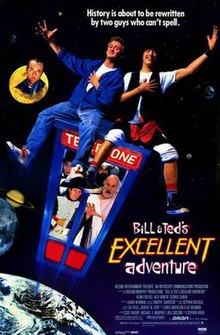
10.  Bill and Ted's Excellent Adventure

This soundtrack is one of the most underrated.  It is pure fun.  It has that retro-80's rock but with all the innocence of the main characters.  I cannot help but smile when I listen to this music.

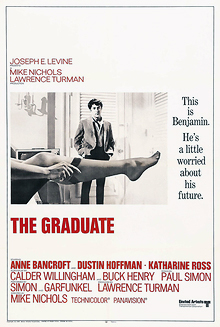
9. The Graduate

This is the first soundtrack on this list that is almost exclusively from one musical group.  It works so well because Simon and Garfunkle set the tone for the entire movie and fill the movie with so many of their now-classic songs that it amazes me that they are all in this movie.  "Sounds of Silence" is so evocative at the beginning and ending of the movie and it still resonates to this day.


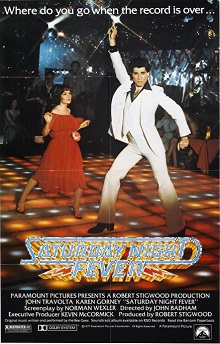
8. Saturday Night Fever

I really don't like this movie and I am not a fan of disco.  But the BeeGees completely owned this era with this soundtrack.  It is a testament to them that even though I don't care for this musical genre, I can appreciate all of the classic songs they made for this movie from "Stayin' Alive," "More than a Woman," "We Should Be Dancin," "Night Fever," and "How Deep is Your Love."

7. Pulp Fiction

A pulp-magazine themed poster shows with a woman in a bedroom lying on her stomach in a bed holding a cigarette. Her left hands lays over a novel that reads "Pulp Fiction" on it. An ash tray, pack of cigarettes, and a pistol is laid down near her. The top tagline reads "WINNER - BEST PICTURE - 1994 CANNES FILM FESTIVAL". A sticker below the title reads "10¢".

There is something about this soundtrack that feels very much of that specific time in movies.  It has this strange ecclectic mix of nostalgic songs like "Son of a Preacher Man" and "You Never Can Tell."  But it also has some cool covers like Urge Overkill's "Girl You'll Be a Woman Soon."  Tarantino knew how to use music to give a specific feel for his movie that is unique.


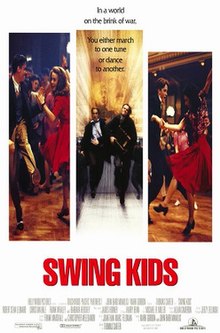
6. Swing Kids

Back in the late '90's there was a resurrgence of interest in Swing music and Swing dancing.  But years before that, there was Swing Kids.  Not only was it a fantastic movie, but it did something that I didn't think was possible: it made Swing music cool.  In the context of the movie, you could see the energy and life and rebellion found in the music.  Before, listening to Swing music would make me think of the older generation and it felt mild.  But now whenever I hear it, I feel the need to get up and dance.

5. Forrest Gump

Film poster with a white background and a park bench (facing away from the viewer) near the bottom. A man wearing a white suit is sitting on the right side of the bench and is looking to his left while resting his hands on both sides of him on the bench. A suitcase is sitting on the ground, and the man is wearing tennis shoes. At the top left of the image is the film's tagline and title and at the bottom is the release date and production credits.

This soundtrack is like a tapestry of American music from the '50's through the '80's.  Zemeckis was able to find music that captured the different times and eras of the main character's life.  There is something about how the music has a way of transporting you across time.

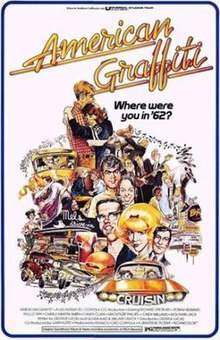
4.  American Graffiti

I believe George Lucas was the one who really pioneered the use of movie soundtracks with this film.  And his use of the music is sometimes so subtle that you barely notice its effects.  But the songs he chose were so specific to that time of his life and they are filled with a fun and innocence that seems to be lost.  When you listen to it, you can feel the culture of the time before the counter-cultre of the middle '60's.


3.  Dirty Dancing

I detest this movie, which has one of the most morally corossive themes of any film.  But the soundtrack is amazing.  What is strangely special about it is that the music is about young desire and romance, but the music is innocent while the movie is illicit.  It's like the innocence of the music sanitizes the horrible morals of the film.  That is a testament to the power of that soundtrack: it has the power to make you feel good.


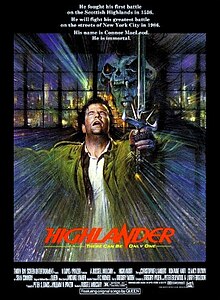
2. Highlander

Some will object to this soundtrack being so high on the list, but Queen outdid themselves with their soundtrack to this movie.  They bring you the heights of human grandeur ("Here we are/ born to be kings we're the princes of the universe!") to the depths of utter despair ("Who wants to live forever when love must die...").  As much as I love Queen, this might be some of my favorite work they have done.


11.  Footloose

undefined

Every song on this Soundtrack is great.  It is pure 1980's pop, but it is filled with such pure joy.  Even the super cheesy songs like "Dancing in the Sheets" have such a silliness to it that I can't help but smile.  I am not ashamed to say that "Never" still gets my blood pumping and makes me wish I could dance like Kevin Bacon (or is dancing double).  And that title song is such a great opening and closing song that it always fills me with joy.


HONORABLE MENTIONS;

-Can't Hardly Wait

-Breakfast Club

-Grosse Pointe Blank

-Guardians of the Galaxy

-The Karate Kid

-Resevoir Dogs

-The 40-Year-Old Virgin

-Juno

-When Harry Met Sally.


Thoughts?


Saturday, July 6, 2024

Film Review: Horizon - An American Saga Chapter 1


Sexuality/Nudity Mature

Violence Mature

Vulgarity Mature

Anti-Catholic Philosophy Acceptable

It is odd to start a review with a few disclaimers, but I think it is warrented for a unique movie like Horizon.

Horizon is not one movie.

It is 4 movies.  Or rather, it is the first part of 4 movies.

Kevin Costner has set out to do something that is so wildly ambitious that I cannot really think of an equivelant.  He is essentially taking the old-school mini-series format and applying it to the cinema.  

If that does not sound like the kind of movie experience that you can handle, then this movie may not be for you.  

And when I make the comparison to the mini-series, I am calling to mind the great epics like North and South.  But it is important to remember that Costner wants this to be a cinematic experience, not one that feels like it was made-for-tv.  If you can give yourself over to that concept, then I think you will enjoy this movie very much.

There are several stories at play here in this movie.  All of them have a tangential connection to a place called "Horizon."  This is an area of land out west that is being sold to settlers before and during the Civil War.  Somehow the stories seem to be interlinked.  Below are some of the basic plots:

-The settlers of Horizon are subject to a brutal night raid by the Apache led by the headstrong Pionsenay (Owen Crow Shoe).  This attack is told primarily through the eyes of the Kittredge Family: father James (Tim Guinee), mother Frances (Sienna Miller), son Owen (Will Patton), and daughter Elizabeth (Georgia MacPhail).  In the aftermath, the nearby Union fort sends Lt. Trent Gephart (Sam Worthington), to bury the dead and escort the lost back to the fort.  To his chagrin, very few choose to leave but instead face the dangers of the wilderness.  This story then branches into one that follows Gephart and the survivors and one that forms a posse to find the Apache.  In addition, Pionsenay comes under the ire of his elder Tuayeseh (Gregory Cruz), who can see more bloodshed coming because of Pionsenay's actions.

-Another story involves a wagon train of settlers heading towards Horizon.  The reluctant leader is Matthew Van Weyden (Luke Wilson), who tries to keep everyone safe and moving through the dangerous wilderness.  He is particularly annoyed with a posh English couple Juliette (Ella Hunt) and Hugh (Tom Payne) who are not pulling (to Matthew's mind) their fair share.  But tensions rise as some of the move violent men of the group begin to lear menacingly at Juliette.

-Another story involves Lucy (Jena Malone) who shoots the patriarch of a Montana family for what appears to be years of a abuse.  She escapes with her child but is pursued by the man's sons: Junior  (Jon Beavers) and Caleb (Jamie Campbell Bower).  These violent men will stop at nothing to exact revenge.

-Another story involves Hayes Ellison (Costner) who finds himself in a small mining town and involved in a life-and-death situation involving the local prostitute Marigold (Abbey Lee)


If that sounds like a lot of plot threads, it is.  And even with its more than three-hour run time, the story doesn't feel like it scratches the surface.  But I have to tell you, the story never drags.  There were times that I felt the need to excuse myself to the restroom, but I resisted because I didn't want to miss anything.  Unlike a lot of TV shows where there appear to be a lot of filler scenes, this movie uses every scene to either advance the plot or deepen our understanding of the character.

Costner famously won an Oscar for directing Dances with Wolves, and the beauty he captured on screen is present in Horizon.  We see the West through Costner's eyes: a place that is as beautiful as it is dangerous, as enchanting as it is deadly.  There were several times where I wanted to pause the movie just to look at the majestic vistas.  In my review of The Bikeriders, I mentioned that the film makers never showed us why the life presented on screen was appealing.  But Costner is able to capture the appeal of the West.  There is something satisfying, wholesome, and honest about wanting to pull yourself up by your bootstraps and create a better, freer, simpler life for your family.  In the town of Horizon before the attack, you could see the joy people had at having a piece of that American Dream.  

But Conster's view is not one of rose-colored nostalgia.  The attack on Horizon is brutal in every way imaginable.  And no one is safe.  The story subverts expectations, but in a way that is trying to draw you in rather than trying to show off.  There is another slaughter elsewhere in the movie that is just as brutal.

One of the smartest things Costner does with this movie is that he trusts the audience to make up its own mind about the events and the characters.  Is Pionsenay justified in his attack or not?  Is the response justified or not?  Costner trusts you to decide these complex things for yourself.  At one point, one of the characters begins to be disgusted by seeing a slaughter of Indegenous people.  But when he is attacked by them, he does not hesitate to empty his rifle at his enemy.  The characters are filled with fascinating contradications.  

There are some strong Catholic images in the beginning of the film where we set up a mediation on the nature of violence and the possibility of rising above it.

The only really strong thematic stance that he seems to have is on the need for strong, virtuous men.  The strong men who are not virtuous are villanous.  The pain and horror of the West is inflicted by these men.  But weak, virtuous men are also looked down upon by Costner.  When these men try to stand up and protect the ones for whom they have responsibility, they fail.  Costner's disgust for their weakness is evident.  The movie clearly wants to say that in a violent, fallen world, men need to be good and dangerous.  This is best exemplified in a scene with Hayes as he walks up a hill to meet with Marigold.  A stranger begins a conversation with him that seems merely annoying.  But by the end, Hayes understands that he will have to take action, perhaps deadly action to do what must be done.

All of the performances are great.  There is not a bad one in the group.  This is the best performance I have seen Worthington give, where his restrained nature works well for the character.  MacPhail also took me by suprise.  Usually young actors are rough around the edges, but she does quiet a lot with very little.  The cast rounded out by some wonderful veteran performances from Danny Huston, Michael Rooker, and Jeff Fahey.

My biggest critique of the movie is that it ends so abruptly that I didn't realize that it was ending.  The final scene moves without indication into a trailer for the next film.

I keep thinking about this movie and I am very happy that I only have to wait until August to see Part II in the cinema


Thursday, July 4, 2024

The Declaration of Independence - 248 Years Ago Today

    (most of the text below is a repost from last year)

File:Writing the Declaration of Independence 1776 cph.3g09904.jpg

Below is the entire text of the Declaration of Independence.  I believe it to be one of the most
audacious and revolutionary documents in history (pun in intended).

I have always loved my country.  But as a philosopher one of the things that I marvel 
at is that  the United States is a country built on an idea.

 Ideas matter.

Freedom is in our nature.  No tyrant, no government can take that away.

I encourage you to read the entire text below on this birthday of our nation.  Particularly, I am struck by the last line:

And for the support of this Declaration, with a firm reliance on the protection of divine Providence,  we mutually pledge to each other our Lives, our Fortunes and our sacred Honor.

Those who wrote their names on that document held up as collateral for the investment in our freedom:

1.  Their Lives.  I am humbled when I remember that so many gave much more than I will
ever give so that people like me could live free.  The only way we can hold onto our freedom is if men and women are willing to pay the ultimate price.  Too often tyrants, both fearsome and soft-spoken, try to snatch away our freedom.  They depend on us to lay down our resistance and give in.  We must never do so.  The Founding Fathers gave us that pledge.

2.  Their Fortunes.  I will likely never see combat.  But how do I spend my money to
ensure freedom?  Do I take care of our wounded warriors?  Do I support laws and
representatives I believe in with my capital?  And do I take payments from those who
would make me dependent?  This pervasive bribery must lead inexorably to subtle slavery.

3.  Their Sacred Honor.  Do we even believe in honor anymore today?  Does our name mean anything?  In A Man for All Seasons, when asked why he would not take an oath of
loyalty to Henry VIII, Thomas More said, "When a man takes an oath, 
he’s holding his own self in his hands. Like water.  And if he 
opens his fingers then — he needn’t hope to find himself again." 
 We are free and we must stand by our commitments. 
 Otherwise who we are, our name, means nothing.  

These great men signed their names to this document. 
 For each of them it may have been a death sentence.
  But they signed it nevertheless.  They their day they
 took a stand against tyranny and stood for freedom.

In their day they stood as men.

Today they stand as giants.

And the challenge of today is this: could we stand with them?

Do we have what it takes to be the patriots at Valley Forge or the resistance at Boston Harbor?  Does that same noble spirit of freedom stir in us?

Or do we stand with those who try to tear down their memory to only have us remember their faults and failings and not the fact that they gave us the greatest nation that the world has ever known?

Perhaps reading this document again will renew and refresh the spirit of liberty.


File:United States Declaration of Independence.jpg

IN CONGRESS, July 4, 1776.
The unanimous Declaration of the thirteen united States of America,
When in the Course of human events, it becomes necessary for one people to dissolve the political bands which have connected them with another, and to assume among the powers of the earth, the separate and equal station to which the Laws of Nature and of Nature's God entitle them, a decent respect to the opinions of mankind requires that they should declare the causes which impel them to the separation.
We hold these truths to be self-evident, that all men are created equal, that they are endowed by their Creator with certain unalienable Rights, that among these are Life, Liberty and the pursuit of Happiness.--That to secure these rights, Governments are instituted among Men, deriving their just powers from the consent of the governed, --That whenever any Form of Government becomes destructive of these ends, it is the Right of the People to alter or to abolish it, and to institute new Government, laying its foundation on such principles and organizing its powers in such form, as to them shall seem most likely to effect their Safety and Happiness. Prudence, indeed, will dictate that Governments long established should not be changed for light and transient causes; and accordingly all experience hath shewn, that mankind are more disposed to suffer, while evils are sufferable, than to right themselves by abolishing the forms to which they are accustomed. But when a long train of abuses and usurpations, pursuing invariably the same Object evinces a design to reduce them under absolute Despotism, it is their right, it is their duty, to throw off such Government, and to provide new Guards for their future security.--Such has been the patient sufferance of these Colonies; and such is now the necessity which constrains them to alter their former Systems of Government. The history of the present King of Great Britain is a history of repeated injuries and usurpations, all having in direct object the establishment of an absolute Tyranny over these States. To prove this, let Facts be submitted to a candid world.
He has refused his Assent to Laws, the most wholesome and necessary for the public good.
He has forbidden his Governors to pass Laws of immediate and pressing importance, unless suspended in their operation till his Assent should be obtained; and when so suspended, he has utterly neglected to attend to them.
He has refused to pass other Laws for the accommodation of large districts of people, unless those people would relinquish the right of Representation in the Legislature, a right inestimable to them and formidable to tyrants only.
He has called together legislative bodies at places unusual, uncomfortable, and distant from the depository of their public Records, for the sole purpose of fatiguing them into compliance with his measures.
He has dissolved Representative Houses repeatedly, for opposing with manly firmness his invasions on the rights of the people.
He has refused for a long time, after such dissolutions, to cause others to be elected; whereby the Legislative powers, incapable of Annihilation, have returned to the People at large for their exercise; the State remaining in the mean time exposed to all the dangers of invasion from without, and convulsions within.
He has endeavoured to prevent the population of these States; for that purpose obstructing the Laws for Naturalization of Foreigners; refusing to pass others to encourage their migrations hither, and raising the conditions of new Appropriations of Lands.
He has obstructed the Administration of Justice, by refusing his Assent to Laws for establishing Judiciary powers.
He has made Judges dependent on his Will alone, for the tenure of their offices, and the amount and payment of their salaries.
He has erected a multitude of New Offices, and sent hither swarms of Officers to harrass our people, and eat out their substance.
He has kept among us, in times of peace, Standing Armies without the Consent of our legislatures.
He has affected to render the Military independent of and superior to the Civil power.
He has combined with others to subject us to a jurisdiction foreign to our constitution, and unacknowledged by our laws; giving his Assent to their Acts of pretended Legislation:
For Quartering large bodies of armed troops among us:
For protecting them, by a mock Trial, from punishment for any Murders which they should commit on the Inhabitants of these States:
For cutting off our Trade with all parts of the world:
For imposing Taxes on us without our Consent:
For depriving us in many cases, of the benefits of Trial by Jury:
For transporting us beyond Seas to be tried for pretended offences
For abolishing the free System of English Laws in a neighbouring Province, establishing therein an Arbitrary government, and enlarging its Boundaries so as to render it at once an example and fit instrument for introducing the same absolute rule into these Colonies:
For taking away our Charters, abolishing our most valuable Laws, and altering fundamentally the Forms of our Governments:
For suspending our own Legislatures, and declaring themselves invested with power to legislate for us in all cases whatsoever.
He has abdicated Government here, by declaring us out of his Protection and waging War against us.
He has plundered our seas, ravaged our Coasts, burnt our towns, and destroyed the lives of our people.
He is at this time transporting large Armies of foreign Mercenaries to compleat the works of death, desolation and tyranny, already begun with circumstances of Cruelty & perfidy scarcely paralleled in the most barbarous ages, and totally unworthy the Head of a civilized nation.
He has constrained our fellow Citizens taken Captive on the high Seas to bear Arms against their Country, to become the executioners of their friends and Brethren, or to fall themselves by their Hands.
He has excited domestic insurrections amongst us, and has endeavoured to bring on the inhabitants of our frontiers, the merciless Indian Savages, whose known rule of warfare, is an undistinguished destruction of all ages, sexes and conditions.
In every stage of these Oppressions We have Petitioned for Redress in the most humble terms: Our repeated Petitions have been answered only by repeated injury. A Prince whose character is thus marked by every act which may define a Tyrant, is unfit to be the ruler of a free people.
Nor have We been wanting in attentions to our Brittish brethren. We have warned them from time to time of attempts by their legislature to extend an unwarrantable jurisdiction over us. We have reminded them of the circumstances of our emigration and settlement here. We have appealed to their native justice and magnanimity, and we have conjured them by the ties of our common kindred to disavow these usurpations, which, would inevitably interrupt our connections and correspondence. They too have been deaf to the voice of justice and of consanguinity. We must, therefore, acquiesce in the necessity, which denounces our Separation, and hold them, as we hold the rest of mankind, Enemies in War, in Peace Friends.
We, therefore, the Representatives of the united States of America, in General Congress, Assembled, appealing to the Supreme Judge of the world for the rectitude of our intentions, do, in the Name, and by Authority of the good People of these Colonies, solemnly publish and declare, That these United Colonies are, and of Right ought to be Free and Independent States; that they are Absolved from all Allegiance to the British Crown, and that all political connection between them and the State of Great Britain, is and ought to be totally dissolved; and that as Free and Independent States, they have full Power to levy War, conclude Peace, contract Alliances, establish Commerce, and to do all other Acts and Things which Independent States may of right do. And for the support of this Declaration, with a firm reliance on the protection of divine Providence, we mutually pledge to each other our Lives, our Fortunes and our sacred Honor.

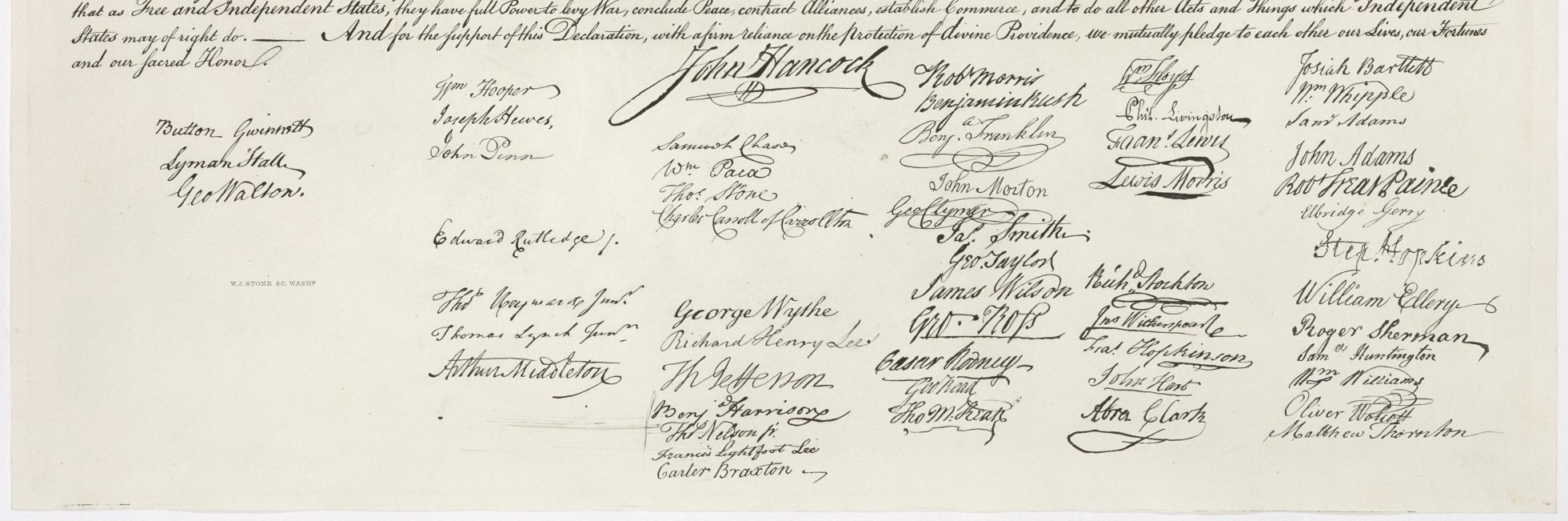
The 56 signatures on the Declaration appear in the positions indicated:

Column 1
Georgia:
   Button Gwinnett
   Lyman Hall
   George Walton
Column 2
North Carolina:
   William Hooper
   Joseph Hewes
   John Penn
South Carolina:
   Edward Rutledge
   Thomas Heyward, Jr.
   Thomas Lynch, Jr.
   Arthur Middleton
Column 3
Massachusetts:
John Hancock
Maryland:
Samuel Chase
William Paca
Thomas Stone
Charles Carroll of Carrollton
Virginia:
George Wythe
Richard Henry Lee
Thomas Jefferson
Benjamin Harrison
Thomas Nelson, Jr.
Francis Lightfoot Lee
Carter Braxton
Column 4
Pennsylvania:
   Robert Morris
   Benjamin Rush
   Benjamin Franklin
   John Morton
   George Clymer
   James Smith
   George Taylor
   James Wilson
   George Ross
Delaware:
   Caesar Rodney
   George Read
   Thomas McKean
Column 5
New York:
   William Floyd
   Philip Livingston
   Francis Lewis
   Lewis Morris
New Jersey:
   Richard Stockton
   John Witherspoon
   Francis Hopkinson
   John Hart
   Abraham Clark
Column 6
New Hampshire:
   Josiah Bartlett
   William Whipple
Massachusetts:
   Samuel Adams
   John Adams
   Robert Treat Paine
   Elbridge Gerry
Rhode Island:
   Stephen Hopkins
   William Ellery
Connecticut:
   Roger Sherman
   Samuel Huntington
   William Williams
   Oliver Wolcott
New Hampshire:
   Matthew Thornton


Monday, July 1, 2024

New Evangelizers Post: Jesus and the Rich Man Part 3


I have a new article up at NewEvangelizers.com.  

Peter then states that, “We have given up everything and followed you.” (Mk 10: 28) In Matthew’s Gospel, this statement is followed up with, “What shall we have, therefore?”(Mt 19:21) This question appears to be implied from this statement of Peter’s in both Mark and Luke. This shows that the disciples still did not understand the spiritual foundations of Christ’s teaching. Culturally, this would have been very difficult for them. As mentioned earlier, wealth was considered a blessing from God. In addition, notions of the Messianic Age that were popular at this time held that there would be increased worldly prosperity for His followers, not poverty and privation.

Jesus responds by addressing those who have “given up house or brothers or sisters or mother or father or children or lands for my sake and for the sake of the Gospel…” (Mk 10:29). As mentioned earlier, the disciples would have had to leave their houses and property to follow Jesus. In Mark’s Gospel, we know at least that Peter is married from the account of the cure of his mother-in-law (Mk 1:29-31). Jesus also addresses the loss of earthly familial relationships. This is parallel to the scene earlier in Mark’s Gospel where Jesus’ family think He is out of His mind and try to take Him. Jesus’ response is, “Whoever does the will of God is my brother, and sister, and mother.” (Mk 3:35) In this passage, Jesus is showing that even if His own earthly family rejects Him, He will have a new, much larger family in the spirit. This saying, which Jesus applied to Himself, is now applied to the rest of the disciples who have also “given up” their family relations for the sake of spiritual ones. They will receive “a hundred times more now in this present age…and eternal life in the age to come.” (Mk 10:30) Jesus is not just speaking about an apocalyptic time (the age to come), but of the time of a person’s earthly life in the Church (the present age). The word here for “age” could be translated in this term of time or it could be translated in terms of space (“world to come”).

When speaking of what the disciples will gain, it is of note that he says they will gain “houses and brothers and sisters and mothers and children and lands…” (Mk 10:30) But omitted from this recompense are “fathers,” even though they are mentioned as those that have been sacrificed for the sake of the Gospel. In the above passage from Mark 3:35 regarding Jesus and His family, He also does not mention a “father” in those who do the will of God. One explanation for this is that this lack of a father represents an anti-patriarchal view of how the Christian community should be organized. In the ancient world, the father acted as the head overseer of the household. Without a father, it could imply that the community was supposed to be completely egalitarian within its structure, where no disciple had some kind of patriarchal authority over another. In the stories of “The Greatest in the Kingdom” (Mk 9:33-37) and “The Ambition of James and John” (Mk10: 35-45), we can see Jesus addressing controversies regarding titles of rank in leadership. The absence of the “father” reference in the community would be harmonious with Christ’s point that leadership is a leadership of service.

In the final lines of the passage, we once again have a reference to “eternal life.” We can see that Mark begins with the rich man’s question, “Good Teacher, what must I do to inherit eternal life?” And now Mark is ending with a direct answer to that question. It also serves as a final contrast to the disciples who answer the call and of the one rich man who does not. Jesus’ final statement in this passage is, “But many that are first will be last, and the last will be first.” (Mk 10:31) This last statement is a warning to the disciples to whom He is addressing this message. Just because you are among the first to be called or the closest to Him, this “does not necessarily give them preeminence, nor any exclusive right to the blessings promised by him.” It also once again subverts the common view of the relationship between wealth and beatitude.

From a pastoral perspective, I would concentrate on three aspects of the story. The first would be that of impediments to the call. I would share with a congregation that all of us are called to follow Jesus, but we need to reflect on what is holding us back. In the case of the rich man, it was his possessions. As someone who loves material things (I am a collector of toys and comics), I understand this struggle. Am I able to prioritize God and others before my own material possessions? As the story points out, the giving of the possessions is necessary for the spiritual perfection of the man. But for many of us, material wealth may not be that obstacle. But if anything is preventing us from following Christ, we should consider if we will be like Peter and the disciples or like the rich man.

You can read the whole article here.