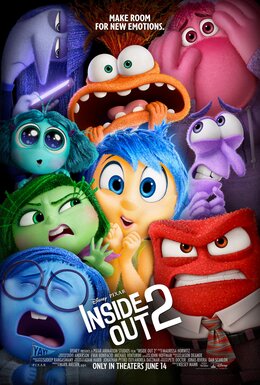
15 words or less film review (full review to follow soon)
Best PIXAR movie since Toy Story 3. Insightful, moving, and family-friendly allegory of adolescence


15 words or less film review (full review to follow soon)

“At that statement his face fell, and he went away sad, for he had many possessions.” (Mk 10:22) This story is a foil to the discipleship calls found earlier in the Gospel. In Mark 1, Peter, Andrew, James, and John are called by Jesus, and they drop everything to follow Him. When Jesus calls Levi to discipleship, he also drops everything to follow Him. Here we have a similar call to discipleship, but this time we have someone who does not respond positively to the call. He goes away tragically sad because of his many possessions.
The other disciples mentioned above did not seem to come from great wealth (though Levi was a tax collector). This is not to say that they were destitute. Archaeological evidence of fisherman houses at Capernum shows that they were quite sizable. The implication seems to be that the danger of great wealth is that it becomes very difficult to let go of it for the sake of Jesus.
The rich man encounters Jesus as He is setting out on a journey. We see later in the chapter that they are on their way to Jerusalem and stop in Jericho. In Jericho, there would have been a great divide among the rich and the poor. It would make sense for Jesus to address this disparity with his disciples before entering into an area of such strong economic disparity. It has also been theorized that Mark makes use of this moment as a reminder to his own community. The audience to whom Mark is writing may have had similar issues regarding wealth disparity. There may have been some in the community with abundance while others were in poverty. This dialogue would serve to remind Mark’s audience about the need of those with more to come to the aid of those with less.
After the rich man leaves, Jesus begins a dialogue with His disciples about wealth. “How hard it is for those who have wealth to enter the Kingdom of God.” (Mk 10:23). The reaction of his disciples is that they were “amazed.” (Mk 10:24). They are then “astonished” (Mark 10:26) when Jesus uses a now-famous analogy to describe this difficulty: “It is easier for a camel to pass through [the] eye of [a] needle than for one who is rich to enter the kingdom of God.” (Mk 10: 25)
To return to the idea that the disciples were “astonished” and “amazed,” we should take note of how wealth was traditionally viewed by the 1st Century Jewish community. Those who had money were generally viewed as blessed by God. The material success was understood generally as a reward for faithfulness. Therefore, it would have been exceedingly shocking to the Jewish listener to hear Jesus say these words. In their minds, the wealthy were those who were closer to God. But here, Jesus describes wealth as an impediment to salvation.
A few weeks ago, a friend of mine (T. Martin) posted his list of his Top 10 Favorite Movie Soundtracks. This got me thinking about what my own list would be, but I ran into a number of problems.
1. What categorizes a soundtrack?
Are we talking about the score or the use of popular music? Because these are two radically different things. And what about original movie musicals?
2. What about the mixed soundtrack?
How many movies have a mix of original scores and popular music. Do they both get credit as being great if one is an original composotion and the others are not?
3. The John Williams problem?
Any list of the greatest scores is going to be dominated by the mighty John Williams. How could it not be? But that would make most lists very boring to write about.
4. High subjective emotional responses?
Music is the most emotionally targeted of the arts. Assesments of a soundtrack's quality will depend greatly on the emotional reception of the listener.
5. Great pieces or the whole album?
There are some fantastic pieces of music found in movies that may be surrounded by a mediocre score. For example, the movie The Switch has an utterly charming little score called "Lice," but the rest of the soundtrack is not very good. But because I am moved by that one score, do I elevate the rest of the soundtrack?
With this in mind, here is what I have decided:
CATEGORIES
The albums will be diveded into three categories:
1. Score - this will be focused on the instrumental music composed originally for the movie.
2. Soundtrack - this will focus on popular music used by the filmmakers.
3. Original Musical - this will focus on musical albums composed just for this film.
In regards to score, because John Williams is so dominant, I have decided to do a list of Top 20 instead of Top 10 so that there will be a better spread.
In regards to albums that have both score and soundtrack items, I will decide if any of them rise to the level of greatness in either category (or potentially both).
I've also decided to focus on the entire album. For example the main theme to Back to the Future is amazing. The rest of the score is good, but does not reach the same level. To be on the list of best scores, not every track as to be good, but enough of them to warrant mention of the entire album.
With that, here are the Top Movie Scores #20-#11
20. Henry V - Patrick Doyle
This is a score that made me take notice. He puts potent danger in the presence of the monarchy as well as the solemn melencholy of military campaigns. He places in there the sweeping epic of the topic. But it is his score for the Agincourt speech that never ceases to uplift.
19. Star Wars Episode III: Revenge of the Sith - John Williams
It is so difficult to decide between Star Wars scores. But this one not only captures some of the almost religious overtones of the story, it maintains its roots in grand action set pieces. Williams knows when how to put a pit into your stomach with "Padme's Ruminations." But "Battle of the Heroes" is one of the best Star Wars themes that never fails to conjur up the movie to my mind in vivid detail
18. Jurassic Park - John Williams
I remember being in the theater when that bombastic score played as the helicopter first came to the island. I knew then that I was watching something special. But then Williams outdid himself by giving us a strong sense of wonder in song as we see the dinasaurs. The rest of the score skillfully moves through various emotions from adventure to terror with the skill only Williams has.
17. Jaws - John Williams

Everyone knows the iconic theme for the shark. But the rest of the score is incredibly touching for a movie that should (on paper) only have been B-movie schlock. Listen to the incredible tenderness in the scene with Brody and his son at the table. Hear the high-seas adventure in the "Shark Cage Fugue." And listen to the slow forboding of Quint's tale.
16. Indiana Jones and the Last Crusade - John Williams
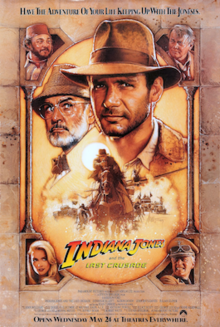
The entire score is wonderful to listen to. Williams puts so many little flourishing themes into each piece like the "Cross of Coranado" or the "Grail" theme. He mixes them in expertly along with the classic score while touching on the comedic aspects of the father-son relationship. What amazes me is that there are times when he hits an incredibly exciting muscial flourish but never leans on it too heavily, as when Indy is riding up to the tank on his horse. Others may disagree (and I respect the difference) but I think this is the best Indiana Jones score
15. Rocky - Bill Conti
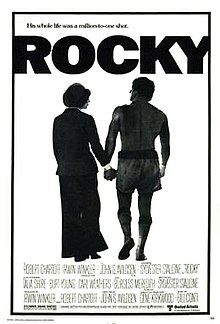
Of course the big themes are the ones that people remember from this movie and rightly so. Conti did something kind of a incredible: he gave us a timelss score that is clearly tied to that specific era. It is a 1970's sound that is effective in all ages. It shouldn't work but it does. The main theme is also incredibly versatile in how he uses it in different tempos and tones to get across subtle and not-so-subtle changes in emotion.
14. Lars and the Real Girl - David Torn

This will probably be my most controversial choice on the list. This comes from a small movie and the music is comprised mostly of light piano, strings, and accordians. But it is amazing how this quircky collection of sounds can be so deeply beautiful and effective. Every time I hear the "Lars and Margo" theme, my heart breaks a litte. Even the smaller pieces like "Karin Accepts Him" have this fairytale-like quality that helps elevate this small movie.
13. The Lord of the Rings: The Return of the King - Howard Shore
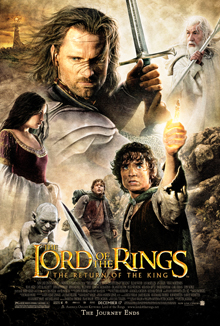
For "Into the West" alone, this album belongs here. But Howard Shore creates an epic sound worthy of the movie that it comes from. Every piece of music captures the granduer and drama of what is placed before us on screen. How seemlessly he goes from tragedy to triumph to heartbreak in just a few notes without ever feeling false. Beautiful.
12. Star Wars Episode I: The Phantom Menace - John Williams

I cannot tell you how many times I listened to this score over and over again in my car. For sixteen years we were hungry for more Star Wars. And while some people dislike The Phantom Menace, Williams gave us some of the Saga's best music. "Duel of the Fates" is forever in the top movie themes of all time. But the entire score is filled with thrills and dark flourishes. But what I think is the most brilliant and subversive part is how the "Emperor's Theme" is woven into "Augies Great Municipal Band," thus telling the audience that the victory they are celebrating is really a defeat.
11. The Shawshank Redemption - Thomas Newman
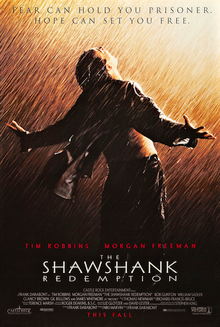
One of the thankless jobs of a score is that it has to capture the feeling of a movie even when it is not pleasent. A lot of the prison drudgery is captured wonderfully by Newman. The horror and sadness and suspense are all there too. You can hear the sands of time running out during "Brooks Was Here," like a melencholy music box. But then he uplifts you with that finally that doesn't feel cheap, but a well-earned rise out of darkness.
Stay tuned for my Top 10.

"The Dark Side of the Force is the pathway to many abilities some consider to be... unnatural."
There has been a lot of talk about the new Star Wars TV show The Acolyte. Critics love it, giving it an over 90% score on Rotten Tomatoes. Most old school fans of the Saga seem to hate it, calling it the worst thing since The Last Jedi. Is either side correct or is the truth somewhere in the middle?
Bottom line: The Acolyte is not good.
But it is not She-Hulk level bad.
This review will be SPOILER HEAVY because there is really no way to talk about this show without talking about the plot points.
The story revolves around the murder of Jedi. I would say it is a murder mystery, but the show reveals the murderer part way through the first episode. The mystery is not who the killer is but why. And this too does not feel to be very deep.
The murderer is Mae (Amandla Stenberg) who is hunting certain Jedi for a past crime against her. She is under the tootalge of some dark force user (hence the title of the show). Her twin sister Osha (also Stenberg) is a dropout Padawan who is arrested mistakenly for Mae's crime. She encounters her former master Sol (Lee Jung-Jae), former fellow Padawan-now-Jedi-Knight Yord (Charlie Barnett) and Sol's current Padawan Jecki (Dafne Keen). Together they try to track down Mae before she kills again.
The first episode was mostly boring. Osha is essentially Rey 2.0. She is smarter than everyone around her, especially concerning technology and seems to be the key to everything. Mae also seems to have very little personality other than angry. Yord and Jecki also seem to have an absence of anything intersting about them. They try to have an MCU-type banter, but it feels very out of place. The only interesting character from that first episode was Sol, but he really only began to become intriguing in the second episode.
I do have to say that episode 2 was better than I expected. This is mostly due to Sol, who shows more depth than the other characters. Mae tries to assassinate a Jedi who is an impervious Force bubble in a state of meditation. Her solution is to talk him in to commiting suicide by drinking poison. Some critics found this plot point stupid. I actually found it a bit intriguing. She basically threatens to expose his past crimes or let him die with his secret. This points to some horrible sin of the Jedi.
The first two episode have a lot of plot contrivances that don't stand up to much scrutiny, but I do not want to nitpik.
Episode 3 is the one that seems to be drawing the most ire.
Here we learn Osha and Mae's origin. They are from a coven for all-female Force witches. Their leader Mother Aniseya used the Force to conceive the twins in the body of Koril (Margarita Levieva). They are training the girls to take over the ways of their order. They call the Force "the Thread" that weaves into the destinies of all and that some can "pull" on the Thread. Aniseya wants the girls to take the burden of their teachings onto them. But when Sol and other Jedi discover the girls, they invoke the right to have the children tested as Jedi. Mae doesn't want to leave and so tanks the test. Osha wants to be a Jedi and decides to leave. Mae decides to try to murder Osha by setting her room on fire. Osha escapes but finds that all of the other witches, including Aniseya, are dead. Sol tells her that Mae's fire killed them all.
A lot of people say that this ruins Star Wars. I would say that it doesn't do anything to win back fans lost by The Last Jedi. The fanbase of Star Wars is 70% male. This show is clearly designed at drawing in (as the Critical Drinker calls them) "modern audiences." But that which is modern is the soonest out of date.
The reason why The Last Jedi should be considered a bigger turn-off is that the philosophy antithetical to Star Wars was placed in the mouth of its biggest hero: Luke Skywalker. In Revenge of the Sith, Palpatine spoke Star Wars heresy, but was acceptable because he was clearly of the dark side.
Whether showrunner Leslye Headland means to or not, her Force witches are clearly evil. Their alternate view of the Force sounds like Palpatine saying "If one is to understand the great mystery, one must study all of it's aspects, not just the dogmatic, narrow view of the Jedi." This pretty much sums up the perspective of these witches. The clearest example of this is in the creation of the twins.
Palpatine told Anakin about that the "Dark Side of the Force is the pathway to many abilities some consider to be unnatural." Anakin's fall to the Dark Side is motivated by his desire to have control over things that he should not. He was a Jedi, but he wanted the power of a god. Palpatine tells Anakin about Darth Plagueis who was "so powerful and so wise, he could use the Force to influence the midichlorians to create life."
Aniseya and Koril have taken upon themselves the power of the Dark Side. Why is this such a problem. Mary Shelley's Frankenstein is subtitled The New Prometheus. Dr. Frankenstein sins because he tries to take the power of God and use it for his own ends. Aniseya and Koril are doing the exact same thing. This is also the reason why we Catholics condemn things like IVF, which rejects God's design for the creation of sacred human life and instead tries to take that power for ourselves. The Force Witches come off as horrific cultists who use wicked powers to produce children to indoctrinate.
Now, the show is clearly moving towards some kind of moral equivelancy between the witches and the Jedi. There is no doubt that Mae's fire did not kill all the witches. One of the Jedi was clearly battle-damaged from a confrontation. My guess is that it will be revealed that the Jedi attacked the witches and killed them all. Afterwards they each reacted to their crime in different ways.
To be sure the system of the Jedi is flawed. The Prequel Trilogy made this same point: the Jedi were too removed from human connection to see things clearly. This is why Qui-Gon Jinn was the model Jedi who knew when to defy the council and why Luke Skywalker embraces his connection to Anakin and ignores Yoda and Obi-Wan's directive to kill him. In The Acolyte, the taking of Force-sensitive children from their families is clealry a problem. But The Acolyte seems to be putting both the Light Side and Dark Side on the same footing.
This philosophical perspective is the biggest objection that most fans seem to have with this show. My biggest problem is that the show is just not very good. The characters outside of Sol are not that intersting. The visuals are decent, but not compared to season one of The Mandalorian. The performances are not very good outside of (again) Lee Jung-Jae as Sol. Carrie-Ann Moss is not in enough of the show to get a sense of her performance. Stenberg does not have the presence to draw in the audience in a compelling way. This could be a problem with the writing more than the acting. Thinking back to The Mandalorian, think about how much Pedro Pascal was able to compel us with just his body language and his voice under the writing and directing of Jon Favreau.
I'm going to continue to watch the show to see if it improves.
But I am not hopeful.
Sexuality/Nudity Mature
Violence Mature
Vulgarity Mature
Anti-Catholic Philosophy Mature
I can't say that I am a big fan of the Mad Max universe. I've only seen some of the Mel Gibson trilogy and it was not to my taste. I reluctantly saw Mad Max: Fury Road and I thought that it was excellent. I wrote back in 2015:
The insanity of the world created by writer/director George Miller belies an amazingly tight narrative. Most action movies are a series of different explosive action set pieces. Fury Road is essentially one long, exhilarating action chase scene.
Nearly a decade later, George Miller has given us a prequel to Fury Road to tell the story of one of the main characters of that movie: Furiosa. Unlike Fury Road, which has an incredibly tight narrative and (as one reviewer wrote) an economy of story), Furiosa is a character epic spanning many years across the wasteland.
But I liked it as much as Fury Road.
The story begins with a young Furiosa (Alyla Browne) who ventures too far from the safety of her oasis to take the fruit of forbidden trees. She ends up getting kidnapped by bandits taken in by the brutal, insanse warlord Dementus (Chris Hemsworth). Dementus' roaving gang eventually brings him in contact with Immortan Joe (Lachy Hulme) from Fury Road. Through all this, Furiosa witnesses first-hand the horrors fo the wasteland. To survive and thrive, she needs to get by on her wits and her cunning. During her travails, she encounters all kinds of people like the wise, yet callow History Man (Geroge Shevtosov), the violent and predatory Rictus (Nathan Jones), and the stoic leader of Immortan Joe's convoy, Praetorian Jack (Tom Burke). What follows is violent and exciting, but always brutal as Furiosa grows into the a woman (Anya Taylor-Joy).
At nearly 80-years-old, writer/director George Miller still infuses his movies with the energy of a man a third of his age. The movie's action sequences are frenetic and thrilling, but told with by someone with the mastery of the visual medium. Contrast the mess that we find in a movie like Quantum of Solace, which tries to create the energetic chaos of a chase sequence by making an insane amount of cuts to the point where you cannot follow what is happening. Miller knows when how to use the camera. He moves it to its maximum effect so that it feels like insane pandemonium, but he secretly has complete control of the visuals so that he directs your attention exactly where it needs to go.
The world of Mad Max is horribly brutal. For some audiences, it will be too much. It is a world of dismemberments, slavery, canibalism... a world where most everyone treats life as a cheaper resource than gasoline. This theme is driven home in a scene where Immortan Joe tells Dementus to pick one of his war boys to confront Dementus' bandits. The movie is intentionally ugly in that way in order to highlight its utter inhumanity. But that is also Miller's point: what of human goodness can survive in this hellscape? This is a human race that has descended into Christless world.
The world is not just physically brutal, but it is emotionally brutal. There is one scene that has stayed with me and Miller filmed it so effectively. Two characters are caught by another. The two of them know that they will be condemed to the death. Their captor stands in front of them speechifying to his own soldiers. As he does, the two captives whisper tender words to each other and lean their heads on each other in affection. What grabbed me so much about this moment is that Miller does this all in a single-take wide shot. Any other director would have cut to a close of the two condemned and tightly captured their eyes filled with love and sadness and we would have heard clearly their last words to each other. But instead, Miller keeps us at a distance and we really cannot hear what they say. In the Wasteland, the tender moments are swallowed up by the violent insatiy of the world around them.
I think that the performances are pretty great all around. Taylor-Joy does a fantastic job as the determined Furiosa. Like Max in Fury Road, she has very few lines and has to convey most everything in her looks and body language. Another reviewer pointed out how the movie did not portray her has being a physical powerhouse with her petite frame. Instead, she uses her agility and weaponry to overcome her enemies. Taylor-Joy has to convey most everything with her eyes and her body language and is able to so admirably.
Hemsworth is clearly having a great time as Dementus. I remember being able to play a truly cruel person on stage once and there is some real fun to be had there, like scratching an itch that you can't in real life. I can see that same enjoyment in Hemsworth's performance. One of the really smart things that the script does is that it shows the difference between conquering and governing and how these two skill sets don't always overlap. Dementus is a vicious and brilliant tactician. But when he actually has to lead what he conquers, he is terrible at it and you can tell in Hemsworth's performance how little he enjoys it. But when the bloody battles occur, Dementus comes alive.
Browne does a good job as Young Furioso so that the transition she goes through feels believable. But I have to give special mention to Burke as Jack. His performance is very restrained, but he holds such tight control over his emotions that any feeling that comes through carries with it a lot more power. He speaks more powerfully with a look and the shooting of a flare than many actors do with pages of emotional monologues. I could not help being reminded of Russel Crowe's Oscar-winning performance in Gladiator.
The movie mostly a meditation on vengeance. Furiosa yearns for revenge and the karmic debt others incur towards her only increases as the movie goes on. The film is a little ambiguous as to her quest. Are we to side with her and revel in her blood lust or are we to see how this could corrupt her and turn her into the very thing she hates? I am actually okay with leaving a little bit of ambiguity here. The reason why is because of that intentional ugliness of Miller's world. He makes wickedness and cruelty horribly unnatractive. Even the smallest sentiment or loyalty is that much more precious because of it. Like Breaking Bad or The Godfather, sometimes the most moral stories are the ones that show you the repulsive face of evil.
The biggest problem with this movie is the pacing. Fury Road was 30 minutes shorter than this movie, but Furiosa feels like an hour longer. This is party an issue with covering such a longer span of time. But the movie could have lost those 30 minutes and the movie would have sailed at a better clip. The movie also ends with an incredibly long dialogue that brings sums up the main themes and character arcs. Rather than being cathartic, it felt a bit indulgent. And at a time when the movie should be speeding mightily towards the finish line, it instead begins to drag.
If you can stand the stark horror of the Mad Max universe, then Furiosa is a powerful movie that will have visceral action scenes and heartbreaking character moments that will stay with you after you leave the theater.
|

Longtime readers of this blog will know that I am a gigantic fan of Geoff Johns. I think he is one of the greatest things to happen to comics in decades.
His output at DC has been minimal of late, but he has been focusing on his new creator-owned comics. He started a few years ago with Geiger and followed it up with Junkyard Joe.
A few months ago, he published Ghost Machine #1 which previewed his plans for an interconnected comicbook universe with these characters and others. Now, he has three ongoing series in his imprint and I have been voraciously reading every one of them. Johns has also been able to bring in some of my favorite writers and artists into his imprint, giving us comic stories of the highest quality.
Below are my mini-reviews of what has been published so far.
Geiger

I was not a huge fan of the original mini-series. It took a few issues for the emotional hook to find its way into the story. But by the end, I found myself caught in it. In this series, our hero is an irradiated man of power in a post-apocalyptic, iradiated wasteland in the American West. In this new ongoing, Geiger is on a quest to find a cure to his condition. Alongside him is a former enemy, Nate, who is following him as his unwanted sidekick and conscience. This dynamic is a lot of fun, with Nate acting as a kind of Sancho Panza to Geiger's reluctant Don Quixote, except that Nate is the one with all of the heroic optimisim. Gary Frank's art is as gorgeous as ever and this series feels like it has a lot more forward momentum than the mini-series
Redcoat

During the Revolutionary War, the cowardly and venal British soldier Simon Pure accidentally stumbled upon an occult ceremony meant to give one of our founding fathers immortality. As a result, Simon has been an unkillable scoundral and mercenary, relying mostly on his un-killability than any actual courage or skill. But his past catches up with him and with the help of a young Albert Einstein, he finds out that his immortal life may be cut short.
I've never seen Johns write such an anti-hero before. Yes, Black Adam is one of his better anti-hero's but that character carried with him menace and dignity. Johns writes Simon Pure as a lout who can barely understand the events of the story that are happening to him. Because of that it is quite strange and funny. He has such a cynical attitude towards everything that you can't help but be amused. Thought I can't say I'm a fan of casting a shadow on our founding fathers to make them look like occultists who worship the dark arts. But that aside, I've been enjoying this book. Bryan Hitch's art is visceral and detailed, always telling us about Simon's buffunary with his body language and facial expressions.
Rook: Exodus

Of the books that are out, this is the one I most enjoy the most. I heard a reviewer say that this book feels like a video game in the best possible way. It is transportive in the way that good sci-fi should be. The story is set on the planet Exodus, a place that was terraformed by a large corroporation to be an exciting paradise for new settlers. Our main hero came to Exodus to be a laborer, building the world for the new residents. He was charged with being an animal "Warden." This means he is given a special helmet that lets him commune with birds like rooks, ravens, and crows. However, something went wrong on the planet and all of the residents evacuated. The corporation said they would be back to evacuate the workers. They never came.
Now the planet has devolved into chaos. People try to piece together space ships to escape, but most fail. Rook spends most of hist time scavenging the empty cities and countryside looking for a means of escape.
This highly-imaginative world is brought to life by Jason Fabok's fantastic art. The world feels modern, but savage. It is such an intersting confluence of high and low technology.
Like Simon Pure, Rook is an anti-hero. But he is not a complete lout like Pure. Instead, he is reminiscent of Mad Max: someone who has been beaten down by loss and desperation and has turned inward and selfish, but cannot help but let his heroic side show now and then. With so few people left, the question of conflict or trust comes up often. The other wardens could be helpful allies or they could be his biggest threats.
This story has me hooked and I can't wait to read more.
Mark 10:17-31 tells the story of the Rich Man and Christ’s teaching on wealth. The story begins with the transitional phrase, “As He was setting out on a journey…” (Mk 10:17). This acts as a separating phrase that distinguishes this passage from the one that came before it. In the chosen passage, we see two conversations take place. The first is between Christ and the Rich Man (Mk 10:17-22), and the second is between Christ and His disciples about wealth (Mark 10:23-30). Both of these conversations are held together because the second conversation is a direct response to the events of the first. Together they form a complete story about Jesus and His teachings on wealth. The structure of the passage is that of three parts with a conclusion: “Jesus and the rich man,” (Mark 10-17-22) “Jesus and the disciples,” (Mark 10:23-27) “Jesus and Peter,” (Mark 10:28-30), and the conclusion (Mark 10:31)
As Jesus is setting out on His journey, “a man ran up, knelt down before him and asked Him ‘Good Teacher, what must I do to inherit eternal life?’” (Mk 10:17). The only other place in Mark where people “run” up to greet Jesus is when an amazed crowd runs up to Him (Mk 9:15). This verb may be used to show the effect that Jesus had on the people of his day. The only other time in Mark’s Gospel that someone kneels before Jesus is the leper (Mk 1:40). In both passages, it shows great reverance fr the Lord. We can therefore see that at the beginning of the story, the rich man comes to Jesus with an intense sincerity of heart. He is truly looking for the answer to his question. This is contrasted to Jesus’ enemies who would often ask him questions to trap him (Mk 11:27-33; 12:13-27).
Although sometimes this story is known as “The Rich Young Man,” there is no reference to the man’s age in Mark’s Gospel. It is only in the parallel story in Matthew that we are told that He is a young man, and that is a detail that is only given towards the end of his conversation with Christ. (Mt 19:20) Luke gives us the detail that the rich man is a “ruler” (Lk 18:18). However, it is clear from all three Gospels that he is wealthy because he has “many possessions”. This rich man uses the specific verb “inherit” regarding eternal life. This is similar to apocryphal writings like 1 Enoch 40:9, “who is in charge of the repentance to hope of those who inherit everlasting life.” There is also Sibylline Oracles lines 46-47 that state, “But those that honor the true eternal God inherit life.” With this background, the “question of the man who runs up to Jesus presupposes expectations of this kind.” The phrase “eternal life” was one that was common as an understanding of what would occur in the Messianic Era. This would imply that the man sees Jesus as the Messiah.
Jesus’ response is, “‘Why do you call me good? No one is good but God alone.’” (Mk 10:18). Jesus is reminding the man that God is the source of all goodness and that any goodness that we have in this world is from God alone. This is not a repudiation of His own divinity, as if by saying this, that it is wrong to call Him good because Christ is not God. The Church Father Origen references this passage and states that Jesus “is not of a different goodness… because He proceeds from no other source but from that primal goodness…”
Christ then points the man to the Scriptures. Jesus then proceeds to paraphrase the commandments. “‘You shall not kill; you shall not commit adultery; you shall not steal; you shall not bear false witness; you shall not defraud; honor your father and your mother.’” (Mk 10:19) It should be noted that these are not all of the commandments, nor are they in the order in which they are traditionally listed. Of note is “you shall not defraud.” This is perhaps a paraphrasing of the commandments against coveting. It may also be a reference to the words of the Prophet Malachi 3:5: I will draw near to you for judgment, and I will be swift to bear witness against sorcerers, adulterers, and perjurers, those who deprive a laborer of wages, oppress a widow or an orphan, or turn aside a resident alien,without fearing me, says the LORD of hosts.
This injunction against defrauding is followed by the command to honor your parents. It is possible that these two commandments are placed together because of an earlier statement by Christ regarding the duty of children towards their parents:
For Moses said, ‘Honor your father and your mother,’ and ‘Whoever curses father or mother shall die.’ Yet you say, ‘If a person says to father or mother, “Any support you might have had from me is qorban”’ (meaning, dedicated to God),you allow him to do nothing more for his father or mother. You nullify the word of God in favor of your tradition that you have handed on. And you do many such things.” (Mk 7:10-13)
Here, Jesus criticizes the Pharisees for allowing children to essentially “defraud” their parents with a loophole: if they declare that they will give their support to God instead of their parents, then they no longer are obligated to financially support their parents. Jesus sees this as “nullify[ing] the Word of God.” It is, in a sense, defrauding one’s parents of their rightful due. This may be why the command to honor your parents comes after the injunction against defrauding in Mark 10.
From a textual critical view, there are some ancient manuscripts that do not have this reference to defrauding in this passage. It is possible that this is influenced by the fact that in the parallel versions of the story in Matthew 19 and Luke 18, this reference to defrauding is also omitted. It is suggested that the fact that the other synoptic Gospels omit it, then this influenced some scribes to also omit it from Mark.
