
15 words or less film review (full review to follow soon)
The Ultimate Spider-Man Movie. If you love Spider-Man you will love this movie.


15 words or less film review (full review to follow soon)
(I know I've been a bit behind on my film reviews. I am hoping to get caught up on Christmas break).
Sexuality/Nudity Acceptable
Violence Mature
Vulgarity Mature
Anti-Catholic Philosophy Mature
Sometimes the B story in a movie makes the film worthwhile. That is the case with Queenpins.
The movie centers around Connie (Kristen Bell), an in-debt lonely house wife who gets a thrill from serious couponing. She saves, stores, and calculates maximum savings with books of coupons. She is aided in this by her best friend and neighbor JoJo (Kirby Howell-Baptiste), who is trying to become internet-famous. Both women are stuck in their lives. But they come up with a plan to steal corporate coupons and sell them online for serious money. This gets the attention of Ken (Paul Walter Hauser), who is in charge of loss prevention for the supermarket. Ken takes this job VERY seriously and even brings this scam to the attention of the FBI. Eventually, he teams with US Postal Inspector Simon Kilmurry (Vince Vaughn) to follow the clues to get closer to taking down Connie and JoJo.
One of the things the movie does really well is that it makes the story interesting and compelling. I actually became fascinated not only with the act of couponing, but also with the entire process of how they are made, as well as investigations into coupon fraud. With a topic that has the potential to be incredibly dry, the movie did an excellent job of keeping me interested.
This movie has an incredible cast for this movie. Bell is one of the most talented actresses working today who can effortlessly switch between comedy and drama. You can see her use every comedic muscle she has to bring Connie to life. Howell-Baptiste has to play the more grounded of the two, but she is able to play off an excellent chemistry (she and Bell worked together on The Good Place and Veronica Mars). Vaughn is at his best here, not as the out-of-control party guy but as the frustrated professional who is barely holding together his seething rage at everyone else he considers and idiot. But for me, Hauser is the real gem of this movie. I have been a big fan of his ever since seeing his fantastic turn in Richard Jewell and I even enjoyed his over-the-top character on Cobra Kai. His Ken is such a lonely loser, and you come so close to hating him but Hauser infuses him with such a core of humanity that you cannot help but like him. You get so annoyed at how much of stickler for the rules he is, and yet he is absolutely right. His chemistry with Vaughn is perfect and he has some of the funniest moments (not an easy thing when paired with Vaughn.
The main story, however, centers around Connie and JoJo. And this is the biggest flaw in the film. The scenes with Ken and Simon are funnier and much more interesting. You begin to wish that the movie was about them instead of the criminals. And this is a movie that puts the criminals as the heroes. Connie and JoJo's criminal enterprise is portrayed as empowering, where the only victims are the large, faceless corporations. Unfortunately, this has the opposite effect than what the filmmakers intended. Instead making Connie and JoJo more engaging, it makes them more unlikeable. (MILD SPOILER AHEAD THIS PARAGRAPH). It comes in drips and drabs, but it really comes to a head when Connie decides to impregnate herself at a clinic without using her husband's contribution. This moment is meant to be a triumphant act of self-determination and independence from her cold-hearted husband. But all I could feel for her in that moment was disgust like that of an infidelity. From that point forward, our main "heroes" could not win me back.
Movies where the heroes are criminals are tricky things. Ocean's 11 is an incredibly fun movie, but we keep wanting our heroes to get away with the sin of theft. Queenpins tries to do the same thing, but they are not nearly as successful at it. It makes sure the heroes are sympathetic enough that we don't want them to get into too much trouble, but it never quite reaches the levels of Ocean's 11. Perhaps that is a good thing so that we don't admire vice and Ocean's 11 is therefore an thematically inferior film. I'm not sure.
The writing is a mixed bag. One of the cardinal rules of good writing is "show, don't tell." We learn that Connie had suffered a miscarriage. We see boxes of her couponed purchase stacked in an unused nursery. As the audience, we can put the pieces together that she is trying to fill her life with something to replace that emptiness. But the script has her husband (Joel McHale) come right out and explicit state this character beat. The script does not have enough confidence in itself to take off the way it could. Bell and Howell-Baptiste do the best they can with this material and it is at times very funny.
But every scene with Vaughn Hauser is well worth the price of admission. There was one part where I had to pause the movie because I was laughing so hard. Ken psyches himself up to interrogate a suspect and he plans on shouting to him, "Who's the girl, Earl?" The memory what happens next still makes me chuckle as I'm writing this.
Writer/directors Aron Gaudet and Gita Pullapilly have an excellent concept and almost execute it in a way that would make this one of the best comedy in years. If they had taken a little more time with the A story, it would not get outshined by the B story.
I would see another movie made by this cast. And I really hope Vaughn and Hauser get to work together again. I would recommend this movie for their scenes alone.

With Spider-Man: No Way Home coming out this week, I thought it would be good to look back at the previous outings of this iconic character and see where they rank. Looking back at a few of them, I was actually fairly surprised at how my thoughts and opinions have evolved over time.
So of the eight Spider-Man movies that have already been theatrically released (ironic), here are my rankings:
8. The Amazing Spider-Man 2

What is so frustrating about this movie is that there are moments of actual greatness here. We finally get to see that wonderfully horrible moment from the comic that defines Peter's tragedy as an adult Spider-Man. The problem is that the main antagonists are absolutely awful and it is surrounded by an overblown conspiracy that doesn't really go anywhere.
7. Spider-Man 3

A lot of people blame the villains here, and there is much to be said about how poorly they were handled. But the main problem is with Peter himself. It's okay to see him tempted by the dark side. That isn't the problem. People are okay with heroes fall a bit from the light. They do have a problem with their hero acting like an... a word I can't say on this blog (but begins with "a" and ends with "e".). This isn't even the problem that occurs with the Venom suit. Peter already becomes a self-centered $*^$#&@ before any of that. It makes for a very unpleasant watch
6. The Amazing Spider-Man

I liked this movie a lot more when it first came out, but the sequel spoiled a lot of it. It removed a lot of the cheesy elements from the Raimi trilogy, but it lost a lot of heart in translation.
5. Spider-Man: Far From Home
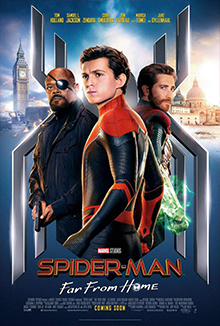
What I like about these MCU movies is that they really explore Peter's life and struggles as a metaphor for the high school experience and growing up the way a show like Buffy the Vampire Slayer did. This movie isn't great, but it is fun and very re-watchable.
4. Spider-Man: Homecoming

See my note above. I love how Tom Holland brings a youthful energy to the character that we never quite got with the other two. I love watching his relationship with Tony. And Keaton is great in his role as one of the most sympathetic villains in the MCU, I almost rooted for him.
3. Spider-Man 2

As I've written previously: What the movie captures so well so early on is how much of burden it is for Peter to be Spider-Man. Unlike Batman or Iron Man, Spider-Man does not have unlimited resources. Heck, even Clark Kent does better than him in the same field of journalism. But Peter's life is on the rocks. Director Sam Raimi captures in such nice visual touches Peter's poverty. It is such a nice carryover from the first film to see how Peter refuses to make money off of his power. That path led to the death of his Uncle Ben.


A few days ago I was rewatching my favorite movie Return of the Jedi.
This is a magical film and such a wonderful finale to the original Star Wars trilogy. But as I was getting to the end, something struck me regarding the Sequel Trilogy.
I am not someone who completely trashes the Disney Sequels. I think The Force Awakens is absolutely a worthy successor to the Saga. And while I think that The Last Jedi was made by a man who fundamentally did not understand Star Wars, it does have some very good moments. And if the The Rise of Skywalker did not have to clean up a lot of the mess from the previous movie, it could have landed much stronger.
But in thinking about the hero's journey that the main character takes in each of the trilogies, I noticed a subtle but important difference.
Rey has no scars.
In The Empire Strikes Back, the fresh-faced Luke is badly beaten. He is scarred at the beginning of the film and then he is pummeled bloody by Vader.
At the end of Attack of the Clones, Anakin is maimed by Dooku. When Revenge of the Sith begins, he is even more scarred and then is horribly burned by the finale.
In both cases, the heroes carry on their bodies the physical reminders of their choices. It struck me the most in Return of the Jedi when Luke removes Vader's helmet and you see all of the scars on Anakin's face as he looks at his son's scarred face and deformed hand. You can see in all of this the pain and vulnerability between these two men. The scars remind you of the crucible that they endured to get to the end of their journey.
But Rey has no scars.
Many people argue that her character is a Mary Sue, but I am not here to debate that point. My point is that a big mistake was made in not giving Rey any scars.
Her character is heroic to the point where she sacrifices her life in her battle with Palpatine. But the scars of the battle matter. You could argue that she has emotional scars over what she has lost and endured, but that misses part of the point.
Movies are visual in nature. That is the primary way they convey story and character. In Anakin, you can see how his anger has both emotionally and physically sent him through hell. Luke has had part of his innocence taken away and broken. There is something sad, even in the victory.
This touches on that mythic element of all of our lives. We grow and we learn and hopefully we overcome. But we are scarred in the process. If we are not, it feels like our victories have less significance. That isn't to say that the pain is what makes the victory good, but in order for something to be heroic the challenge has to be real and almost insurmountable. That is what makes heroes admirable.
The scar is also a perpetual reminder of the cost. I remember when I first saw How To Train Your Dragon, I enjoyed it very much. But I actually gasped when I saw that Hiccup has been maimed in the end. It made me feel a much deeper emotional connection to him for what he gave up. Frodo lost his finger and ultimately his health in order to get the ring to Mordor. Harry Potter carries his scar from infancy through to the end.
But Rey never experiences that same kind of pain. She endures a great deal, but it isn't quite the same. It's intersting that it is her antagonist that receives a scar from her. And in that way, Ben Solo is a bit more interesting of a character. He has a more dramatic arc. Like Anakin and Luke, he is scared by his choices, both internally and externally. When he has to face his father in the end, he appears no longer as his fresh-faced son, but as a scarred sinner. The shame and pain are all present in that moment.
Scars not only show injury, but they also show healing. It shows us where someone has been wounded, but how they have endured. Rey doesn't have that. She looks exactly the same at the beginning of the Sequel Trilogy as she does in the end. Perhaps if we could see her scars we could feel a deeper connection to her journey.

This week we will be celebrating the Feast of the Immaculate Conception.
We Catholics believe in the Dogma that the Virgin Mary was conceived without Original Sin. Some of our Protestant brothers and sisters sometimes misunderstand this dogma. They infer from the fact that the Immaculate Conception occurs before the saving work of the Cross that Catholics believe Mary doesn’t need Jesus to be saved.
This misunderstanding comes partially from the fact that we look at time from the human perspective, not the Divine perspective.
Human beings go through time from moment to moment. We travel from past to present to future. To explain this in class, I draw a line on the chalkboard. I then take the piece of chalk and begin going over the line again. I say to my students that the piece of chalk only experiences the line at the point where it is touching. This is the present. The place where the chalk just touched is the past. The part of the line the piece of chalk has yet to touch is the future. In the same way, human beings experience only the present moment of time, with memories of the past and anticipation of the future.
I then ask “What about the chalkboard itself?”
The chalkboard does not experience a part of the line at a time. The chalkboard experiences the entire line at the same time. It is the same with God.
God is not inside of space/time the way we human beings are. In Him we live and move and have our being. In other words, God is not inside of time, but rather time is inside of God. God is bigger than our timeline. Like the chalkboard experiencing every part of the chalk line at the same time, God is experiencing every part of the timeline at the same time. For God, what we call the past, present, and future are all happening at the same time. He is there at the first moment of creation, the final moment of creation, and everything in between.
Because God is outside of time and space, the same rules do not apply to His graces.
All are saved because of Christ’s saving work on the Cross. This includes the Virgin Mary. But since God is outside of time, He applied that saving power to Our Blessed Mother in advance of the event in our time.
The Catechism of the Catholic Church, citing Vatican II states “The ‘splendor of an entirely unique holiness’ by which Mary is ‘enriched from the first instant of her conception’ comes wholly from Christ: she is ‘redeemed, in a more exalted fashion, by reason of the merits of her Son’”. (CCC 492).
This is why we say that Mary is “full of grace.” In fact, if you go the literal translation of the words from Luke’s Gospel, the Angel Gabriel greets her not as “Hail Mary, Full of Grace,” but simply as “Hail Full of Grace” as if “Full of Grace” is her title.
What does it mean to be “full of grace?” In class, I use an analogy I got from Dr. Scott Hahn.
I take a cup and I fill it to the brim with water. I think hold it directly over a student’s head. I then ask them to hand me their pen or pencil so that I can put it in the cup. The will always refuse. When I ask why, they tell me that if I put the pen or pencil in the cup, they will get wet. When I press them further as to why, they explain that the cup is full and there is no more room for anything else.
And so I tell them the same is true of Mary. Her soul is so filled with the grace of God that there no room for anything else. There is no room for sin.
This is an important lesson for us. Mary may have had the unique privilege of being the only human creature since the Fall not have Original Sin, but she was also sinless her entire life. Adam and Eve were without sin, but they gave in to temptation. So why not Mary?
Because she is “full of grace.” She is so filled with God’s love that to turn away from it is unthinkable.
Most of the below article is from 2017, but for the most part, the list has not changed (except for the new entry at the top).





15 words or less film review (full review to follow soon)

