ReasonForOurHope

Thursday, July 9, 2020

The Permanence of Conversation

When I was in high school and college I kept a journal.  

As I began to lose the urge to write down my thoughts, I looked back on what I wrote.  It was enlightening and nostalgic.  But most of all, it was embarrassing.  I was amazed by the things that became the center of my thoughts and worries.  Everything was written in that overly-dramatic tone that is common to that time of life.  

The poems were particularly cringe-worthy.

I've been thinking about that journal recently and about the strange ideas of youth.  I began to think of all those evenings where my friends and I would stay up until we heard the chimes at midnight together.  And as you find those friends, you begin to unpack your mind with ideas, many of which are not fully formed.  You batter your thoughts around between you to see if they have any merit.  But as you start forming your own identity there is a great yearning to be heard, known, and understood.

And all the while, we would try to make each other laugh.  Some jokes light up the room.  Others land with a solid thud.  I can't recall all of them, but I'm sure that not all of them were in good taste.  When I was much, much younger, my brother and I found a book of the most vile and disgusting jokes you could imagine.  I probably didn't understand half of them, but I repeated them anyway because they got laughs.  I would be mortified if those horrid words from my ignoble youth were ever to be repeated.

Yet this is the situation that many people find themselves in today.

With the advent of social media, we have a phenomenon I don't think we've ever seen before which is the permanence of conversation.  This was a phrase that was proposed to me by a very good friend.  All the private words of a journal or the late night bad-taste jokes only live on the memory of those who were experienced them.  But social media has changed this.

Facebook encourages people to share their thoughts with the entire social network.  Twitter is a bit more of an edge in that it lends itself much more to impulsive reactions rather than reasoned restraint.  Even blogs like this act as a kind of online journal, with a wider readership than the one I put to paper.

The downside is that this digital conversation is permanent conversation.  The words you share are permanently chiseled into the uneraseable internet.  A lapse in judgment online, even for a moment, can come back to haunt you.  It can be immediate, as we saw with Roseanne Barr when she lost her hit TV show because of a tweet.  Or it can linger for years and resurface out of nowhere.  Hartley Sawyer, the actor who played The Elongated Man on The Flash, was fired when tweets from eight years earlier were found and people were offended.  I even wrote about James Gunn when he was fired from Guardians of the Galaxy Vol. 3 for old social media posts.  The justice or injustice of the outrage from these posts, I will leave up to the reader.  My point is simply that once someone you put something up online, it is permanent and can be eventually held against you.

I have always been cognizant of this reality when I started this blog 8 years ago.  Even though I publish it anonymously, I have always held as my principle that everything I put here would be something I would be proud to have published.  Anonymity online is something that can never be guaranteed, so I always keep in mind on how my words reflect on my family, my friends, my employer, and my community.  It is one of the reasons I try very hard to steer clear of politics on this page and only engage them tangentially as they touch on philosophy, faith, or pop culture.  I pray that the only controversial things I have written have been controversial because they stand with the Catholic faith against the fashions of the world.  In the current climate of cancel culture, I believe my social media crime I could be accused of is my orthodoxy.  

And yet I have found a good deal of writing on the internet to be intemperate.  People react swiftly and emotionally.  This is not always a bad thing.  And being up front with your ideas is a healthy thing for defenders of free speech.  But when our words are enshrined on the web forever, we should employ a bit more caution.  

This is especially problematic for the young.  As I wrote, as we grow up we want to be heard, known, and understood.  But like that teenager who wrote that cringe-worthy journal, my thoughts lacked a coherent maturity.  And that is perfectly okay for a teenager trying to find out who they are.  But when that same teenager puts those thoughts online, I don't believe they realize that what they could be planting the seed of a very bitter harvest.  

Before my conversion experience, I held to beliefs that were against the Catholic faith in which I was raised.  I was in favor of women's ordination, contraceptives, and same-sex "marriage."  By God's grace, when I had my encounter with Christ, He led me towards joy of orthodox Catholicism.  But if I had posted these heterodox ideas online, I wonder how that would affect getting hired for my job teaching theology or the scandal it would cause should they resurface.  Thankfully, the internet was not what it is today.  And I only share my old heterodox beliefs by way of repudiation.

This problem is not limited to the young, though the impetuosity of youth compounds this.  Another issues is that ideas that were not scandalous at one point are now no longer socially acceptable.  But when old social media posts are found, they are presented to the world as a fresh conversation.  Often we don't take into account how the world has changed or how the person has matured.  

Back in 2013, I wrote about how Orson Scott Card was fired from writing a Superman comic book because he opposed same-sex "marriage."  While this position is no longer in the main stream of popular thought, it is still the moral teaching of the Catholic faith.  But even more so, it was the official position of all presidential candidates until the year before.  Within the space of one year, a belief that was once socially acceptable became unacceptable and any social media posts before the change can be held against you.

If things continue this way, perhaps all of the socially acceptable thoughts of today will soon be socially heterodox.  In this case, we will all have built up ammunition against ourselves that we stored online.

But with that in mind, I pray we can look at others with even greater patience and understanding.

Monday, July 6, 2020

Film Review: Hamilton


Sexuality/Nudity Mature
Violence Acceptable
Vulgarity Mature
Anti-Catholic Philosophy Acceptable

I don't think there is a Broadway musical that has been more hyped than Lin-Manuel Miranda's Hamilton.  When the touring production came to my city, the tickets were so ridiculously expensive that I missed out on seeing it.  So it was with great curiosity that I watched the movie on Disney+ a few days ago to see if it lived up to the the bar that it set.

And boy did it ever!

Hamilton is one of the greatest musicals of all time.  I would put it up there with Les Miserables, The Sound of Music, and The Phantom of the Opera.  It deserves all of its accolades.

The musical is about the founding father Alexander Hamilton (Miranda).  It attempts to encapsulate his entire life from his birth in the Caribbean to his death at in a duel by his rival Aaron Burr (Leslie Odom Jr.).  Along the way, we his friendship with the revolutionaries Hercules Mulligan (Okieriete Onaodowan), John Lurens (Anthony Ramos), and Lafayette (Daveed Diggs) through his involvement in the war under George Washington (Chris Jackson).  But the story also delves deep into his personal life with his wife Eliza (Phillipa Soo) and her sister Angelica (Renee Elise Goldsberry).  

But throughout, the heart of the story he and his foil Burr.  We see in the men two stark contrasts.  They are both ambitious.  But Burr plays the game of politics, holding his true beliefs close to the chest and learns how to tell men what they want to hear.  Hamilton, on the other hand, cannot help but make his mind known.  He has no time for niceties and will always tell you where he stands and if you don't live up to his ideals.  It becomes a constant source of envy that despite his abrasive nature, Hamilton seems to achieve more success than Burr.

But let us return to the main point: why is this musical so beloved?

The key to understanding this is that the primary purpose of any dramatic art, but most particularly in a musical, is that it must make you feel something deeply.  All other considerations must be secondary to the emotional impact of the musical.  And this is why Hamilton is a work of genius.  

I am not a big fan of hip-hop.  Watching the first half of the show, I would say that it caused me to greatly admire the skill involved in making it.  The production values are top-notch.  The choreography is fantastic.  The performances are also excellent.  But if the entire show were just like that first half, then Hamilton would have achieved greatness.  The hip-hop styling of the first half capture that aggressive and active tone of youth, with all of its drama and bravado.  But in the second half, we begin to see emerge a more complete portrait of Hamilton's entire life.  The bravado gives way to betrayal, disappointment, and tragedy.  This is the magic and the power of the show: it lowers your emotional guard by and then hits you with emotional wallop.  For the last hour, I found myself openly weeping several times.

Allow me to elaborate.  One of the things that is often overlooked in the reviews I've read for this show is how utterly masculine it is.  This is where the hip-hop stylings really help the tone of the show.  As I said, I'm not a fan of hip-hop, but even its biggest detractors would acknowledge that it tends to be a intensely masculine form of artistic expression.  The main revolutionaries are all very manly men, full of courage and ready to do righteous violence.  Burr is portrayed as cautious, but he is never portrayed as cowardly (until perhaps the end).  George Washington stands as a giant.  Even in his even-handed carefulness, he is clearly a man of action.  This is all juxtaposed to the completely effete and effeminate King George III (Jonathan Groff) who is a show-stealing comedic character that is so loathsome in his lack of masculinity.

But the show is not a simple glorification of the masculine.  In the second act, we see how these qualities, if not tempered with virtue, especially the kind offered by the feminine, can lead to destruction.  There is a solid thru-line from the "young, scrappy, and hungry" Hamilton of the first act to the devastated, haunted Hamilton of the final scenes.  And yet, even in this, there we get the sense that there is wisdom gained in the suffering.  Hamilton makes mistakes that cause so much destruction.  And in the show's most amazing song, "It's Quiet Uptown," you get a glimpse of transcendent beauty.  I loved every part of this song.  But I was most amazed and moved by these lines, after Hamilton has experienced a great tragedy:

I spend hours in the garden
I walk alone to the store
And it's quiet uptown
I never liked the quiet before
I take the children to church on Sunday
A sign of the cross at the door
And I pray
That never used to happen before

His sins have brought him low.  But instead of breaking him, they have humbled him.  And the power of that moved more than most anything I've seen on stage.

Speaking of the stage, Disney was very smart to make this movie a "concert" version of the full stage musical instead a full cinematic film like 2012's Les Miserables.  I get the distinct impression that Hamilton would not translate to this style nearly as well.  The show has a deceptively simple set that actually contains hidden complexities to allow rapid scene changes.  The production design is a strange combinations of anachronistic and time-appropriate styles.  The costumes and props are all of the period, but the behavior, hairstyles, language all belong to the modern era.  There is a special kind of artificiality to live-theater that allows us to accept more readily a story's lack of reality.  Making this a cinematic endeavor would draw too much attention to the anachronisms.  The fact that no attempt is made to make the cast look like the historical figures they represent has no impact on the play if you buy into its emotional core.  And when you do, you are dazzled by all of the technical craft on display on stage.

The performances and singing is also outstanding.  Soo is amazing as Eliza.  Her song "Burn" is so devastating in its hurt and betrayal.  Goldsberry's Angelica conveys such sharpness and stifled sadness that her song "Satisfied" is like a cathartic explosion.  Odom Jr. is every bit a match for Miranda's Hamilton and even though he is the "villain" of the story I could not help but feel constant sympathy for him.  Jackson's Washington has a deep an commanding voice which does its best to cover up his deep-seated anxieties at knowing only he can get the job done but not sure if he can do it.  But everything centers around Miranda.  His performance is appropriately theatrical, almost going a little over the top.  But in the final act, there is a moment when he has such a look of gratitude mixed with utter shame that was so honest and devastating.

While I try to keep current year issues out of movie reviews, Hamilton is a very timely film.  The founding fathers are portrayed not as distant demi-gods.  They are great men who are also flawed like all of us.  But those flaws do not stop them from being recognized as great.  Hamilton leaves a legacy that is in some ways divisive, but even his enemies admit of his impact.  There is hopefully something in Hamilton that could unite people of different worldviews.  Maybe this could be some of the common pop culture space where we can all meet each other and talk.  

Hamilton left me emotionally drained in a good way.  When it was over, I felt like I didn't just watch a musical, but that I had an experience.

And that is the highest compliment I can give a musical.


Sunday, July 5, 2020

New Evangelizers Post: What Will You Give Up For the Kingdom?


I have a new article up at NewEvangelizers.com.  

I was just reading about a teacher who asked his students to imagine that they were living in the South during the height of slavery. He asked all of them if they would have publicly opposed this evil institution. Naturally, all of them raised their hands and said they would. But then he asked them for evidence of this courage in their own life today. He asked them when they have publicly opposed something that would cost them their job, their freedom, and the disdain of the powerful forces in the culture.

When we read about history, we all like to believe that we would have had the moral strength to stand against the tide, especially when it comes to things that moderns have clear moral certainty about. Every rational modern person recognizes the evil of things like slavery and the Holocaust. If we ever imagine ourselves in those circumstances, we often concoct an image of someone unbowed to these evils and giving aid to those who are oppressed.

But is that how we behave now?

In this age of “cancel culture,” do we have the courage to say things that are out of the mainstream, even if they are true. Do we dare speak the Church’s truth about human sexuality or the sanctity of human life, even when it is unpopular? This is not about political sides. As someone who adheres to the Church’s pro-life principles, I must speak out in defense of all human life. This means I could incur the wrath of the political left when speaking against abortion or the political right when in opposition to the death penalty.

However, all too often we reduce these questions to things in the public sphere. This also applies to our personal lives. When you are sitting with your co-workers at lunch and they are badmouthing a fellow employee, are you going to be the unpopular one who says, “Maybe we shouldn’t gossip about other people?” It’s something that sounds so easy in principle, but can be difficult for many.

And being true to the Gospel will cost you.

Jesus said, “If anyone wishes to be my disciple, he must deny himself, take up his cross, and follow me.” (Matt 16:24)

We often think of the cross in terms of pain, which is perfectly valid. But we should also remember the cross as humiliation. The condemned person is forced to carry the implement of their own death. It is like being forced to carry the rope to scaffolding where you will be hanged or carrying the bullet that they will use to shoot you. All the while, He was crowned with thorns because He told them that He was the King. Because of this, they mocked Him as King.

Can we endure to be mocked? If we cannot then we are less like Christ and more like Satan. St. Thomas Moore once wrote “The devil… the prowde spirit… cannot endure to be mocked.” No one deserved mockery less than Jesus, but He allowed it to happen because He trusted that His love would shine through. Do we have that same trust? There is nothing wrong with defending yourself, but do we do so for God’s glory or our own wounded pride.

The price of discipleship can be high.

My wife and I prayed for children since the day we were married. After many years, we prayed about adoption. We worked through several avenues, but with very few results. If you’ve never gone through the process, you may not know that before you can do almost anything, you have to have a space created for the child. We had a baby’s room with a crib all ready. Our home was inspected, car seats and strollers were purchased, parenting classes were taken, and several other things. And for years, the nest we furnished remained empty.

Until one day, we were chosen by a birth mother for an interview. We both dressed as maturely as we could and we went to the agency to meet her in the presence of the social workers. When the birth mother saw me in my red bowtie, she commented how I looked like the Doctor from Doctor Who. At this, I produced a replica of the Doctor’s sonic screwdriver from my pocket. For the next 20 minutes, the three of us bonded over our love of all things pop culture. We learned about her life and her circumstances and she learned about us. Then after about an hour or so, she said this:

“Religion was sort of forced on me growing up. It’s very important to me that whoever adopts this baby lets them choose their own religion and doesn’t have it forced on them.”

I looked at my wife and without saying anything, we both knew the choice we were about to make and what it would cost us.


You can read the whole article here.

Sunday Best: STEVEN SPIELBERG MOVIES RANKED - #12-#11


12. Bridge of Spies. 

Bridge of Spies poster.jpg

Hoffman: OK, well, listen, I understand attorney-client privilege. I understand all the legal gamesmanship, and I understand that's how you make your living, but I'm talking to you about something else, the security of your country. I'm sorry if the way I put it offends you, but we need to know what Abel is telling you. You understand me, Donovan? Don't go Boy Scout on me. We don't have a rule book here.
James Donovan: You're Agent Hoffman, yeah?
Hoffman: Yeah.
James Donovan: German extraction.
Hoffman: Yeah, so?
James Donovan: My name's Donovan. Irish, both sides. Mother and father. I'm Irish and you're German. But what makes us both Americans? Just one thing. One. Only one. The rule book. We call it the Constitution, and we agree to the rules, and that's what makes us Americans. That's all that makes us Americans. So don't tell me there's no rule book, and don't nod at me like that you son of a b****.


This bit of dialogue is the central point of the Spielberg/Hanks collaboration Bridge of Spies.  While this movie was marketed as a thriller with political intrigue, that really isn't what its about.

The story revolves around James Donovan (Tom Hanks) who has been assigned to to a pro bono case for Soviet spy Rudolf Abel (Mark Rylance in the role that won him an Oscar).  The first half of the film is an examination of civil liberties in relation to national security.  That story, in and of itself, would have been enough for a complete narrative.  But instead, Bridge of Spies takes a turn in the second half and it becomes about a potential prisoner exchange of Abel for U2 spy plane pilot Francis Gary Powers (Austin Stowell) with the Soviets.

This movie falls into the category of other political Spielberg fare like The Post and Munich.  But this one is the best of those in his collection.  The main reason for this is that he is smart enough in here to not flog a political message as he did in The Post or attempt some kind of vague moral equivalency as he did in Munich.  

The only political message here is the belief in the Constitution.  Spielberg presents the protections and pitfalls of a system where even an enemy of the state gets a fair trial.  The movie never calls into question Abel's guilt.  In fact, Spielberg has a wonderful dialogue-less scene showing Abel at work in his treasonous work that is so completely fascinating and lacking any kind of obvious visual flourish.  Spielberg films his 1950's America with all of its nostalgic glory and innocence.  This is not a naive world, but there is a wholesomeness that seems worth preserving.  Even as shadowy government forces pressure Donovan to compromise Constitutional rights, the movie makes clear that Abel is trying to harm a good and free land.

The second half emphasizes this even more when Donovan must go to East Berlin right around the construction of the wall.  Spielberg does an amazing job of not only capturing the bleak blight of life under Communism, but he does so in a way that wonderfully contrasts the country Donovan has left behind.  Spielberg uses incredibly subtle visual tweaks to create a mood and tone that is oppressive.  Everything is cold and unforgiving in this Communist hell hole.  The color is all muted away.  Everyone is an actor, not showing you their true face.  

It would have been easy and lazy to try and set up an equivalency between America and the Communists.  Instead, he does something much more complicated.  He presents the good and the bad in the people on both sides and lets you, the audience, be the judge.  He does not sugar coat Communism as movies like Pan's Labyrinth did.  And he does not present our own government agencies as purely altruistic.

This is best exemplified when an American student named Frederic Pryor (Will Rogers) is arrested by the Stasi and the American government is willing to let him rot in an East German prison as long as they can secure Powers.  Spielberg deftly shows Donavan's maneuvering for Pryor's release in the most intense showdown of the movie on the bridge in the final act.  The movie is about standing for what is right and good when everyone else stands against you.  And in one of the movie's most powerful moments, it shows that sometimes the only way to see those principles through is if someone, even the most unlikely person, stands with you.

11. Poltergeist


This is the most controversial choice on the list because Steven Spielberg is not credited with directing this movie.  Instead, Tobe Hooper, most famous for directing The Texas Chainsaw Massacre is credited for this film.

Spielberg co-wrote the story, cast the actors, directed actors performances, produced, made most (if not all) of the storyboards, adjusted Hooper's shots while filming, made most of the creative and editorial decisions, and was on set every day of filming except for three.  There was a stipulation in Spielberg's contract that he could not officially direct anything while working on ET, which was constantly being delayed.  

I am open to being proven wrong, but Poltergeist is clearly a Spielberg movie.  Compare directing style of this movie to both Hooper and Spielberg and there is little question.  You could make the argument that Hooper was imitating Spielberg's style, but it doesn't ring true.  Look at the use of light and shadow, color and music, humor and drama, and it all screams Spielberg.

Poltergeist is a terrifying film.  But it is terrifying in a very Spielberg way.  One of the keys to much of Spielberg's work is his insatiable sense of wonder.  This film opens a window into the undiscovered country of the afterlife.  It is both beautiful and terrifying.  He draws you in with fascination but then you realize too late that this is a door you may not be able to close.

Some of the special effects might be dated, but Spielberg knows how to makes something terrifying with the camera.  I will never forget the clown sitting there staring at Robbie (Oliver Robbins).  And even worse, is when Robbie looks and the clown is gone.  The moment is so quietly scary because Spielberg is able to capture the silent terror of late night fears.  Is this all in my head?  Or is there a monster under my bed.

What's amazing to me too is how much Spielberg is able to break the maxim "Show, don't tell" and do it effectively.  We never see the inside of the ghost world, we can only hear Carol Anne's  (Heather O'Roarke) haunting echo in the TV.  When she describes she's not alone or when Tangina (Zelda Rubinstein) describes "the Beast," your emotions are primed for terror.

The entire film has an ominous quality that you cannot shake.  But what is amazing and so Spielbergian is that it is not an existential dread that is fueled by nihilism.  There is an overwhelming cosmic horror at being helpless to forces beyond your control.  But there is always a continual hope that things might turn out for the best.

At its heart, Poltergeist is the story about a family in crisis.  Steve (Craig T. Nelson) and Diane (JoBeth Williams) are an average middle-class couple just sleepwalking through suburban life.  But when Carol Anne gets taken, the family's complacency is shattered.  The movie explores the strain and stress of having a child in distress and how that effects the relationship of the parents, their children, and their whole lives.  Watch how Steven is worn away by his own helplessness and Diane's relentlessness is almost off-putting.  This culminates in the amazing scene where Diane must enter into the light to get her daughter.  In the most desperate and ominous line, Diane looks back at Steven, who is holding the only tether that she has to this world as she is about to plunge in.  She screams, "Steven!  Don't let go!"  These are not superheroes, but an ordinary man and woman who will most likely fail.  It never fails to put me on the edge of my seat.

The also has some amazing laughs, which Spielberg uses not to mitigate the horror but to intensify its effect.  The jokes don't make you wink at the camera.  Instead, it lowers your defenses so when the scares occur, you are not ready and it hits you even harder.  The only time we are allowed to let a joke truly sink in is in the very last shot.  And it is Spielberg's parting gift to the audience, giving them a chance to laugh together one last time after sharing so many screams.


Friday, July 3, 2020

The Declaration of Independence: 244 Years Ago Today

(most of the text below is a repost from last year)
File:Writing the Declaration of Independence 1776 cph.3g09904.jpg

Below is the entire text of the Declaration of Independence.  I believe it to be one of the most
audacious and revolutionary documents in history (pun in intended).

I have always loved my country.  But as a philosopher one of the things that I marvel 
at is that  the United States is a country built on an idea.

 Ideas matter.

Freedom is in our nature.  No tyrant, no government can take that away.

I encourage you to read the entire text below on this birthday of our nation.  Particularly, I am struck by the last line:

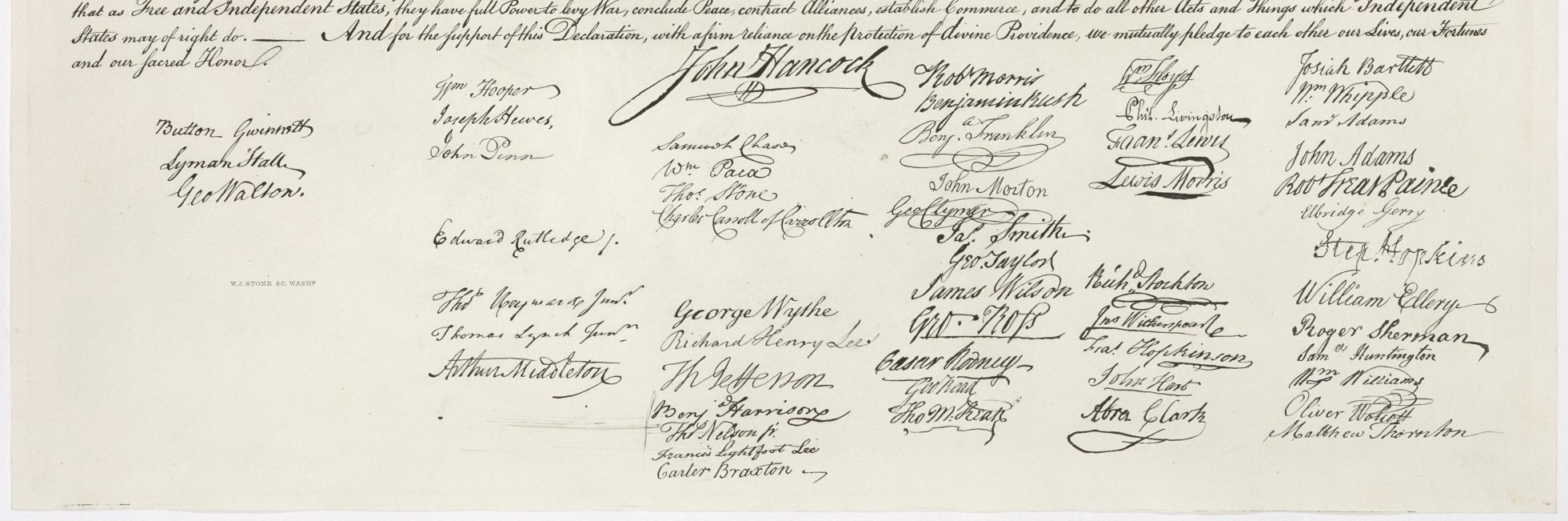
And for the support of this Declaration, with a firm reliance on the protection of divine Providence,  we mutually pledge to each other our Lives, our Fortunes and our sacred Honor.

Those who wrote their names on that document held up as collateral for the investment in our freedom:

1.  Their Lives.  I am humbled when I remember that so many gave much more than I will
ever give so that people like me could live free.  The only way we can hold onto our freedom is if men and women are willing to pay the ultimate price.  Too often tyrants, both fearsome and soft-spoken, try to snatch away our freedom.  They depend on us to lay down our resistance and give in.  We must never do so.  The Founding Fathers gave us that pledge.

2.  Their Fortunes.  I will likely never see combat.  But how do I spend my money to
ensure freedom?  Do I take care of our wounded warriors?  Do I support laws and
representatives I believe in with my capital?  And do I take payments from those who
would make me dependent?  This pervasive bribery must lead inexorably to subtle slavery.

3.  Their Sacred Honor.  Do we even believe in honor anymore today?  Does our name mean anything?  In A Man for All Seasons, when asked why he would not take an oath of
loyalty to Henry VIII, Thomas More said, "When a man takes an oath, 
he’s holding his own self in his hands. Like water.  And if he 
opens his fingers then — he needn’t hope to find himself again." 
 We are free and we must stand by our commitments. 
 Otherwise who we are, our name, means nothing.  

These great men signed their names to this document. 
 For each of them it may have been a death sentence.
  But they signed it nevertheless.  They their day they
 took a stand against tyranny and stood for freedom.

In their day they stood as men.

Today they stand as giants.

And the challenge of today is this: could we stand with them?

Do we have what it takes to be the patriots at Valley Forge or the resistance at Boston Harbor?  Does that same noble spirit of freedom stir in us?

Or do we stand with those who try to tear down their memory to only have us remember their faults and failings and not the fact that they gave us the greatest nation that the world has ever known?

Perhaps reading this document again will renew and refresh the spirit of liberty.


File:United States Declaration of Independence.jpg

IN CONGRESS, July 4, 1776.
The unanimous Declaration of the thirteen united States of America,
When in the Course of human events, it becomes necessary for one people to dissolve the political bands which have connected them with another, and to assume among the powers of the earth, the separate and equal station to which the Laws of Nature and of Nature's God entitle them, a decent respect to the opinions of mankind requires that they should declare the causes which impel them to the separation.
We hold these truths to be self-evident, that all men are created equal, that they are endowed by their Creator with certain unalienable Rights, that among these are Life, Liberty and the pursuit of Happiness.--That to secure these rights, Governments are instituted among Men, deriving their just powers from the consent of the governed, --That whenever any Form of Government becomes destructive of these ends, it is the Right of the People to alter or to abolish it, and to institute new Government, laying its foundation on such principles and organizing its powers in such form, as to them shall seem most likely to effect their Safety and Happiness. Prudence, indeed, will dictate that Governments long established should not be changed for light and transient causes; and accordingly all experience hath shewn, that mankind are more disposed to suffer, while evils are sufferable, than to right themselves by abolishing the forms to which they are accustomed. But when a long train of abuses and usurpations, pursuing invariably the same Object evinces a design to reduce them under absolute Despotism, it is their right, it is their duty, to throw off such Government, and to provide new Guards for their future security.--Such has been the patient sufferance of these Colonies; and such is now the necessity which constrains them to alter their former Systems of Government. The history of the present King of Great Britain is a history of repeated injuries and usurpations, all having in direct object the establishment of an absolute Tyranny over these States. To prove this, let Facts be submitted to a candid world.
He has refused his Assent to Laws, the most wholesome and necessary for the public good.
He has forbidden his Governors to pass Laws of immediate and pressing importance, unless suspended in their operation till his Assent should be obtained; and when so suspended, he has utterly neglected to attend to them.
He has refused to pass other Laws for the accommodation of large districts of people, unless those people would relinquish the right of Representation in the Legislature, a right inestimable to them and formidable to tyrants only.
He has called together legislative bodies at places unusual, uncomfortable, and distant from the depository of their public Records, for the sole purpose of fatiguing them into compliance with his measures.
He has dissolved Representative Houses repeatedly, for opposing with manly firmness his invasions on the rights of the people.
He has refused for a long time, after such dissolutions, to cause others to be elected; whereby the Legislative powers, incapable of Annihilation, have returned to the People at large for their exercise; the State remaining in the mean time exposed to all the dangers of invasion from without, and convulsions within.
He has endeavoured to prevent the population of these States; for that purpose obstructing the Laws for Naturalization of Foreigners; refusing to pass others to encourage their migrations hither, and raising the conditions of new Appropriations of Lands.
He has obstructed the Administration of Justice, by refusing his Assent to Laws for establishing Judiciary powers.
He has made Judges dependent on his Will alone, for the tenure of their offices, and the amount and payment of their salaries.
He has erected a multitude of New Offices, and sent hither swarms of Officers to harrass our people, and eat out their substance.
He has kept among us, in times of peace, Standing Armies without the Consent of our legislatures.
He has affected to render the Military independent of and superior to the Civil power.
He has combined with others to subject us to a jurisdiction foreign to our constitution, and unacknowledged by our laws; giving his Assent to their Acts of pretended Legislation:
For Quartering large bodies of armed troops among us:
For protecting them, by a mock Trial, from punishment for any Murders which they should commit on the Inhabitants of these States:
For cutting off our Trade with all parts of the world:
For imposing Taxes on us without our Consent:
For depriving us in many cases, of the benefits of Trial by Jury:
For transporting us beyond Seas to be tried for pretended offences
For abolishing the free System of English Laws in a neighbouring Province, establishing therein an Arbitrary government, and enlarging its Boundaries so as to render it at once an example and fit instrument for introducing the same absolute rule into these Colonies:
For taking away our Charters, abolishing our most valuable Laws, and altering fundamentally the Forms of our Governments:
For suspending our own Legislatures, and declaring themselves invested with power to legislate for us in all cases whatsoever.
He has abdicated Government here, by declaring us out of his Protection and waging War against us.
He has plundered our seas, ravaged our Coasts, burnt our towns, and destroyed the lives of our people.
He is at this time transporting large Armies of foreign Mercenaries to compleat the works of death, desolation and tyranny, already begun with circumstances of Cruelty & perfidy scarcely paralleled in the most barbarous ages, and totally unworthy the Head of a civilized nation.
He has constrained our fellow Citizens taken Captive on the high Seas to bear Arms against their Country, to become the executioners of their friends and Brethren, or to fall themselves by their Hands.
He has excited domestic insurrections amongst us, and has endeavoured to bring on the inhabitants of our frontiers, the merciless Indian Savages, whose known rule of warfare, is an undistinguished destruction of all ages, sexes and conditions.
In every stage of these Oppressions We have Petitioned for Redress in the most humble terms: Our repeated Petitions have been answered only by repeated injury. A Prince whose character is thus marked by every act which may define a Tyrant, is unfit to be the ruler of a free people.
Nor have We been wanting in attentions to our Brittish brethren. We have warned them from time to time of attempts by their legislature to extend an unwarrantable jurisdiction over us. We have reminded them of the circumstances of our emigration and settlement here. We have appealed to their native justice and magnanimity, and we have conjured them by the ties of our common kindred to disavow these usurpations, which, would inevitably interrupt our connections and correspondence. They too have been deaf to the voice of justice and of consanguinity. We must, therefore, acquiesce in the necessity, which denounces our Separation, and hold them, as we hold the rest of mankind, Enemies in War, in Peace Friends.
We, therefore, the Representatives of the united States of America, in General Congress, Assembled, appealing to the Supreme Judge of the world for the rectitude of our intentions, do, in the Name, and by Authority of the good People of these Colonies, solemnly publish and declare, That these United Colonies are, and of Right ought to be Free and Independent States; that they are Absolved from all Allegiance to the British Crown, and that all political connection between them and the State of Great Britain, is and ought to be totally dissolved; and that as Free and Independent States, they have full Power to levy War, conclude Peace, contract Alliances, establish Commerce, and to do all other Acts and Things which Independent States may of right do. And for the support of this Declaration, with a firm reliance on the protection of divine Providence, we mutually pledge to each other our Lives, our Fortunes and our sacred Honor.

The 56 signatures on the Declaration appear in the positions indicated:

Column 1
Georgia:
   Button Gwinnett
   Lyman Hall
   George Walton
Column 2
North Carolina:
   William Hooper
   Joseph Hewes
   John Penn
South Carolina:
   Edward Rutledge
   Thomas Heyward, Jr.
   Thomas Lynch, Jr.
   Arthur Middleton
Column 3
Massachusetts:
John Hancock
Maryland:
Samuel Chase
William Paca
Thomas Stone
Charles Carroll of Carrollton
Virginia:
George Wythe
Richard Henry Lee
Thomas Jefferson
Benjamin Harrison
Thomas Nelson, Jr.
Francis Lightfoot Lee
Carter Braxton
Column 4
Pennsylvania:
   Robert Morris
   Benjamin Rush
   Benjamin Franklin
   John Morton
   George Clymer
   James Smith
   George Taylor
   James Wilson
   George Ross
Delaware:
   Caesar Rodney
   George Read
   Thomas McKean
Column 5
New York:
   William Floyd
   Philip Livingston
   Francis Lewis
   Lewis Morris
New Jersey:
   Richard Stockton
   John Witherspoon
   Francis Hopkinson
   John Hart
   Abraham Clark
Column 6
New Hampshire:
   Josiah Bartlett
   William Whipple
Massachusetts:
   Samuel Adams
   John Adams
   Robert Treat Paine
   Elbridge Gerry
Rhode Island:
   Stephen Hopkins
   William Ellery
Connecticut:
   Roger Sherman
   Samuel Huntington
   William Williams
   Oliver Wolcott
New Hampshire:
   Matthew Thornton


Film Flash: Hamilton


Hamilton Disney+ poster 2020.jpg


15 words or less film review (full review to follow soon)

If you've never seen Hamilton (like me) believe the hype.  One of the greatest musicals.


Wednesday, July 1, 2020

Pop Culture Needs a Common Space

It would be very difficult to argue that we live in polarized times.  Our politics feel more diametrically opposed than I can remember in my lifetime.  As the divide widens, it becomes more and more difficult to find common ground to talk to each other.  

And we need to talk to each other.  We need to be able to dialogue with people who are different than us, who think differently than us.  I'm not saying that we should abandon our deeply held convictions to all meet in mushy middle of muddled ideas.  But there must be a place where we can make contact.

One of my favorite moments in the movie City Slickers is where a character talks about his dad and baseball.  He said that no matter what was going on between them, they could always talk about baseball.  Baseball became that common space where they could talk.

In my own family, that common place has always been movies.  My siblings and I grew up in the age of the VHS and HBO.  Between us we have thousands of hours of movie watching hours between us.  And over the years my siblings and I have grown up and found lives of our own, which we all must do.  But normally, no matter how far apart we became physically or philosophically, we could always talk about movies.

I mentioned before on this blog how I am a "slow-to-warm-up" personality type.  In new social settings, I have a difficult time initiating conversation.  But once I feel comfortable, you can't shut me up.  The exception to this is when I go to the comic book store.  There, I can strike up a conversation with total strangers, because we all know we are there because we love the medium the store is built around.  

Now, these pop culture conversations are not the end all be all of a relationship.  If I had relationships with friends and family where movies, comics, or sports were the ONLY topic of conversations allowed between us, then those relationships would lack all depth.  But those pop culture topics can become part of the conversational stew that mixes our lives together with greater ease and flavor.  Some people can just jump right into the big issues.  But for many of us, we need to be able feel comfortable enough before we dig deeper.

In addition to this, pop culture talk is fun.  We get to speak about our passions and there is a double of enjoyment when they are shared.  A friend of mine once said that everyone is an expert on something and we love to share our expertise.  I remember when I was a teenager, I was at a party where someone asked me about what was going on in X-Men comic books.  I talked his ear off for at least an hour.  Strangely, he was fascinated by what I said and his fascination made my sharing all the more gratifying.  

Another thing that this pop culture space gives us is the thrill of intense emotions with little consequence.  Watch how emotionally invested we get in sports.  When my home team won a national championship, I was over the moon.  When one my favorite character was killed on a show I watch, I raged.  And we can get into merry little wars over our pop culture tastes.  Unlike arguing about politics, where families and friendships have a greater chance of fracturing, pop culture arguments can be invigorating verbal jousts.

I have gotten into heated arguments with some of my dearest friends over things from the Star Wars saga to Caddyshack.  In fact, regarding the latter, my friends staged a sort of intervention for me because I said that Caddyshack II is better than Cadyshack I.  They gathered and made me watch the first one with them.  When I did not acquiesce, they were happily enraged and we went round and round, shadowboxing on the topic.  We could argue and rail and filibuster and shout, but no relationships were hurt.  In fact, they are strengthened by our shared history.  The verbal sparring does not damage because the arena is a common space.  We get all the thrill of fighting without any emotional bruises.

I should mention that this can at times go too far.  I once didn't speak to a friend of mine for an entire summer over an argument about Alien 3.  But this is the exception, not the rule.

Or at least, that is the way it used to be.

One of the most toxic things to enter into the pop culture was its politicization.  I don't mean that it has politics in it.  Pop culture has had movies, TV shows, and comics that have dealt with political issues for ages.  What I mean is that a particular pop culture medium becomes a area that is staked out to push a particular perspective.

There has been a push in the last few years to look at popular culture as a means of changing the culture.  There is truth to this assessment.  The popular culture affects how the culture behaves.  These can result in fashion fads like wearing your clothes backwards or checkered shoes.  But they can also affect deeper societal issues.  Abraham Lincoln famously pointed to Harriet Beecher Stowe's Uncle Tom's Cabin for awakening the North's outrage at slavery.  When he met the author, Lincoln said, "So this is the little lady who made this big war."

Because of this, popular culture is looked at as a tool in the culture war.  I'm not here to argue about how successful or not these attempts to move the culture have been.  But I am here to lament the effect, which is that it pushes out the common space.

The primary purpose of any art is to captivate.  

Great art also should elevate and touch upon transcendent truth and beauty.  But it's first job is to take hold of our attention and cause entertain.  As I teacher, I have found that students learn better when they are more entertained.  This is why edu-tainment like Sesame Street has such and enduring impact.  

The problem is that there are many who think that the primary goal of art is to teach.

This is one of the reason why most Christian movies are terrible.  As earnest as the cast and crew are, they are overly concerned with making sure that the lesson is learned rather than focusing on proper directing, acting, story structure, etc.  The greatest Christian movie ever is The Passion of the Christ (it also happens to be tied with Schindler's List with the greatest movie ever made).  Notice that while there are sermons in it, the movie is not a sermon.  It is an experience of Christ's love by telling the story of His passion.  Mel Gibson, of course, wanted to move people towards devotion to God.  But he understood that he had to first and foremost make a movie that was beautifully directed, acted, structured, etc.  

Now, look at what has happened in the last few years with pop culture brands like Star Wars, Ghostbusters, Doctor Who, Terminator, and The Last of Us.  There has been a great deal of ideological battle over this content.

The Last Jedi is the most polarizing Star Wars film ever made.  And this controversy is so needless.  Rian Johnson not only got it into his head that he wanted to subvert all expectations, but the film makers decided to push a post-modern socioeconomic perspective (especially in the scenes on Canto Bigt) that made the move feel so odd.  You can read my analysis of the philosophy of that movie here.  

Ghostbusters 2016 actively attacked the franchises fanbase in the advertising campaign.  Criticism of the film was perceived as some kind of political attack and was returned with that level of aggressiveness.  We saw this same thing happen to the latest Terminator film where the director labeled the movies detractors as misogynists.  Chris Chibnall, the show runner for the latest incarnation of Doctor Who, specifically mentioned making the show more "educational."  What this translates to is a stronger focus on teaching lessons rather than entertaining.  In addition, Chibnall has retconned the decades-long Doctor Who cannon in a move that appears to tear away the primacy of William Hartnell's incarnation as the Doctor.

Whether I agree or disagree with the the politics is irrelevant.  The point is that people are being pushed out of the common space.  It is also creating art that is less likely to transcend their own time.  The more specifically and politically pointed a piece of art is, the more dated is likely to become.  

When Tolkien wrote The Lord of the Rings, many people thought that the destructive power of the one ring was an allegory to nuclear weapons.  Tolkien strenuously rejected this idea.  Allegory, particularly political allegory, limits the effect and the reach of the art.  Tolkien instead focused on making the symbolism of the ring strong in its applicability.  This means that the symbol touches on something so pervasive and universal that it can be applied to a plethora of things.  The one ring embodies the archetype of evils found in fascism, communism, capitalism, etc.  


I am convinced that one of the reasons that the original Star Wars was such a big hit was because where it found itself in the pop culture.  America had just been through the Vietnam War and Watergate.  The country was polarized politically much like today.  But in Star Wars people from all different political perspectives, cultures, and ages were able to find something captivating and enjoyable.  And we could talk to each other about that galaxy far, far away and be brought closer to each other.

The first Hunger Games was such a big hit because the decadence of the evil Capitol could be applied to an out of control central government or to a runaway consumeristic materialism.  We could all see ourselves in that story and then argue about its merits.

Critics often lambast the Marvel films for being bland.  But they overlook that this "blandness" is part of the reason why it is successful.  Most of the Marvel films have an easy point of entry and identification for their characters.  And because of that, people are drawn to them.  Like the old Star Wars, I have been able to talk, debate, and enjoy the Marvel films with people from all political perspectives, cultures, and ages.  Marvel created a common space for us to meet.

That doesn't like it will last.  Captain Marvel became a flashpoint of political perspectives.  And The Eternals looks like it will try to "push the envelope," which usually means that it will try to push a politicized point of view in and push those who do not share this vision out.

Marvel is, of course, free tell their stories however they choose.  But it would be a shame to lose one of the few unifying pop culture spaces.

And when they are all gone, I do not know what shall happen.