ReasonForOurHope

Wednesday, May 6, 2020

TV Review: Ozark


File:Ozark TV series logo.png

I think Breaking Bad is one of the greatest TV shows ever made.  As dark as the show became and as Walter White descended further into evil, the show nevertheless had a strong hold on the viewer.  It did quite an amazing feat in that you understood that Walter was clearly in the moral wrong, but you never stopped rooting for him to somehow turn it around.

I bring this up, because I think perhaps Breaking Bad set the bar too high.

Ozark is a Netflix series that recently released its third season.  What intrigued me most about the show most was the unusually high number of people who compared this show to Breaking Bad.  With the lockdown in place, my wife and I decided to give it a try.

What I found was that Ozark was not the next Breaking Bad.  It was the new Sopranos.  And for me, that is not necessarily a compliment.

Ozark focuses on the Byrde family.  The father, Marty (Jason Bateman), is a money manager who launders money for the 2nd largest drug cartel in Mexico.  When he and his business partner run afoul of that cartel, Marty makes a desperate bid to save his life and life of his family: let them go to the lake of the Ozark and set up multi-million dollar laundering network.  His cartel handler Del (Esai Morales) knows Marty's skills and is intrigued enough to let him start this venture on a probationary basis.  But if he does not meet the cartel's expectation, his entire family dies.

On top of this, Marty has learned that his wife Wendy (Laura Linney) has been having an affair.  Saving her life is more of a calculation to keep their family intact.  Wendy, knowing already of Marty's life, becomes his default business partner.  They have to then uproot their children from their current life.  Teenager Charlotte (Sofia Hublitz) is understandably upset and middle-schooler Jonah (Skylar Gaertner) takes his confusion out in strange ways.  Once in the Ozark, things immediately derail from the plan.  For reasons I won't get into here, Marty's life becomes intwined with the non-juvenile teen criminal Ruth (Julia Garner) and her family.  Ruth is cunning, though lacking in book-smarts.  She alternately is an aid and an obstacle to the Byrd's goals.

The acting on this show is fantastic.  This is some of the best work Bateman has done, all the while he keeps everything very restrained.  Linney also does a great job, overwhelmed by the state of her family's survival while continuing a loveless marriage.  Garner is a real standout as Ruth, allowing her to play the contradictions of youth and innocence with sin and cynicism.  The writing is also very sharp, allowing a great deal of subtext laying on the table for the audience to pick up, causing us to be more actively involved in the story.  And the directing has been consistently strong, using powerful visuals to draw us in while maintaining the show's bleak tone.

However, this is where the show's similarity to The Sopranos becomes its biggest detriment.  I watched the first two full seasons of The Sopranos and then began the third.  But a switch went off in my head and I dropped the show cold.  The epiphany I came to was this:  "All of these characters are terrible and spending time wallowing in their evil is incredibly unpleasant."

That is how I feel about Ozark.

Where Breaking Bad spoiled me is that there was this wonderful moral tension in the show where you didn't want Walt to get caught, but you also didn't want him to get away with it.  For a good portion of the show, it always felt like Walt's redemption could be just around the corner.  A few choices and he could drink the wholesome, but bitter cup of justice.  But you never get that sense from the Byrd family.

Marty fancies himself as, if not a good man, at least not an evil man.  He is a pure pragmatist who does what he can to achieve his goal.  But there is no sense that he wrestles with the moral implication of what he is doing.  Wendy also is morally bankrupt.  At least Walter White could feel his soul slipping from his hands.  Marty and Wendy are already soulless.  Yes, they try to avoid hurting people unnecessarily.  But even that is not an impediment to their self-preservation.

This plays out most clearly in the story of Mason the preacher.  I will not spoil what happens, but this very sincere and earnest Christian is caught up in Marty's schemes with tragic consequences.  I don't mind that bad thing happen to good people in fictional stories.  This only serves to enforce their realism.  But the whole series feels very Godless and Christless.  Life in Ozark is but a walking shadow, with no sense of deeper meaning or transcendence.  With the exception of Ruth, most of the characters simply descend deeper and deeper into the abyss.  In fact, in the third season, Wendy does something that is Walter-White-level evil.  She emotionally distraught by this choice, but it feels so hollow, like a self-indulgent expulsion of emotion without any moral insight.

After three seasons, I think I am done with Ozark.  The souls of the characters continue to circle the path to destruction without reaching out for any kind of redemption.  Unless something radically changes, I don't think I can stare into that abyss any more.

Tuesday, May 5, 2020

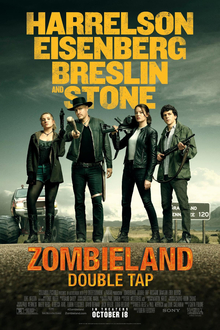
Film Flash: Zombieland - Double Tap

Four people stand ready with weapons. Behind them, partly obscured, is a monster truck and a signpost for Graceland Tennessee.
15 words or less film review (full review to follow soon)

Like reheating your favorite pizza: enjoyable for what it is, but not as fresh.


Sunday, May 3, 2020

Sunday Best: STAR WARS SAGA Films Ranked (Updated 2020)


Tomorrow is Star Wars Day and The Rise of Skywalker will be officially released on Disney+.  I thought it would be a good time to make a definitive list of where all SAGA films (Episodes I-IX) rank.

I did a similar list last December before the final film came out.  The list also included the non-SAGA movies, but they have been omitted here.  Much of the text remains from the previous post.

My assessment of the ranks may be a little odd for most people.  In fact, when I told one person a few years ago, he said to me point-blank (and without humor), "You're insane."

So below is how I would rank the Star Wars movies.

9.   Star Wars Episode VIII: The Last Jedi
Star Wars The Last Jedi.jpg
This movie is half-great.  The problem is that the B-story isn't just bad, it is completely pointless.  Nothing of consequence occurs in that B-story.  A number of people attack the film because of the portrayal of Luke.  I disagree.  I think that the guilt-ridden Luke was a fascinating take on the character.  If only writer/director Rian Johnson was not so obsessed with subverting expectation, then he could have made the story work better for all Star Wars fans.

8.  Star Wars Episode I: The Phantom Menace
Illustration depicting various characters of the film, surrounded by a frame which reads at the top "Every saga has a beginning". In the background, there is a close-up of a face with yellow eyes, and red, and black tattoos. Below the eyes are a bearded man with long hair, a young woman with face paint and an intricate headdress, three spaceships, a short and cylindrical robot besides a humanoid one, a boy wearing gray clothes, a young man wearing a brown robe holding a laser sword, and an alien creature with long ears. At the bottom of the image is the title "Star Wars: Episode I – The Phantom Menace" and the credits.
I love this film for what it is: a fun adventure for kids.  It also has one of the best lightsaber duels in the entire franchise.  The main flaw is how talky it is as it gets bogged down in space politics.  It also misses the opportunity to establish a strong friendship between Padme and Obi-Wan.  But despite its flaws I can still get a great deal of enjoyment from this film.

7. Star Wars Episode IX: The Rise of Skywalker
Star Wars The Rise of Skywalker poster.jpg
If this movie didn't have to work so hard in the first half to undo the damage of The Last Jedi, then it could have had more room to breathe.  I really loved seeing Rey, Poe, and Finn finally have scenes together to let their chemistry work.  If they had set up Palpatine in the previous film, there could have been a more seamless transition to this.  But the film we actually got feels too rushed.  However, I can say that I truly enjoyed the last half as much as anything in the Sequel trilogy.


6.  Star Wars Episode VII: The Force Awakens

I did not mind that this movie was a rehash of A New Hope's plot or that they killed off one of the main characters from the original.  This movie delivered on what it promised: Star Wars style fun and space adventure.  The opening was strong and JJ Abrams understood the visual vocabulary of George Lucas' universe.  And the moment Rey force grabs the lightsaber is as iconic as anything in the other Saga films.

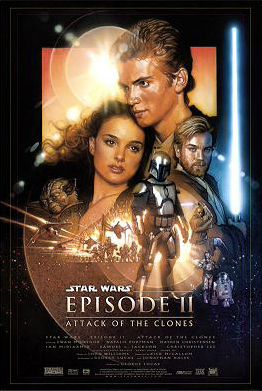
5. Star Wars Episode II: Attack of the Clones
Film poster. A young man is seen embracing a young woman. A man holds a lightsaber. A battle scene is in the middle, and in the lower foreground, there is a man wearing a suit of armor.
While they could have done a better job of showing Padme fall in love with Anakin, everything from the Genoshian arena until the end is gold.  All of that is a spectacle bigger than any we had seen in a Star Wars film until that point.  And the moment when Yoda draws his lightsaber... pure movie magic!

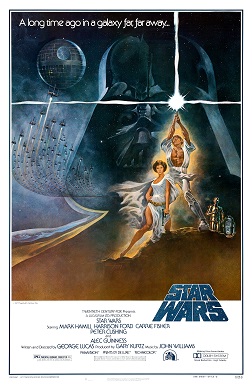
4.  Star Wars Episode IV: A New Hope
Film poster showing Luke Skywalker triumphantly holding a lightsaber in the air, Princess Leia kneeling beside him, and R2-D2 and C-3PO behind them. A figure of the head of Darth Vader and the Death Star with several starfighters heading towards it are shown in the background. Atop the image is the text "A long time ago in a galaxy far, far away..." On the bottom right is the film's logo, and the credits and the production details below that.
This is the one that started it all.  George Lucas took the universal story of the hero and turned it into an epic that no one had ever seen before.  It was so strange and yet so hauntingly familiar.  It is still as thrilling and compelling as it was over 40 years ago when it was released.  To this day, that final run on the Death Star Trench will have me on the edge of my seat and cheering.

3.  Star Wars Episode III: Revenge of the Sith

As I wrote above, someone told me I was insane for putting this one above A New Hope.  But when you look at the Saga movies as a whole, you can feel the power of Revenge of the Sith.  Anakin's fall to the dark side is so horribly tragic because you can see how morally trapped he feels.  All of his relationships fall apart because the only help he gets is from the one who wants to destroy his soul.  The last act perfectly captures the fall of man and how it plunges everything into darkness.

2. Star Wars Episode V: The Empire Strikes Back
. This poster shows a montage of scenes from the movie. Dominating the background is the dark visage of Darth Vader; in the foreground, Luke Skywalker sits astride a tauntaun; Han Solo and Princess Leia gaze at each other while in a romantic embrace; Chewbacca, R2-D2, and C-3PO round out the montage.
What this movie understood more than anything was Aristotle's principle that plot is character.  The whole movie is about how are characters are changed by the ordeals they face and the people that they face them with.  It never failed to turn out a story of truly epic scale and spectacle, but director Irvin Kershner turned the narrative inward and explored the souls of the characters involved.  Like that one cryptic shot of helmetless Darth Vader, the real story was beneath the surface.

1.  Star Wars Episode VI: Return of the Jedi
. This poster shows a montage of characters from the movie. In the background, Darth Vader stands tall and dark in front of a reconstructed Death Star; before him stands Luke Skywalker wielding a lightsaber, Han Solo aiming a blaster, and Princess Leia wearing a slave outfit. To the right are an Ewok and Lando Calrissian, while miscellaneous villains fill out the left.
This is my favorite movie of all time.  This is the end point of the Original Trilogy and in brought the entire story to the most satisfying conclusion I could imagine.  It turned the entire trajectory of the narrative from defeating Darth Vader to saving Anakin Skywalker.  It was something I did not expect and changed the way I looked at the world.  The bright colors, the epic adventure, the iconic moment, and the fantastic story all culminate into the greatest of all the Star Wars films.

Period.

Thoughts?

Friday, May 1, 2020

May 1st 2020 - Feast of St. Joseph the Worker

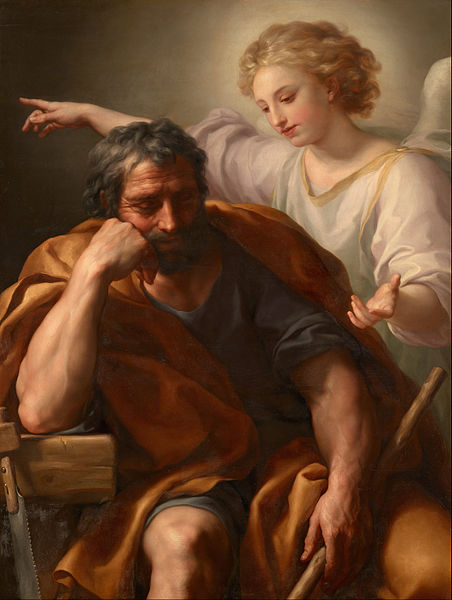
File:Anton Raphael Mengs - The Dream of St. Joseph - Google Art Project.jpg


40 days ago, we were told to shelter in place.  In that time we have been doing our best to go on with life as normal while our economy came to a dead halt.  Most of us understood that there was real danger from this virus, maybe not for ourselves but for those who are most vulnerable in our society.  And as much as it may hurt us, most Americans were willing to endure some sacrifice for the greater good.

Now, on this the Feast of St. Joseph the Worker, businesses are slowly beginning to open up.  We are reminded in the image of St. Joseph about the dignity of work.  There are many people who are struggling because they don't have the income they need to meet their needs.  But on top of this, work gives us a chance to participate in the creative and fruitful action of God.  In the Garden of Eden, Adam worked the land before labor became a toil.  We all complain about our jobs, but our work can give us purpose.  Work can also fill us with a sense of satisfaction and accomplishment when we achieve our goals. 

St. Joseph worked every day to provide for the Incarnate Word and the Immaculate Conception.  Our work allows us to take care of those we love and it gives us the opportunity to be generous with our talent and our treasures.  As much effort as it takes to do our jobs, I can imagine that there will be some measure of relief as many of us go back to work.

As we do, there is still the risk of sickness.  Today, let us pray through the intercession of St. Joseph the Worker.

St. Joseph the Worker, keep us safe as we begin to return to work.

St. Joseph the Worker, give gainful employment to all who are seeking it.

St. Joseph the Worker, grant success to the work of our hands so that we may be generous like you Son.

St. Joseph the Worker, let everything we do in our work be for the greater glory of God.

St. Joseph the Worker, pray for us!

Thursday, April 30, 2020

Film Review: Onward


Sexuality/Nudity Mature (for a children's movie)
Violence Acceptable
Vulgarity Acceptable
Anti-Catholic Philosophy Mature (for a children's movie)

Like most PIXAR films, Onward is incredibly clever.  Its premise is creative and its story has some intelligent twists and turns.  But what keeps this movie from really soaring is the excessive melancholy present in the film.

Onward takes place in a magical world of fairies, centaurs, and the like.  However, instead of continuing to rely on magic, these mythical beings embraced technology to create a world like ours, where magic has been relegated to legends and myths.  The story centers around Ian (Tom Holland), a geeky high school kid who is the yin to his boisterous, magic-obsessed brother Barley (Chris Pratt).  Their father died several years earlier so that Ian doesn't have any real memories of him and yearns for that connection that has been missing in his life.  On his birthday, their mother Laurel (Julia-Louis Dreyfus) presents them with a magical staff that their father willed to the boys when they were both of age.  It turns out that Ian has the power to use the staff to bring back their father for 24 hours.  He attempts the spell, but something goes wrong and their father only manifests from the waist down.  So the boys have 24 hours to find a magical crystal to complete the spell before their father is gone forever.

As I said, the movie is very clever.  The jokes and gags are witty and the brother are written to be incredibly likable.  Pratt's ability to infect his character with his child-like energy is uncanny.  Barley should be insufferably frustrating in his devil-may-care attitude.  But Pratt's voice makes him innocent and enthusiastic enough to be on his side the entire time.

The animation is also top-notch.  Director Dan Scanlon makes the movie a bold and colorful blend of the technical and magical.  The production design believable merges the worlds of technology and magic in a way that feels incredibly natural to the story.  Anyone who has played Dungeons and Dragons or Magic: the Gathering will be able to easily pick up on all the subtle and not-so-subtle references to the fantasy genre that give the movie a lot of its fun texture.  Barley constantly spouts things that sound familiar to fantasy fans.  The movie humorously blends the mythical with the absurd.  The Manticor (Octavia Spencer) has moved on from her role in dispensing mythical quest items to running a Chuck E. Cheese style restaurant.  The juxtaposition is so silly that it works very well.

There is one sequence by a draw bridge that not only hearkens back to Indiana Jones and the Last Crusade, but it was a thrilling and uplifting character moment.  Moments like this made me almost love this movie.

And I wanted to love this movie.  I really did.

But I couldn't.  It is a good movie, but it has a horrible flaw at its heart.

Ian and Barley's father is present in most of the movie only with his lower half.  He cannot talk, he cannot see.  He stumbles around, unable to communicate with his sons, nor have any idea what is happening around him.  I don't think the writers truly grasped what a horrific idea this is.  Parents, imagine you got trapped under something with only your bottom half exposed.  You know your kids are present, but you cannot hear them or see them.  Everyone once and a while they make contact with you, but you don't know what is happening and you know that time is running out.  This made the race against time aspect of the movie drastically unpleasant.  Every obstacle was not only a challenge to overcome, but another nail in the coffin.  I don't think writers Scanlon, Jason Headley, and Keith Bunin thought their story through enough.

MILD SPOILERS AHEAD

As the movie progresses, it pivots from a story about fathers and sons to a story primarily about brothers.  This move should have felt more natural and cathartic, but with the tragic-time crunch of the botched spell with the father created too much of an emotional investment in that story to move on to the new focus in the third act.

END OF SPOILERS

I would not recommend this movie for kids.  That was probably my biggest gripe.  A great kids movie could be enjoyed by both children and adults.  But this is something that is packaged to kids but geared towards adults.  When I said that the movie was melancholy, that doesn't mean that sadness is a deal-breaker.  Finding Nemo and Up have some of the saddest moments in animation and I would whole-heartedly recommend that film for children.  But the difference is that those movies front-load the sadness to the beginning and then show our heroes finding joy after tragedy.  People once asked GK Chesterton if it was a bad thing to teach children fairy stories since it presented an unrealistic view of the world.  Chesterton said that children already know that there are monsters in the world.  Fairy stories tell them that there are heroes who can defeat them.  In the same way, children already know that there is sadness in the world.  They want to know that there is a way to overcome it.

I was also on alert for the insertion of same-sex relationships in this film.  I will admit that the moment happens so quickly that you may not notice it at all, as it was in The Rise of Skywalker.  But it's insignificance also is part of its insidiousness.  If a movie wanted to be about characters with same-sex attractions and have it be marketed to children and families, I would prefer they do it openly so that parents can decide if they think their children are mature enough to engage the material.  But do not sneak in these agenda-driven moments like poison mixed into a drink.  Maybe the culture is at a point where this kind of movie would be a hit.  But don't try to sucker punch the audience.

This is such a shame, because if the shadow of melancholy and agenda evaporated, Onward would be a classic tale for the ages.

Wednesday, April 29, 2020

Wednesday Comics: Can Comics Survive?


Lauded comic book writer Grant Morrison said that comic books as an art form will endure.  He said even if it evolves into a weird technology that beams the image directly into your eyeball, there will be some kind of persistence.

With the shutdown of the major publishers and hundreds of comic book shops, the entire industry is hurting.  The main way the comic book industry has maintained itself is through the direct market to the individual comic book stores.  They ship new comics to the stores that release them on Wednesdays.  Long time collectors like myself make up the majority of their business.  They also release digital comics through apps like Comixology, but not nearly in the numbers that they do at the brick and mortar stores.  Because of the massive shut downs, there has been a month of no new comics being made, shipped, or sold.

Will it survive in its current form?

There are many people who are more learned than I about the ins and outs of the comic book industry.  I am writing from the perspective of an avid customer and an enthusiastic amateur.  These are my observations.

SUPPORT THE STORES

If comics in the current form is to survive, it will depend on the local comic book shops staying open.  The major companies have to do everything that they can to support them.  A store owner could probably give you a better perspective on what DC, Marvel, and the other companies can do to help.

The most important thing that I can think of is returning unsold comics.  DC offered to do this at the start of the outbreak.  To understand, the standard practice was for a company like Marvel or DC to sell a set number of each title like Iron Man or Batman to the store each week.  The store own buys them for a certain price below the cover price and then sell the comic for the cover price (standard now is $3.99 per comic book) and then they keep the difference as profit.  The problem is that if the comic does not sell with customers, the shop owner is left with a lot of product that they paid for to sit there and not sell.

For example, imagine you bought 30 copies Captain Marvel #1.  Cover price is $3.99 and you buy them for $1.99 each (these are only example numbers).  You then sell 10 copies.  You've taken in $39.90, but you've paid $59.70.  So you are at a loss on your investment.  Add to that shipping costs and other basic expenses of running a business, and you can see the problem.  Especially with first issues of a series, companies push high numbers on the stores and the stores might want to speculate as well.  But if the stores would be able to return the unsold comics, it could prevent them from taking a loss on poorly selling comics.

This would also help with the second issue

AGENDA-LESS STORIES

Every industry calls for this, but there is a real need for quality control in the comic book industry.  This is not exclusive to comics.  Movie box office numbers have been declining for years.  Even with record-breaking hits like Avengers: Endgame, the overall amount of people purchasing tickets continues to decline.  There are several reasons for this, but we have to take into account the poor quality of many of the movies Hollywood is producing.

The same thing applies to comics.  Avengers: Endgame is the highest grossing film of all time.  Why isn't the Avengers comic book being given this same investment of quality?  Marvel keeps pushing low-selling characters like Ms. Marvel.  Look at the debacle of the upcoming New Warriors, which has so much negative buzz that I am shocked that they are still making it.  Like Hollywood, so many comic book writers have forgotten that the most important thing is to create an entertaining and exciting story.  Instead, many of them want to make "important" stories that impact the culture.  This agenda-driven approach always harms the stories because people want to be to transported away to another world, not be lectured to about the world. 

WORK WITH CROWD-FUNDING

While the local comic stores have been struggling, there are some creators that have been doing incredibly well with crowd-funding.  They pitch a story through the internet and comic book fans can pay them to produce the stories they want to read.  It is really an inversion of the current model where many of the big companies create lots of comics that most people don't want to read or purchase.  Hasbro did something similar with their HASLABS where they crowdfunded massive toys like Jabba's Sail Barge. 

The success of people like Ethan Van Sciver and Richard C. Meyer is actually quite stunning.  Other professionals I love like Chuck Dixon and Scott McDaniel are also doing well here.  Todd McFarlane recently crowdfunded an action figure of his comic book creation Spawn and he made over $2 million in 2 days. 

The advantage of a system like this is that it gives you an immediate gauge of what fans want and what they don't and it gets you the money upfront even before you've spent in on writers and artists to create it.  Right now, crowdfunding results in comics being directly mailed to customers.  But if these campaigns made enough profit, they could work to have them distributed to comic book stores.  In fact, Meyer was planning to do this with his first crowdfunded comic Jawbreakers: Lost Souls.  However, because he is disliked by other comic professionals, it is alleged that his distributor was pressured into dropping him.  This is actually the subject of a current lawsuit.

This could even be a model that the bigger companies use.  They could experiment with prestige projects and then see how that it could work on the series level.  McFarlane, Meyer, and Van Sciver have together raised millions of dollars and proven that there are people who want to spend their hard-earned money on stories that they want to read.  If Marvel and DC catered to their audience in a similar way, they could create more comics that fans like me will want to buy.

Will the big companies adapt?  I see that DC has been doing a lot to try to adjust to these new circumstances.  Also, they have some great writers like Geoff Johns and Robert Venditti producing some incredible work.  I don't know about Marvel.  In order for local comic shops to do well, both of the major companies need to have healthy sales. 

We will see.


Monday, April 27, 2020

New Evangelizers Post: The End of Penance


I have a new article up at NewEvangelizers.com.  

We have now left the penitential season of Lent. For many of us, as soon as this time ended, we dropped our Lenten sacrifices like a bad habit. In some sense, this is right and proper since we are not celebrating Easter joy.

But the question remains: how much have we changed and drawn closer to God?

The end or purpose of our penitential practices is to detach ourselves from our sins and our worldly desires so that we can become more single-hearted in our devotion to God. The reason why many of us give up chocolate for Lent is not because there is something inherently evil about chocolate or the enjoyment of its sweetness. But we deny ourselves so that we can become more self possessed and not as beholden to our appetites and desires.

We also take on more devotional practices like the rosary and the Stations of the Cross during this season partly because we are sacrificing our time to show our devotion to the Lord. All of this is good and proper. But the addition of more penances and prayers is not the end or purpose of penance. In other words, God is not interested in having us do more simply for the sake of doing more.

In his novel The Brothers Karamazov, Dostoyevski has the buffoonish character Fyodor upbraid the inhabitant of a nearby monastery. He tells them that they are foolish because they think they are saving their souls by living in self-imposed poverty. And while Fyodor is no sage, his words have a point.
It is very important that we begin by understanding that there is nothing we can do to make God love us more than He does at this very moment. The Pelagian heresy held that we could earn our way to heaven by our devotion. St. Augustine was adamant that this was a contradiction to the Gospel. If I could earn my own way to salvation, then I would not need a Savior.

Some of my students ask if I think I am good enough to enter Heaven when I die. I tell them in no uncertain terms that I am not good enough. This fact is not a statement of despair, but of simple fact. The Lord’s gift of salvation is one that I will never earn. I feel the same way about my relationship with my wife. I don’t know why she chose to marry a bum like me, but I’m just grateful that she did. I will never be good enough, but I will spend the rest of my life doing my best to be worthy of her.

And that is essentially the end or purpose of penance. Ultimately, it is about our relationship to the Lord. It is not a cold , calculous, like some kind of spiritual economy. On the sitcom The Good Place, they describe an afterlife where you are punished or rewarded based on some kind of ethical point system. This is completely contrary to how Christianity teaches judgment will occur, though this may be how many Christians believe it will go. God is not our Spiritual Accountant. He is our Father.

Actions and works do matter. In the story of the final judgment in Matthew 25, those that are sent to hell are the ones who do not take care of the needs of the poor. Our penitential actions matter as well. But all these actions of penance and charity must be done from a good heart, a good soul. St. Paul writes in 1 Corinthians 13 “If I speak with human and angelic tongues but do not have love, then I am a resounding gong or a clashing cymbal… and if I give over my body to be burned so that I may boast, it profits me nothing.” Paul is not saying that speaking well and dying a martyr are bad things. He himself did both. What he is saying is that they are expressions of a holy heart.

This brings us back to penance. Returning to The Brothers Karamazov, there is a dying elder in that same monastery. Like the buffoonish Fyodor, he speaks of penance. There is a strange harmony between the vulgar attack from Fyodor and the wise dying words of the elder. The dying sage reminds the monks that they do penance in the monastery and mortify their lives not because they are spiritually strong.

They do it because they are spiritually weak.

You can read the whole article here.