ReasonForOurHope

Wednesday, November 20, 2019

Film Flash: Ford vs. Ferrari


15 words or less film review (full review to follow soon)

Like A Star is Born,  the final 10 minutes completely ruin an otherwise good movie.


Add caption

Sunday, November 17, 2019

Sunday Best: Movies Inspired by Shakespeare Plays


Last week, I made a list of the Top Ten Adaptations of Shakespeare to Movies.  However, I received some feedback asking where movies like 10 Things I Hate About You were.  This would require a different category.  Movies like this are based on Shakespearean plots, but they do not incorporate his words. 

There is also another added level of difficulty in that ideas, themes, dialogue, and plot points have been borrowed from the Bard in a myriad of movies.  So this list current list must be selective.  The plot must have large enough plot similarities to the original Shakespearean story in order to be here. 


So here are the Top 5 Movies Inspired by Shakespeare Plays


10 Things I Hate About You
(based on The Taming of the Shrew)
10 Things I Hate About You film.jpg
While the dialogue is often not great and most of the acting is sub-par, this movie works primarily because of the fantastic charisma of Heath Ledger.  He elevates this material by being incredibly masculine and sensitive.  One of the greatest romantic moments in movies that I have seen is Ledger effortlessly sliding down the light pole while singing Frankie Valley. 

Warm Bodies
(based on Romeo and Juliet)
Warm Bodies Theatrical Poster.jpg
It is scary how much this movie adheres to the source material, but transposes It into a zombie apocalypse.  The movie is clever and funny and surprisingly strong in its theme about how love can bring us back to life.  Wonderful performances by Teresa Palmer and Nicholas Hoult

The Lion King
(based on Hamlet)
In an African savannah, several animals stare at a lion atop a tall rock. A lion's head can be seen in the clouds above. Atop the image is the text "Walt Disney Pictures presents The Lion King".
The story of Hamlet is complex, but it is primal.  This means that it can be whittled down to its essence and folded into a children's film.  The story parallels have been pointed out all over the Internet.  And while this movie does not end as tragically as the other, it does a wonderful job of capturing how Hamlet's inaction leads to more tragedy.


Star Wars Episode III: Revenge of the Sith
(based on Othello)
Below a dark metal mask, a young man with long hair is front and center, with a woman at his left and a bearded man at his right. Two warriers hold lightsabers on either side, and below them in the middle, two men clash in a lightsaber duel. Starfighters fly towards us on the lower left, and a sinister hooded man sneers at the lower right.
The parallels between the main story line of this movie and Othello are too strong to ignore.  Palpatine acts as the villainous Iago, poisoning Anakin's soul under the guise of friendship until he is so enraged by jealousy that he strangles his wife to the point where he "kills" her.  I've always felt that this movie was a tragedy of Shakespearean proportions.


West Side Story
(based on Romeo and Juliet)
West Side Story poster.jpg
Dare I say that this story is actually an improvement on the original.  Shakespeare writes some of his most romantic lines for his play.  But I firmly believe that Romeo and Juliet is horribly misinterpreted by modern audiences.  I believe Shakespeare meant to show Romeo as the villain, like Macbeth, who resorts to murder because of his passions.  West Side Story not only makes Tony a complete hero (albeit one who falters in a moment of shock and grief), but the music  elevates the emotion.  I do not think anyone could make a better movie inspired by a Shakespeare play.

Thursday, November 14, 2019

New Evangelizers Post: Clarity and Confusion

I have a new article up at NewEvangelizers.com.  
There is a song that was particularly dear to me many years ago when I came to my conversion experience. One of the lyrics goes “Lord, take the darkness from my min, when confusion makes me blind, come renew me with your truth.” A short while later, a friend of mine changed the lyrics when we sang to “when temptation makes me blind…” He reasoned that temptation was a spiritual problem, but confusion was not.

Over the years I have come to see that my friend was wrong.

Confusion, like temptation, is not necessarily a spiritual weakness. Jesus was tempted, after all. And God can use our confusion as a means to his will. Sometimes in our confusion, we come to realize how in the dark we truly are. As the great Rich Mullins wrote, sometimes God allows us to be confused so that I can come to the place “where I’m lost enough to let myself be led.”

But there is another kind of confusion that is incredibly problematic for Catholics: moral confusion.
One of the things that I have found in all my years of teaching is that my students want to know the answers to their questions. Even if they don’t like the answers, they want clear responses from their teacher. I can see how many of them roll their eyes when I tell them how is too far to go with their boyfriend or girlfriend. Some of them bristle when I inform them that intentionally skipping the Lord’s Day Mass is a mortal sin. I understand the temptation that some teachers have in avoiding the difficult topics. But it is the responsibility of the theology teacher to speak the truth, whether convenient or inconvenient.
To be sure, not all answers are cut and dried. When I get a question like, “Is it true that if someone kills themselves, they are going to hell?” it requires a great deal of sensitive explanation. But even with cases like these, it is important to be absolutely clear. There are some who would shy away from the Church’s teaching here so as not to offend those who have lost their loved ones to suicide. But this leads to more problems, not less.

Take a concrete issue from recent days. Inside of the Church of Santa Maria, close to the Vatican, were displayed statues of Pachamama in recognition of the Amazon Synod. The problem was that Pachamama is a god to some people who reverence and worship Pachamama as an idol. So some Catholics took the statues and threw them into the Tiber. Pope Francis apologized for this desecration of Pachamama. This whole event has led to a great deal of confusion.

Was this an idol? And if so, shouldn’t they be removed from the Church? If they are not idols, but they are not sacred images, why are they on display in the Church? If they are simply symbols of planet earth, then why did people bow down and reverence them? If they were not reverencing them, what were they doing?

All of this confusion leads to even bigger problems. Can we revere and image that is being used by some as an idol for worship? It would seem the answer is obviously no. That is, unless there is absolute clarity on the part of all involved that Pachamama is only a symbol. But this is problematic, since the lived experience seems to say the opposite.

When Peter was at Antioch, he made sure to eat with the Jewish Christians and follow the Jewish dietary laws. Paul took Peter in front of everyone and scolded him. Peter’s actions caused confusion among the Gentile Christians, and Paul wasn’t having it. Paul understood that this confusion could be used for diabolical doubt and the erosion of true faith.

In America, Pope Paul VI refused to excommunicate Catholic leaders who openly defied his teaching on artificial contraception. Many, like author Philip Jenkins, believed that Paul feared if he did so it would lead to a schism with the American Catholics. And to be sure, a Schism would be disastrous. But even more disastrous is what followed. In the confusion, many people came to the conclusion that they could be full-fledged Catholics and reject essential Catholic teaching. If the pope wasn’t going to kick them out, then it must be okay, right? This is why we have so many “pro-choice” Catholics and Catholics who support things like same-sex “marriage” while other fundamental teachings like the Real Presence of the Eucharist.

I believe that there are some (and feel free to disagree with me on this point), that use the confusion as a moral smoke-screen. Thinking that the moral teachings are the Church are too difficult, they create an atmosphere where the answers are intentionally murky. They think that as long as people act in good conscience, then the confusion excuses their rejection of the moral law.

But this overlooks one of the most important lessons about the moral law: that it exists for our good. Sin is not just bad, it is bad for us. Yes, confusion may lessen the culpability, but it doesn’t change the disastrous effect it has on our lives and the world. If you raised by an alcoholic, you may have less culpability if you become an alcoholic yourself. But whether it is your fault or not, alcoholism can destroy your life.


You can read the whole article here.

Sunday, November 10, 2019

Sunday Best: Top 10 Shakespeare Movies

This is the opening week for the second Shakespeare play I have directed.  I adore William Shakespeare, though I will not vouch myself an expert.  Instead I will say that I am enthusiastic student of his work.  His plays have been adapted hundreds of times in hundreds of different ways for the stage and screen.

With that in mind, it would be good to look at the best ways in which the immortal writer's stories were captured on the sliver screen.


10. Love's Labour's Lost (2000)
Loveslabourslostpost.jpg
You are going to see a lot of movies directed by Kenneth Branagh on this list.  Those familiar with this blog know that I am not shy about my partiality towards his work.  This time he does something quite experimental: he combined the play with 1930's Broadway hits.  The combination is odd and works sporadically well.  The modest budget of $13 million forced the film to look a bit almost all the sets looking artificial like a film from the era of the songs the cast was singing.  The reason this film makes it into the top ten is that when Branagh is able to get it to work, the movie is incredibly charming.  Like many of his comedies, the story is incredibly silly.  But Branagh and his cast do an admirable job of moving the movie along with some toe-tapping numbers in between.  I particularly enjoyed Branagh's monologue about love towards the end of the film.

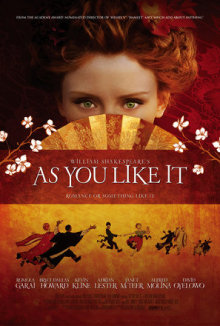
9. As You Like It (2006)
As U Like It 2006 poster.jpg
Another Branagh adaptation, this one transposes Shakespeare's characters to feudal Japan.  The scenery is simple, but beautiful.  But what really makes this one work are the performances.  I was surprised at how good Bryce Dallas Howard was in the lead role.  She was both charismatic and charming, showing intelligence and feminine grace.  Kevin Kline showed wonderful range as the melancholy Jaques.  Alfred Molina also does a wonderfully comedic job as Touchstone the jester.

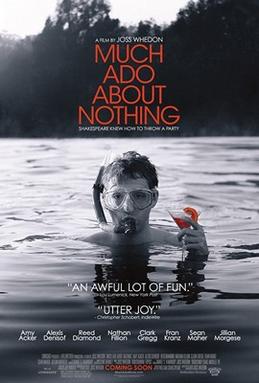
8. Much Ado About Nothing (2012)
A man wearing scuba googles and snorkle, his head is just above water. In his hand is a red cocktail, the image is otherwise black and white.
Joss Whedon adapted this version of the classic comedy and shot it with friends almost exclusively at his home.  The simple black and white piece captures the universality of the story and why it is so familiar and resonant whenever it is adapted.  The war of the sexes should always end in mutual surrender to love.  Alexis Denisof and and Amy Acker lost none of their chemistry from their time on the TV show Angel.  Nate Fillion is particularly good as the dead serious, but dead stupid Dogberry.

7. The Hollow Crown: Henry IV Part I (2012)
Hollow crown logo.jpg
This adaptation is the best I have seen of this story.  Most of that falls on the shoulders of Tom Hiddleston as Prince Hal.  He carries with him his roguish Loki grin, but he pushes all of his dramatic buttons to really peel back the layers of this incredibly complex character.  Jeremy Irons does a great job as the imposing Henry IV, but the one who brings both the comedy and tragedy to all of this is Simon Russell Beale as Falstaff.  The play-within-a-play scene turns from hilarious to heartbreaking because he and Hiddleston play the subtext to perfection.


6. Julius Caesar (1970)
209029~Julius-Caesar-Posters.jpg
There is no getting around the fact that Jason Robards as Brutus Is awful in this movie.  But as bad as his casting is, you will completely overlook it because of the magnificence of the mighty Charlton Heston.  His performance as Antony, especially at the funeral speech is one of the all-time greatest Shakespearean performances.  You can see how Shakespeare understood the power of words and how they can sway people's hearts, even when they are insincere.  Heston squeezes every drop of dramatic blood from those words to conjure a rhetorical storm so that you believe the power of his speech could move a city to riot.


5. A Performance of Macbeth (1978)

This one is a little bit of a cheat.  It is a recording of something that is essentially a stage play.  But the filming of it is very specifically used to make it feel more than a theatrical performance.  The performance space is bare and so the entire movie must hang on the faces of the actors.  And these performances are world-class.  Ian McKellen knocks it out of the park as you see the slow erosion of MacBeth's soul.  Judi Dench is every much his equal as she goes from evil to insane as the sins she commits come back to destroy her.  This is dark and haunting the way Macbeth should be.

4. Hamlet (1990)
Hamletposter.jpg
This was my first exposure to Hamlet.  I was only twelve, but I was shocked at how much I was able to understand.  Not only was this because of Franco Zeffirelli's direction, but it was primarily because of Mel Gibson.  I had known him primarily as an action star and hadn't thought of him much beyond that.  But he gives a tour-de-force performance that knocked my socks off.  There is a wildness in his eyes, a madness that sets the movie on fire.  I could feel his intensity in my own heart and it resonated with me like few other Shakespeare performances.  Helena Bonham Carter's waifish Ophelia, who collapse into madness, haunted me with her crazy, sunken eyes.  A dark and tragic take on the classic story.


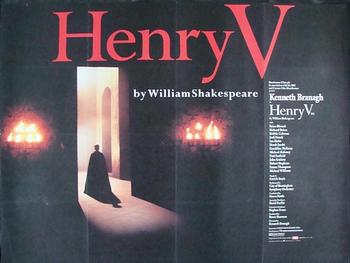
3. Henry V (1989)
Henry v post.jpg
This film received a number of Oscar nominations, all of them well deserved.  I did not know the story of Henry V when I went to watch it and Branagh drew me in with his directing and his performance.  Everything fires on all cylinders in this movie.  I absolutely adore everything from the night before the battle of Agincort through to the final tracking shot.  It is so beautifully filmed with such long, sweeping takes.  The Patrick Doyle score has been sampled dozens of times for film trailers because it captures the uplift and drama presented on the screen.  I still get chills watching Branagh give his St. Crispin's Day speech.  It is the perfect antithesis of Heston's Caesar speech.  Whereas I believed Heston's words could spurn others to vile destruction, Branagh made me believe his words could inspire hopelessly outnumbered men that they were privileged to stand their ground and fight with him.  A great film.


2. Hamlet (1996)
Hamlet 1996 poster.jpg
This movie is absolutely beautiful.  Branagh took all of his skills as a visual filmmaker and brought to life the best version of Hamlet I have seen.  It is the only movie that captures the entire entire text of the play, clocking in at just above four hours long.  The icy landscape ultra-wide and ultra-wide format give a scale reminiscent of Doctor Zhivago.  All of the performances are excellent and are complimented by the incredible visual design.  Patrick Doyle's score is passionate and haunting.  The movie is a who's who of acting greats with Branagh in the lead, but also featuring Derek Jacobi, Kate Winslet, Julie Christie, Charlton Heston, Richard Attenborough, Billy Crystal, and Robin Williams.  And yet none of the casting feels like a stunt as each actors executes their role to great effect.  Crystal's gravedigger is a particular highlight for me.  The film requires endurance to sit through because of the length, but doing so rewards you with a unique and beautiful cinematic experience.

1. Much Ado About Nothing (1993)
Much ado about nothing movie poster.jpg
I've said this before about this movie: it was a revelation to me because it taught me that Shakespeare was actually funny.  That revelation made me realize that his words were not cold and distant, but alive and relevant.  The movie is pure romance, and I mean that in both the modern and medieval way.  It captures to pomp and poetry of the age.  Branagh is fantastic as Benedick and Emma Thompson shines as Beatrice.  Denzel Washington brings his princely bearing to the proceedings and Michael Keaton shows off all of his manic comedic skills as Dogberry.  This movie is a joy and triumph.  The subject matter may be whimsical, but it captures the pain, poignancy, and pleasures of romance.  If I were ever to show a movie to help someone fall in love with Shakespeare it would be this one.

Saturday, November 9, 2019

Film Review: Ad Astra


Sexuality/Nudity Acceptable
Violence Mature 
Vulgarity Mature
Anti-Catholic Philosophy Mature

I've always said that if you want to sound smart to people, either quote them Latin or Shakespeare.  The makers of this movie desperately want to sound smart.  To the Stars didn't sound pretentious enough, so they Latinized the title: Ad Astra.


The film centers around Roy McBride (Brad Pitt), an emotionally walled-off astronaut in the not-too distant future.  A calamity befalls the people of earth and the powers that be think that the source of the problem is Roy's father, H. Clifford McBride (Tommy Lee Jones).  Clifford went on a mission to Neptune and from there seek out intelligent life outside of the solar system.  SpaceCom lost all contact with the expedition decades earlier, but they have reason to believe that some kind of energy wave is emanating from their ship and affecting Earth.  Roy is tasked to go to Mars to make radio contact with his long-lost father and see if they can resolve this crisis.

I don't know what it is about space movies that brings out the pretension in directors.  This movie desperately wants to be 2001: A Space Odyssey.  To be sure, writer/director James Gray does some fine visual work.  But the space opera feels like it is trying too hard to be lofty.  Even the great Christopher Nolan fumbled a little with his finale to Interstellar.  Gray wants to make a movie with big themes, sweeping emotions and potent visuals.  But he forgets that first and foremost he is telling a story.  And none of those other things matter if you do not have characters that you want to follow. 

There is absolutely nothing interesting about Roy.  He is a block of wood in a space suit.  That is not an insult to Pitt's performance.  I am sure he was told to play the part of someone with the emotional depth of a thimble.  I suppose this was meant to show how Roy's abandonment as a child has stunted his full emotional growth.  Donald Sutherland has an extended cameo as a friend of Clifford, but he exits the movie too soon to have any impact.  The movie builds to our potential reunion between Roy and his father, but everything about it is hollow.

The world-building is excellent.  In fact, it is so good that you almost wish they would jettison the main story and explore some of the side ones.  Usually in good writing, you create a detailed environment for the story to take place in, while explicit showing only about 10% of the foundation that you imagined.  But the story that is told in this movie isn't worth telling.  Some of the fascinating tidbits include commercial trips to the moon, where it has been colonized.  But factions have broken things down in some areas like the Old West.  When traveling beyond safe borders, moon pirates attack travelers for supplies.  Also, there is a space ship that is in distress because the baboons being used for research animals escaped and started eating the crew.  All of these things are much more interesting than what we end up watching.

One of the things that the film tries to capture is the tedium of space travel and the long loneliness that it engenders.  While this is interesting on paper, it was unenjoyable in execution.  You begin to feel like a child in a long car ride, waiting for it to end. 

One of the other annoying things was how the film used religion.  Many movies about the future remove all mention of Christianity, seemingly under the assumption that humans will outgrow religion.  So it would have been refreshing to see that a movie recognizes the deeply rooted religious instinct in human beings.  But any good will is undercut by the cliched use of religiosity as a sign of irrationality.  Whenever a character speaks of God or prays in the movie, you know that they are either crazy or stupid.

MAJOR SPOILERS BELOW

One of the most frustrating things about the movie is how pointless all of it is.  When contact is finally made with Clifford, Roy is not allowed to go on the mission from Mars to Neptune because of his emotional connection.  He fears that the ones they are sending will simply nuke his father's ship and call it a day.  So Roy sneaks onto the ship and during the struggle, all three of the other astronauts are killed.  Instead of Roy realizing that he made a mistake, he caries on for months through space alone to Neptune.  When he gets there, he decides to nuke the ship anyway and his father commits suicide in a moment where Roy has to literally let him go that is about a subtle as a sledgehammer.  The only thing Roy accomplished was getting three people killed who were only doing their jobs.  Roy does bring back the data of the lifeless worlds his father found, but that seems a poor exchange of value.

END SPOILERS

This movie was a mistake.  It is a spectacle devoid of character, emotion, and catharsis.  Instead of this one going "To the Stars" it is going "To the Dollar Bin" at Walmart.


Friday, November 8, 2019

Happy I'm Still Sad

CS Lewis said that "No one ever told me that grief was so much like fear." 

On dealing with the death of his wife, Lewis was overcome with a grief that shrouded his mind for a long time.  He spent a great deal of mental and spiritual effort to work through his grief.  He did not need to live with it very long as he followed his wife into eternal rest three years later.

For me, the biggest loss I've had so far in my life has been my mom.  Those weeks and months of her hospitalization had been filled with fear and sadness.  After her passing, only the sadness remained.  Oddly, there was a calming sense of relief.  It was a very strange feeling, but I think I understand it.  One the thing I had feared came to pass, there was no longer anything to be afraid of.  All we had to do was process the loss we endured.

For weeks and months later, I would describe to people what I would call "sadness attacks."  It is the best way I can describe it.  They similar to people having panic attacks, where the overwhelming feeling comes out of nowhere and takes over your emotions.  I would be doing something simple like wrapping some leftovers in foil, and I would remember how the first time my mom made me a school lunch it was KFC wrapped in foil.  As innocuous as these memories seem, it only reinforced that this person whom I loved and loved me was no longer here.  And then the sadness would come.

It has been over two years since her passing.  And time does do a great deal to heal.  Yet every once and a while, I will remember and my heart will ache.  Just recently, there was an episode of the TV show The Goldbergs that aired where the dad wanted to do something special for his sons.  So he bought them Wrestlemania tickets even though he hated wrestling.  I've written before about how one of my favorite memories with my mom was when she took me to see Wrestlemania III even though she hated it.  Watching the show I got oddly emotional.

I share all of this not to complain.  With all of life's challenges, I am still incredibly blessed and happy.  And yet this grief has become a constant, though not debilitating, part of my life.

Hitting middle age, you lose people from your life.  I've lost relatives and friends.  And I will lose more.  There are those for whom the loss is felt, but does not persist.  I had a very close friend named Scott from grade school.  I remember for my third grade birthday, my parents took me out and only allowed me to bring one friend and it was Scott.  We were close all the way through junior high.  We went to different high schools and lost touch.  He hooked up with a bad crowd and his life ended way too early.  When I found out about Scott, I was incredibly sad.  But even now as I think back, the feeling is more akin to pity than to grief.

I think this is because Scott had not been a part of my life for so long.  I am sorry for his loss and he is missed.  But the loss of someone like my mom feels more akin to a piece of who I am being torn from me.  When people lose limbs, they often experience phantom pain, which is the feeling of pain coming from a body part that isn't there.  There is a phantom pain in my heart for the piece that is missing that was my mom.

And here's the thing: I don't want this pain to go away.

I think that if ever I completely "get over" my mother's death, it would be a loss for my soul.  This doesn't mean that I shouldn't go on with life and enjoy the days ahead.  But if I ever come to a place where I don't miss her, then I know I've come to a place where my love for her has diminished.  And I don't want that.  My wife will sometimes feel the same way about my mom's loss and it will bring her to tears.  As much as I hate to see her cry, it fills my heart with great relief to know that other people still miss my mom.  She was that important and that loved.  And that loss is in proportion to that love.

One of my greatest fears in this world is the loss of my wife.  As the years march on, I know that the day of our separation is getting closer.  In this mortal world, there is no avoiding it.  That's the deal.  If she should leave before me, I could not imagine the hole that it would tear in my life.  It is such a loss that I don't know how much of me would be left.

And yet, by the grace of God, I know He can bring healing, especially over time.  But there would never be a time where I wouldn't want to feel the loss of her.  There would never be a time when I would ever want to not miss her.  Even in our life now, when I am not with her, I miss her every moment.  That ache in my heart reminds me of the place she has there.  It is as if her place has been reserved for her and no one else.  And without her, it is empty.

That is how I now feel about my mom.  But I know that the vacancy is only temporary.  The rooms are closed, but not shut up and shuttered.  We will be reunited one day and all of that emptiness will be filled. 

Until then, I want my sadness to be like a candle in the window: a sign that the place in my heart for her and those I've loved is still here.  I have not forgotten.  And because I have not forgotten, even though they are not here, they are still a part of me until the day I die.  In that way, their memory has not left this world.

And for that reason, I am happy that I am still sad.

Tuesday, November 5, 2019

New Evangelizers Post: No Detente with the World


I have a new article up at NewEvangelizers.com.  
“I have given them your word and the world has hated them, for they are not of the world any more than I am of the world. My prayer is not that you take them out of the world but that you protect them from the evil one.” (John 17:14-15)

There has been a lot of talk recently about how best to evangelize to the world. While every generation has its own challenges, there are things that this modern world faces the likes of which we have never seen before. Unlike the pagans of old, in many ways, we live in a post-Christian society. CS Lewis made the observation in Mere Christianity that preaching to the pagans was like preaching marriage to a virgin about marriage while speaking to modern non-Christians is like speaking to a divorcee about marriage. Both are unmarried, but one has never experienced marriage and the other one has and rejected it.
In our modern world, many people have rejected Christianity or at least what they think is Christianity. So when we speak to them about the faith, their hearts close up against something that they think is antiquated, outdated, discredited, and thoroughly unmodern.

One of the purposes of Vatican II was to open the windows of the Church to reach out to the modern world as it. There is no point in preaching to a world in which you have no understanding or engagement. In the post-modern society, a world that has in many ways become smaller and larger, the Church must constantly learn the best ways to engage and dialogue with modernity.

But dialogue is not the end. It is only a means.

I have noticed that in many circles, there appears to be a kind of detente (meaning a kind of peace with the modern world that accepts it as it is) mentality when it comes to the Church and the modern world: . In the name of tolerance and diversity, there seems to be an acceptance of the ways in which modern society is at odds with the Church. This is, of course, not a blanket statement. But when we reach out to communities at odds with our faith, what is the end or purpose?

Our ultimate goal must always be to bring them into communion with salvific love of Jesus Christ. The Gospel of Matthew ends with the great commission: “Therefore go and make disciples of all nations, baptizing them in the name of the Father and of the Son and of the Holy Spirit, 20 and teaching them to obey everything I have commanded you. And surely I am with you always, to the very end of the age.” (Matthew 28:19-20) Our goal must always be to bring people to Jesus. As long as this is the ultimate goal, then there can be some legitimate disagreement on methods. For example, many in proposed during the Amazon Synod that missionaries do not impose a Western style of Christianity if it will not make sense to the people. This may be wise or foolish. But as long as the ultimate goal is to bring people to Christ, then we can have a legitimate debate.


You can read the whole article here.