ReasonForOurHope

Sunday, November 10, 2019

Sunday Best: Top 10 Shakespeare Movies

This is the opening week for the second Shakespeare play I have directed.  I adore William Shakespeare, though I will not vouch myself an expert.  Instead I will say that I am enthusiastic student of his work.  His plays have been adapted hundreds of times in hundreds of different ways for the stage and screen.

With that in mind, it would be good to look at the best ways in which the immortal writer's stories were captured on the sliver screen.


10. Love's Labour's Lost (2000)
Loveslabourslostpost.jpg
You are going to see a lot of movies directed by Kenneth Branagh on this list.  Those familiar with this blog know that I am not shy about my partiality towards his work.  This time he does something quite experimental: he combined the play with 1930's Broadway hits.  The combination is odd and works sporadically well.  The modest budget of $13 million forced the film to look a bit almost all the sets looking artificial like a film from the era of the songs the cast was singing.  The reason this film makes it into the top ten is that when Branagh is able to get it to work, the movie is incredibly charming.  Like many of his comedies, the story is incredibly silly.  But Branagh and his cast do an admirable job of moving the movie along with some toe-tapping numbers in between.  I particularly enjoyed Branagh's monologue about love towards the end of the film.

9. As You Like It (2006)

As U Like It 2006 poster.jpg
Another Branagh adaptation, this one transposes Shakespeare's characters to feudal Japan.  The scenery is simple, but beautiful.  But what really makes this one work are the performances.  I was surprised at how good Bryce Dallas Howard was in the lead role.  She was both charismatic and charming, showing intelligence and feminine grace.  Kevin Kline showed wonderful range as the melancholy Jaques.  Alfred Molina also does a wonderfully comedic job as Touchstone the jester.

8. Much Ado About Nothing (2012)
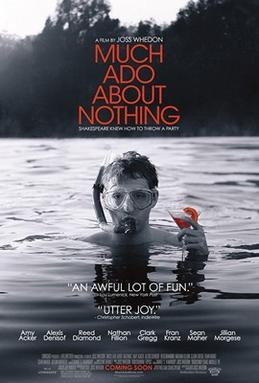
A man wearing scuba googles and snorkle, his head is just above water. In his hand is a red cocktail, the image is otherwise black and white.
Joss Whedon adapted this version of the classic comedy and shot it with friends almost exclusively at his home.  The simple black and white piece captures the universality of the story and why it is so familiar and resonant whenever it is adapted.  The war of the sexes should always end in mutual surrender to love.  Alexis Denisof and and Amy Acker lost none of their chemistry from their time on the TV show Angel.  Nate Fillion is particularly good as the dead serious, but dead stupid Dogberry.

7. The Hollow Crown: Henry IV Part I (2012)
Hollow crown logo.jpg
This adaptation is the best I have seen of this story.  Most of that falls on the shoulders of Tom Hiddleston as Prince Hal.  He carries with him his roguish Loki grin, but he pushes all of his dramatic buttons to really peel back the layers of this incredibly complex character.  Jeremy Irons does a great job as the imposing Henry IV, but the one who brings both the comedy and tragedy to all of this is Simon Russell Beale as Falstaff.  The play-within-a-play scene turns from hilarious to heartbreaking because he and Hiddleston play the subtext to perfection.


6. Julius Caesar (1970)
209029~Julius-Caesar-Posters.jpg
There is no getting around the fact that Jason Robards as Brutus Is awful in this movie.  But as bad as his casting is, you will completely overlook it because of the magnificence of the mighty Charlton Heston.  His performance as Antony, especially at the funeral speech is one of the all-time greatest Shakespearean performances.  You can see how Shakespeare understood the power of words and how they can sway people's hearts, even when they are insincere.  Heston squeezes every drop of dramatic blood from those words to conjure a rhetorical storm so that you believe the power of his speech could move a city to riot.


5. A Performance of Macbeth (1978)

This one is a little bit of a cheat.  It is a recording of something that is essentially a stage play.  But the filming of it is very specifically used to make it feel more than a theatrical performance.  The performance space is bare and so the entire movie must hang on the faces of the actors.  And these performances are world-class.  Ian McKellen knocks it out of the park as you see the slow erosion of MacBeth's soul.  Judi Dench is every much his equal as she goes from evil to insane as the sins she commits come back to destroy her.  This is dark and haunting the way Macbeth should be.

4. Hamlet (1990)
Hamletposter.jpg
This was my first exposure to Hamlet.  I was only twelve, but I was shocked at how much I was able to understand.  Not only was this because of Franco Zeffirelli's direction, but it was primarily because of Mel Gibson.  I had known him primarily as an action star and hadn't thought of him much beyond that.  But he gives a tour-de-force performance that knocked my socks off.  There is a wildness in his eyes, a madness that sets the movie on fire.  I could feel his intensity in my own heart and it resonated with me like few other Shakespeare performances.  Helena Bonham Carter's waifish Ophelia, who collapse into madness, haunted me with her crazy, sunken eyes.  A dark and tragic take on the classic story.


3. Henry V (1989)

Henry v post.jpg
This film received a number of Oscar nominations, all of them well deserved.  I did not know the story of Henry V when I went to watch it and Branagh drew me in with his directing and his performance.  Everything fires on all cylinders in this movie.  I absolutely adore everything from the night before the battle of Agincort through to the final tracking shot.  It is so beautifully filmed with such long, sweeping takes.  The Patrick Doyle score has been sampled dozens of times for film trailers because it captures the uplift and drama presented on the screen.  I still get chills watching Branagh give his St. Crispin's Day speech.  It is the perfect antithesis of Heston's Caesar speech.  Whereas I believed Heston's words could spurn others to vile destruction, Branagh made me believe his words could inspire hopelessly outnumbered men that they were privileged to stand their ground and fight with him.  A great film.


2. Hamlet (1996)
Hamlet 1996 poster.jpg
This movie is absolutely beautiful.  Branagh took all of his skills as a visual filmmaker and brought to life the best version of Hamlet I have seen.  It is the only movie that captures the entire entire text of the play, clocking in at just above four hours long.  The icy landscape ultra-wide and ultra-wide format give a scale reminiscent of Doctor Zhivago.  All of the performances are excellent and are complimented by the incredible visual design.  Patrick Doyle's score is passionate and haunting.  The movie is a who's who of acting greats with Branagh in the lead, but also featuring Derek Jacobi, Kate Winslet, Julie Christie, Charlton Heston, Richard Attenborough, Billy Crystal, and Robin Williams.  And yet none of the casting feels like a stunt as each actors executes their role to great effect.  Crystal's gravedigger is a particular highlight for me.  The film requires endurance to sit through because of the length, but doing so rewards you with a unique and beautiful cinematic experience.

1. Much Ado About Nothing (1993)
Much ado about nothing movie poster.jpg
I've said this before about this movie: it was a revelation to me because it taught me that Shakespeare was actually funny.  That revelation made me realize that his words were not cold and distant, but alive and relevant.  The movie is pure romance, and I mean that in both the modern and medieval way.  It captures to pomp and poetry of the age.  Branagh is fantastic as Benedick and Emma Thompson shines as Beatrice.  Denzel Washington brings his princely bearing to the proceedings and Michael Keaton shows off all of his manic comedic skills as Dogberry.  This movie is a joy and triumph.  The subject matter may be whimsical, but it captures the pain, poignancy, and pleasures of romance.  If I were ever to show a movie to help someone fall in love with Shakespeare it would be this one.

Saturday, November 9, 2019

Film Review: Ad Astra


Sexuality/Nudity Acceptable
Violence Mature 
Vulgarity Mature
Anti-Catholic Philosophy Mature

I've always said that if you want to sound smart to people, either quote them Latin or Shakespeare.  The makers of this movie desperately want to sound smart.  To the Stars didn't sound pretentious enough, so they Latinized the title: Ad Astra.


The film centers around Roy McBride (Brad Pitt), an emotionally walled-off astronaut in the not-too distant future.  A calamity befalls the people of earth and the powers that be think that the source of the problem is Roy's father, H. Clifford McBride (Tommy Lee Jones).  Clifford went on a mission to Neptune and from there seek out intelligent life outside of the solar system.  SpaceCom lost all contact with the expedition decades earlier, but they have reason to believe that some kind of energy wave is emanating from their ship and affecting Earth.  Roy is tasked to go to Mars to make radio contact with his long-lost father and see if they can resolve this crisis.

I don't know what it is about space movies that brings out the pretension in directors.  This movie desperately wants to be 2001: A Space Odyssey.  To be sure, writer/director James Gray does some fine visual work.  But the space opera feels like it is trying too hard to be lofty.  Even the great Christopher Nolan fumbled a little with his finale to Interstellar.  Gray wants to make a movie with big themes, sweeping emotions and potent visuals.  But he forgets that first and foremost he is telling a story.  And none of those other things matter if you do not have characters that you want to follow. 

There is absolutely nothing interesting about Roy.  He is a block of wood in a space suit.  That is not an insult to Pitt's performance.  I am sure he was told to play the part of someone with the emotional depth of a thimble.  I suppose this was meant to show how Roy's abandonment as a child has stunted his full emotional growth.  Donald Sutherland has an extended cameo as a friend of Clifford, but he exits the movie too soon to have any impact.  The movie builds to our potential reunion between Roy and his father, but everything about it is hollow.

The world-building is excellent.  In fact, it is so good that you almost wish they would jettison the main story and explore some of the side ones.  Usually in good writing, you create a detailed environment for the story to take place in, while explicit showing only about 10% of the foundation that you imagined.  But the story that is told in this movie isn't worth telling.  Some of the fascinating tidbits include commercial trips to the moon, where it has been colonized.  But factions have broken things down in some areas like the Old West.  When traveling beyond safe borders, moon pirates attack travelers for supplies.  Also, there is a space ship that is in distress because the baboons being used for research animals escaped and started eating the crew.  All of these things are much more interesting than what we end up watching.

One of the things that the film tries to capture is the tedium of space travel and the long loneliness that it engenders.  While this is interesting on paper, it was unenjoyable in execution.  You begin to feel like a child in a long car ride, waiting for it to end. 

One of the other annoying things was how the film used religion.  Many movies about the future remove all mention of Christianity, seemingly under the assumption that humans will outgrow religion.  So it would have been refreshing to see that a movie recognizes the deeply rooted religious instinct in human beings.  But any good will is undercut by the cliched use of religiosity as a sign of irrationality.  Whenever a character speaks of God or prays in the movie, you know that they are either crazy or stupid.

MAJOR SPOILERS BELOW

One of the most frustrating things about the movie is how pointless all of it is.  When contact is finally made with Clifford, Roy is not allowed to go on the mission from Mars to Neptune because of his emotional connection.  He fears that the ones they are sending will simply nuke his father's ship and call it a day.  So Roy sneaks onto the ship and during the struggle, all three of the other astronauts are killed.  Instead of Roy realizing that he made a mistake, he caries on for months through space alone to Neptune.  When he gets there, he decides to nuke the ship anyway and his father commits suicide in a moment where Roy has to literally let him go that is about a subtle as a sledgehammer.  The only thing Roy accomplished was getting three people killed who were only doing their jobs.  Roy does bring back the data of the lifeless worlds his father found, but that seems a poor exchange of value.

END SPOILERS

This movie was a mistake.  It is a spectacle devoid of character, emotion, and catharsis.  Instead of this one going "To the Stars" it is going "To the Dollar Bin" at Walmart.


Friday, November 8, 2019

Happy I'm Still Sad

CS Lewis said that "No one ever told me that grief was so much like fear." 

On dealing with the death of his wife, Lewis was overcome with a grief that shrouded his mind for a long time.  He spent a great deal of mental and spiritual effort to work through his grief.  He did not need to live with it very long as he followed his wife into eternal rest three years later.

For me, the biggest loss I've had so far in my life has been my mom.  Those weeks and months of her hospitalization had been filled with fear and sadness.  After her passing, only the sadness remained.  Oddly, there was a calming sense of relief.  It was a very strange feeling, but I think I understand it.  One the thing I had feared came to pass, there was no longer anything to be afraid of.  All we had to do was process the loss we endured.

For weeks and months later, I would describe to people what I would call "sadness attacks."  It is the best way I can describe it.  They similar to people having panic attacks, where the overwhelming feeling comes out of nowhere and takes over your emotions.  I would be doing something simple like wrapping some leftovers in foil, and I would remember how the first time my mom made me a school lunch it was KFC wrapped in foil.  As innocuous as these memories seem, it only reinforced that this person whom I loved and loved me was no longer here.  And then the sadness would come.

It has been over two years since her passing.  And time does do a great deal to heal.  Yet every once and a while, I will remember and my heart will ache.  Just recently, there was an episode of the TV show The Goldbergs that aired where the dad wanted to do something special for his sons.  So he bought them Wrestlemania tickets even though he hated wrestling.  I've written before about how one of my favorite memories with my mom was when she took me to see Wrestlemania III even though she hated it.  Watching the show I got oddly emotional.

I share all of this not to complain.  With all of life's challenges, I am still incredibly blessed and happy.  And yet this grief has become a constant, though not debilitating, part of my life.

Hitting middle age, you lose people from your life.  I've lost relatives and friends.  And I will lose more.  There are those for whom the loss is felt, but does not persist.  I had a very close friend named Scott from grade school.  I remember for my third grade birthday, my parents took me out and only allowed me to bring one friend and it was Scott.  We were close all the way through junior high.  We went to different high schools and lost touch.  He hooked up with a bad crowd and his life ended way too early.  When I found out about Scott, I was incredibly sad.  But even now as I think back, the feeling is more akin to pity than to grief.

I think this is because Scott had not been a part of my life for so long.  I am sorry for his loss and he is missed.  But the loss of someone like my mom feels more akin to a piece of who I am being torn from me.  When people lose limbs, they often experience phantom pain, which is the feeling of pain coming from a body part that isn't there.  There is a phantom pain in my heart for the piece that is missing that was my mom.

And here's the thing: I don't want this pain to go away.

I think that if ever I completely "get over" my mother's death, it would be a loss for my soul.  This doesn't mean that I shouldn't go on with life and enjoy the days ahead.  But if I ever come to a place where I don't miss her, then I know I've come to a place where my love for her has diminished.  And I don't want that.  My wife will sometimes feel the same way about my mom's loss and it will bring her to tears.  As much as I hate to see her cry, it fills my heart with great relief to know that other people still miss my mom.  She was that important and that loved.  And that loss is in proportion to that love.

One of my greatest fears in this world is the loss of my wife.  As the years march on, I know that the day of our separation is getting closer.  In this mortal world, there is no avoiding it.  That's the deal.  If she should leave before me, I could not imagine the hole that it would tear in my life.  It is such a loss that I don't know how much of me would be left.

And yet, by the grace of God, I know He can bring healing, especially over time.  But there would never be a time where I wouldn't want to feel the loss of her.  There would never be a time when I would ever want to not miss her.  Even in our life now, when I am not with her, I miss her every moment.  That ache in my heart reminds me of the place she has there.  It is as if her place has been reserved for her and no one else.  And without her, it is empty.

That is how I now feel about my mom.  But I know that the vacancy is only temporary.  The rooms are closed, but not shut up and shuttered.  We will be reunited one day and all of that emptiness will be filled. 

Until then, I want my sadness to be like a candle in the window: a sign that the place in my heart for her and those I've loved is still here.  I have not forgotten.  And because I have not forgotten, even though they are not here, they are still a part of me until the day I die.  In that way, their memory has not left this world.

And for that reason, I am happy that I am still sad.

Tuesday, November 5, 2019

New Evangelizers Post: No Detente with the World


I have a new article up at NewEvangelizers.com.  
“I have given them your word and the world has hated them, for they are not of the world any more than I am of the world. My prayer is not that you take them out of the world but that you protect them from the evil one.” (John 17:14-15)

There has been a lot of talk recently about how best to evangelize to the world. While every generation has its own challenges, there are things that this modern world faces the likes of which we have never seen before. Unlike the pagans of old, in many ways, we live in a post-Christian society. CS Lewis made the observation in Mere Christianity that preaching to the pagans was like preaching marriage to a virgin about marriage while speaking to modern non-Christians is like speaking to a divorcee about marriage. Both are unmarried, but one has never experienced marriage and the other one has and rejected it.
In our modern world, many people have rejected Christianity or at least what they think is Christianity. So when we speak to them about the faith, their hearts close up against something that they think is antiquated, outdated, discredited, and thoroughly unmodern.

One of the purposes of Vatican II was to open the windows of the Church to reach out to the modern world as it. There is no point in preaching to a world in which you have no understanding or engagement. In the post-modern society, a world that has in many ways become smaller and larger, the Church must constantly learn the best ways to engage and dialogue with modernity.

But dialogue is not the end. It is only a means.

I have noticed that in many circles, there appears to be a kind of detente (meaning a kind of peace with the modern world that accepts it as it is) mentality when it comes to the Church and the modern world: . In the name of tolerance and diversity, there seems to be an acceptance of the ways in which modern society is at odds with the Church. This is, of course, not a blanket statement. But when we reach out to communities at odds with our faith, what is the end or purpose?

Our ultimate goal must always be to bring them into communion with salvific love of Jesus Christ. The Gospel of Matthew ends with the great commission: “Therefore go and make disciples of all nations, baptizing them in the name of the Father and of the Son and of the Holy Spirit, 20 and teaching them to obey everything I have commanded you. And surely I am with you always, to the very end of the age.” (Matthew 28:19-20) Our goal must always be to bring people to Jesus. As long as this is the ultimate goal, then there can be some legitimate disagreement on methods. For example, many in proposed during the Amazon Synod that missionaries do not impose a Western style of Christianity if it will not make sense to the people. This may be wise or foolish. But as long as the ultimate goal is to bring people to Christ, then we can have a legitimate debate.


You can read the whole article here.

Sunday, November 3, 2019

Sunday Best: Top 10 Movies About the Afterlife

Welcome back, gentle readers!

Thank you for your patience as I took care of the number of projects I had in October.  Now that there is a little bit less of an issue with time, I can return to writing for all of you.

I thought that since we just celebrated Halloween, All Saints Day, and All Souls Day, it would be nice to rank the best movies about the afterlife.

To be clear, I am not ranking these movies on how well they ascribe to Catholic orthodoxy.  Some of these movies have very different views of what happens after we have shuffled off this mortal coil than what the Church says.  These movies are simply being ranked on their quality and their qualification that they be about some kind of life after death.  That last part means that in order to qualify, the movie must be ABOUT the afterlife.  There are number of fantastic movies like Somewhere in Time or Titanic that have elements of the afterlife in there.  But they are not major parts of the plot or the theme, so they are not on this list.


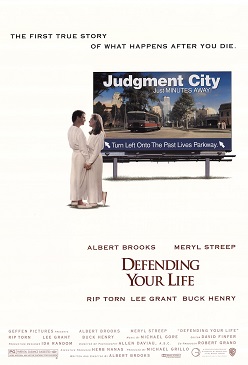
10.  Defending Your Life

Defending your life poster.jpg

This is a unique film.  The concept is that after you die, you are placed on trial to see if you have overcome fear in your life.  If you have, you move on to a higher level of consciousness.  If not, you are reincarnated.  The story centers around a thoroughly average man played by Albert Brooks.  This version of the afterlife is simplistic in its wish fulfillment (e.g. all food tastes amazing and you never get too full).  What makes this film even more interesting is that Brooks' character falls for a woman played by Meryl Streep.  This breaks through the established convention of the movie to an incredibly satisfying finale.


9.  The Frighteners
Frighteners ver1.jpg
I remember being shocked the first time I saw this film.  It does an amazing job of transitioning from Ghostbusters-like horror/comedy to an outright horror film.  The story centers on Michael J. Fox as a man who is part fraud/ part actual psychic who gets caught up in a real ghostly mystery that could spell doom for everyone he knows.  You can see how adept Peter Jackson became at visual storytelling and how this translated later into The Lord of the Rings

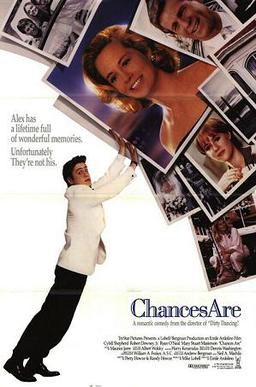
8.  Chances Are
Chances are poster.jpg
This film is so effortlessly charming, thanks in no small part to Robert Downey Jr.'s performance.  In this movie, he plays a man who gets reincarnated and finds his wife 20 years later and rekindles the romance.  But things get incredibly complicated with how her life has moved on.  It is a nice, feel-good movie that has some of my favorite performances by Cybill Shepherd and Ryan O'Neil.

7.  Flatliners
Flatliners.jpg
This was such an original concept (the first movie, not the remake).  5 medical students decide to induce death to be resuscitated soon after so that they can explore whether or not there is an afterlife. Not only did it capture the raw competitiveness of medical school, but it explored the afterlife in a truly unique way.  The last act devolves a bit into too much sentiment, but the journey to get there was strong enough to be invested in the end.

6.  Exorcist III
The Exorcist 3.jpg
This is one of the scariest films I have ever seen.  And what it implies about the afterlife can be horribly disturbing.  But the movie does it so effectively.  The soul of a serial killer (who may be attached to a demon), has possessed the body of the priest who died at the end of the first Exorcist.  That priest's soul is trapped in torment in that body as the serial killer continues to do his evil work.  This is not a film for the easily frightened.  It is masterfully written and directed by William Peter Blatty.  Everything puts you on edge until the very end.

5. Ghost
Ghost (1990 movie poster).jpg
This movie received a nomination for Best Picture at the Academy Awards and it was well deserved.  It does such a good job of embodying that Scriptural ideal of "love stronger than death."  Sam (Patrick Swayze) dies and cannot leave behind his love (Demi Moore), and must communicate through psychic Oda Mae Brown (Whoopi Goldberg) and solve his own murder.  The movie makes you yearn for the simply things we take for granted, like reaching out and touching the ones we love.  It's image of damnation is so incredibly terrifying.  And the last line of the movie still haunts me: "It's amazing, Molly.  The love inside, you take it with you."


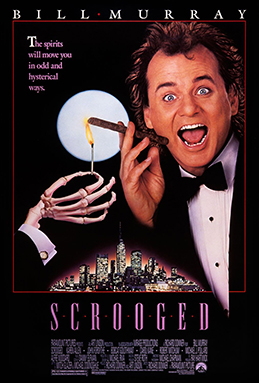
4.  Scrooged
Scrooged film poster.JPG
Even though this is traditionally a "Christmas movie," the supernatural element, particularly regarding death and judgment, are essential to the story.  There have been several iterations of Charles Dickens' A Christmas Carol, but few have captured its pure, life-changing ecstasy of the Christmas spirit.  This movie is a wonderful Memento Mori to remind us that this world is not our home and that the only thing we take with us is the love we give away.

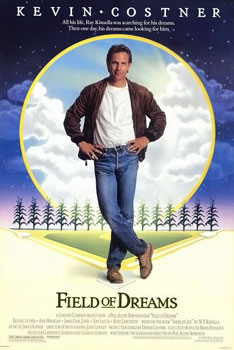
3. Field of Dreams
Field of Dreams poster.jpg
I think that you and your father ever shared a game of catch, this movie would resonate with you in a way that it does not with me.  Nevertheless, the movie is so powerful that it breaks through my deficit in this traditional father/son activity and still strikes at the heart.  Kevin Costner plays a farmer who hears a voice and receives a vision to build a baseball field in his corn field.  The movie is one whose logic is completely fluid.  There is almost never any kind of rational explanation for anything that happens.  But the emotional truth that runs throughout the entire movie becomes the structural glue that binds everything together until the final, touching conclusion.  For many people, the final scene may be the most cathartic moment in movie history.

2.  Ghostbusters
Ghostbusters (1984) theatrical poster.png
It's Ghostbusters.


1.  Dead Again
Dead Again poster.JPG
This is the story of a woman with amnesia (Emma Thompson) who thinks that she is the reincarnation of a murdered musician who was killed by her composer husband (Kenneth Branagh).  This woman gets involved with a private detective who also might be the reincarnation of her husband.  This movie is one of the best mystery/thrillers that I have ever seen.  It is charming, funny, scary, and shocking.  I witnessed an entire theater jump simply because someone said the name "Margret."  It explores the idea of reincarnation and karma and how it would affect something like love and murder.  A fantastic film!


Honorable Mentions:


Hamlet (1990 and 1996)
Coco
Beetlejuice
Almost an Angel
Made in Heaven
Always
Ghostbusters 2
Just Like Heaven
Heaven is for Real
What Lies Beneath

Sunday, October 20, 2019

Lack of Updates - October 2019

Dear Reader,

Thank you for you patience.  You may have noticed that I've only been able to get out a couple of articles a week for the last few weeks.  The reason for this is because of the following:

-I have a major writing project that must be completed by the end of the month that has been taking up most of my writing time.
-I am currently taking a Master's Degree class in Aristotle and I have been writing and reading about the Philosopher for the last two months.
-The grading quarter is coming to an end and I am spending a great deal of time grading.
-I am directing a play and we are less than a month away from opening.

For these reasons, my blogging time is going to be very limited until the end of October.

As always, your loyalty to reading this blog means a great deal to me and I never want to take you for granted.  Once November rolls around, I should have more time to write.  Some things to look forward to:

-Film Review of Brittany Runs a Marathon
-Film Review of Ad Astra
-My next in the countdown to the Best Spielberg Movies
-A reflection on the final season of Game of Thrones
-An essay about qualitative rise and fall of writer Tom King
-Reaction to the final The Rise of Skywalker trailer
-Poll results for Fantastic Four Casting Call.
-and much more.

Until then, thank you again for reading.

Monday, October 14, 2019

New Evangelizers Post: The Failure of the Saints


I have a new article up at NewEvangelizers.com.  
St. Francis of Assisi went on a pilgrimage to the Holy Land. When he returned, he found out that two of his vicars has made changes to the Franciscan community. Francis was shocked to find his brothers living in a wealthy monastery in Bolonia. His dream of a community completely dedicated to poverty appeared compromised. He worked the rest of his life to restore this vision.

St. Joan of Arc put all of her faith in God that she had been called to lead the armies of France, expel the English invaders, and place the rightful prince of France on the throne. All of this she did. Her reward: she was betrayed by the man she placed on the throne. He allowed her to be captured by the English, who burned her at the stake as a heretic.

St. Francis Xavier had a life-changing friendship with St. Ignatius of Loyola. Filled with zeal, he wanted to preach the Gospel to mainland China. He was able to go throughout all of Southeast Asia, but he kept missing opportunities to get to his goal. At one point he was on a boat setting sail for mainland China when he remembered he left his essential paperwork at his last port. He waited and waited for the opportunity to preach in mainland China. He died of a fever while waiting.

St. Charles Borromeo wanted to throw a jubilee celebration for his home city of Milan. He worked tirelessly to bring this about until his dream came to fruition. Several people came from all over the region to celebrate. Unfortunately, they also brought with them the plague. Charles emptied out all his and the church’s treasuries to deal with the crisis.

Dorothy Day had a deep conversion to the Catholic faith from her atheistic world-view. Unfortunately, the man she loved and the father of her child, Forster Batterham, refused to come to the Lord. She had to choose God over her romantic love. This caused her so much distress that she had to be hospitalized.
St. Paul met the disciples of Socrates in Athens and was able to explain to them that the Unknown God that the Socrates worshiped was, in fact, Jesus. Despite this, Paul was grieved because he found very few converts in Athens.

St. Peter was the first pope. And yet at Antioch, he behaved so scandalously that Paul had to criticize him in front of the entire Church.

The list goes on and on. I could write an entire book about the failure of the saints.

What is the point?

Failure is a part of the journey.

All things are possible for God (Matt 19:26). With Him there is no limit to what we can accomplish. But some people become discouraged when on the road to righteousness, we stumble. Of course there is the constant struggle of sin, but that isn’t really what I’m talking about here. When we decide to follow God, we may be surprised to find that we still fail at our mission. If God is with us, shouldn’t we have success? Is this because we lack faith?

I can tell you that I have been teaching Theology for twenty years and I am constantly confronted by my own failures. I have a deep, burning desire to share the love of God with my school community. Often that fire appears to only be barely keeping a few embers warm rather than setting the world on fire. Why is that?

In my case, I’m sure I have a lot of spiritual growth to do. I am not a saint, so there are probably a great deal of spiritual graces I’m failing to bring into my community because of my own lack of holiness.
But even the saints experienced failure. How do we account for their failures if they were holy? There are few things to keep in mind:

1.Failure is a Matter of Perspective.
Did Joan of Arc fail? If her mission was to free France, then no. She could have died gloriously in battle, but then she would have remembered mainly for her military campaigns. But Joan was called to witness to her complete faith in God even when all the powers of the world and the church turn against you. She was true to the end. In fact, she was able to receive the Eucharist before her execution (which proves her conviction was a sham) and was able to look upon a crucifix as she endured her martyrdom. God allowed a perceived failure in order for her to witness to a greater glory.
2.God’s Plans are Not Our Plans

We have plans and ideas and goals. But God knows what will work out better for us and for the world. We are only failures if our plans are not completely surrendered to the Divine Plan. If this wasn’t the case, then Christ would have been a failure, dying abandoned on the cross. But of course this isn’t the case. As Jesus said, “Not my will, but Your will be done!” (Luke 22:42). God’s will was done and Christ mission is not a failure.

3.Humility
The deepest spiritual pitfall on the journey is pride. God’s power can allow for miraculous successes. And this is a great thing. But the person through whom these things are accomplished may make the mistake that the power to change lives comes from themselves and not from God. This could have a much worse effect on the soul of the potential saint. But failure reminds us that we are in constant need of God. This humility is more valuable than any perceived victory. Those we are trying to reach have the freedom to accept or reject the word. We have to remember that any change comes not from us, but God in us.


You can read the whole article here.