A lot of people don't know that when Jerry Siegel and Joe Schuster first came up with the idea for a character named "Superman" that he was intended to be a villain. The name came from German philosopher Friedrich Nietzsche.
Some of you may be familiar with Nietzsche. He is especially popular with teenagers who are looking at a way to rebel against "society." Nietzsche believed that morality was something imposed upon on us and that right and wrong do not exist objectively. Most people are like sheep who follow whatever their culture deems good and appropriate. But if a man could somehow look beyond all of that, if a man had a strong enough will to power that could take him beyond good and evil, he would transcend ordinary humanity and be truly above the fold. He would be an "Uber-mensh" or "Superman."
Sadly, some in history have tried applying Nietzsche's ideals and tried to make them real. If you listen to much of Hitler's words on the master race, you find the DNA of the philosopher's thought. And in art, there have been many attempts to dramatize the "Superman" in stories. But to my mind, no one has ever realistically done so.
I can understand the appeal of a character who has no morality. How many of us have known the hell of a guilty conscience. There is a freedom in not caring about right and wrong. Let us be honest, if we found out that God would give us a 24-hour pass to commit whatever sin we desired without any consequence, how many of us would indulge? The idea of the Superman is that he cannot be tied down to conventions and is above consequences.
The problem is that you cannot get beyond consequences and you cannot get beyond your nature.
This is one of the reasons that the art of story-telling is so important for us to understand why Nietzsche is wrong. Story-telling is the only universal art form and it is the oldest one at that. CS Lewis understood that when we tell stories, particularly myths, we circumvent the analytic part of the mind and experience the thing directly. This is not to say that the experience is irrational or merely emotional. It means that we touch the truth of reality in a straightforward way. In other words, I can describe to you what friendship is, give you every type of definition, but it will not compare to experiencing Samwise Gamgee taking Frodo onto his back saying, "I can't carry it for you, but I can carry you!"
Think about all of the characters in movies or stories who have embodied the Nietzschian Superman. First of all, we find that most of them are villains. Emperor Palpatine says to Anakin "Good is a point of view." Jack in Lord of the Flies descends into utter savagery. Voldemort tells Harry Potter that there is no good or evil, but "only power." Even the Joker from The Dark Knight said he wasn't a monster, he was just "ahead of the curve," meaning that he was the first to understand that morality was a joke that he had moved beyond.
And even attempts to make these "Supermen" heroic often falls flat. Hipster-geek favorite Joss Whedon has tried several times to do just his. Angel, the vampire with a soul, concludes that his war against evil is pointless, but he fights because "what else is he going to do?" Whedon's Mal Reynolds does not believe in archaic things like sin, but he fights for his people with ferocious faithfulness. Non-Whedonverse character Jack Bauer commits deceit, torture, and murder of innocents to achieve his ends. We admire these men for their heroism, but their motivations leave us empty.
In the realm of the less fantastic, we see characters like the heroes of Wag the Dog who enter a campaign of lies and smears to get a president re-elected. We find them them diverting and entertaining. But part of us also finds them horribly disgusting. The reason why is because we intuitively get that they are living against their nature.
The best example I have ever seen of a Nietzchian Superman is Michael Corleone in The Godfather Part I and II. Particularly by the time you get to the end of Part II, Michael has become a man with ice water in his veins who orders the death of all of his enemies, even those in his own family. And all of his plans have been successful. He has achieved, through sheer force of will, the triumph he sought. And yet how haunting is that last shot of Michael sitting alone. Alone.
Alone.
Nietzsche should have warned us of the terrible loneliness of those who don't play by society's rules. Who would want that person cannot see you as anything other than a means to an end? There are no heroic "Supermen" successfully portrayed in art. But that does not mean that there are no heroes.
As I wrote in my essay "The Cape and the Cross," we can find copious amounts of heroic characters, particularly those who act as Christ figures. There is a reason that we latch onto Luke Skywalker, Harry Potter, and, yes, Superman. They touch on the truth of heroism, which is self-sacrifice. This is the nature of a hero, the nature of a saint.
I also think that there is another reason why we intuitively reject the portrayal of the "Superman" but can accept the depiction of the saint. The reason is that the Superman is a fiction, while the saint is a reality. Nietzsche concocted the idea of the "Superman" as a way for him to fantasize about an existence beyond his drab life. Yes, Nietzsche was a great writer and a genius. He also had the temperament of a petulant child and he went insane and tried to strangle a horse.
But saints are real. We see them in history. Who hasn't been moved by the courage of the early Christian martyrs: of Peter, Paul, Andrew, Bartholomew, Agnes, Barbara, and the rest. We see them in the world today. As bad as the news of the world is, we also read stories about those like Mother Teresa or Pope Francis, who lovingly devote themselves to the anawim ("the least ones").
And we see them in our every day lives. We see them in the parents who cradle a crying child at 3am. We see them in the neighbor who helps you with your home repairs "just because." We see it in the teacher who stays hours after the last bell has rung to make sure that their student has everything they need to pass. We see it in that one person in our life who is unfailingly kind to us, even when we don't deserve it. We see those who do what is right for no other reason than it is right.
When we see Nietzsche's "Superman" in art, we are staring into a window of fantasy.
When we see a saint in art, we are looking at a mirror held up to reality.
ReasonForOurHope

Friday, June 21, 2013

Wednesday, June 19, 2013
Wednesday Comics: The Green Lantern Geoff Johns Finale

It was the end of an era.
I've very rarely seen the in-book fanfare of farewells that were present in Green Lantern #20, the last issue written by master scribe Geoff Johns. Interspersed in the narrative were people inside and outside of the comic book industry making small testimonials to Johns epic 9 years with Hal Jordan, Green Lantern of sector 2814.
I've commented in the past on how Johns innovation of the character and the universe made this book the true flagship of the DCU. His ingenious weaving of old story lines and new innovations wove an amazingly colorful tapestry of cosmic adventure. But I would like to focus on that final issue.
Johns' Green Lantern had a habit of doing epic-sized stories while planting the seeds of another future epic in the narrative. During the dire and violent Rise of the Third Army, Johns introduced a new character called Volthoom, the First Lantern. To introduce his back story, Johns goes back to the oldest legend of the Oans.
The rebel Krona opened a window to the dawn of creation to watch the "Hand of God" create everything. But instead a human named Volthoom arrives in a space suit. What are his origins? How did he get there? Why is he wearing something that looks like an American flag? These questions are never answered. All we know is that Volthoom acts like a vampire on the emotional spectrum and this allows him to manipulate reality and re-write history.
The build up to the finale mostly involved character pieces where Volthoom entered into the main characters' minds and saw what their greatest fears, hopes, loves, and hatreds were. He then drove them to feel all of these as deeply as he could so that he could feed off of their energies. These issues proved to be very intriguing glimpses into the psyches of our heroes, but they felt a bit repetitive.
I would say that is the biggest problem with the issue: it is too short. I do not mean that this particular issue is short. In fact, it is over long at 64- pages, which is nearly 3-times the size of an average comic. But reading it, I had the same feeling I had when I watched the finale to Buffy the Vampire Slayer. The story felt like it was condensed to fit everything in rather than being let out to breathe, making the conclusion more satisfying. I feel like another 3 months or so would have opened up a richer conclusion.
But having said that, Johns fills his finale with colossal action and powerful character moments. When the story begins, both Hal Jordan and his eternal foil Sinestro are at their lowest, for reasons I will not spoil here. Both, at the beginning are Green Lanterns, but both embrace other corps for various reasons. What follows is both exhilarating and tragic. And that is the way it should be. There should be a cost, a heavy cost, to fighting the good fight or the victory earned will not feel as valuable. It also makes the joy that arises out of the sadness all the sweeter.
Johns also wisely ties together loose ends from all of his major epics in his Green Lantern run, like a composer weaving earlier movements and motifs into a grand guignol. It reminded me so much of what James Robinson did in his conclusion to the incomparable Starman. Each callback is a thrill and a delight. And there is a moment where Sinestro confronts a long-time Green Lantern villain that has the trademark "I didn't see that coming but should have" feel to it.
My favorite moment (MILD SPOILER THIS PARAGRAPH), by far, is between Hal and Sinestro. In a way, this series has always been about the 2 of them. Way back in the series, Hal was bringing Sinestro to his execution (things, obviously, did not go as planned). Before they were attacked, Hal wanted to ask Sinestro a question. He never got the chance. That dangling mystery has been a key thread to the whole dynamic between these two. In the end, Hal finally gets to ask it of Sinestro: "Were we ever friends?" Sinestros answer is so perfect, so powerful, and so devastating that it makes me want to re-read the entire series once again.
The coda to the story involves the Toris, the keeper of the Book of Oa in the far future, telling a new Green Lantern about the fates of all the main characters. This had the feeling of the epilogue to the Harry Potter series, which splits fans down the middle. I personally, very much enjoyed the Green Lantern epilogue. Johns understands that when you spend so many years with these characters, saying goodbye is difficult. Like parting with close friends, above all you want to know that they are going to be okay. Johns lays out the path of all the survivors of this epic finale in a way that is logically consistent and emotionally cathartic.
This is also the best work I've seen Doug Manke do as artist, and that is saying a lot. I was not excited when he originally took over, but he has time and again proven me wrong. There are nice moments drawn by Green Lantern Rebirth artist Ethan Van Sciver and some by Ivan Reis. All of it flows nicely to capture the wild and imaginative action and heartbreaking drama.
I want to end this review with a simple thank you to Mr. Geoff Johns. I doubt that you will ever read this, but I just wanted to say that reading your work on Green Lantern has given me years of wonder and joy. Your stories will stay with me.
Thank you for filling my world with Green Lantern's Light.
Film Flash: The Heat
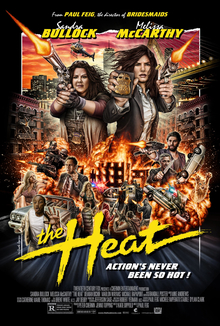
15 words or less film review (full review to follow soon)
Standard buddy/cop movie minus any real laughs. A waste of time and talent.
2 out of 5 stars.
Opening June 28th
Monday, June 17, 2013
Film Review: Man of Steel
The movie had ended and the lights came up and despite how bad it was, I convinced myself that I liked it because it was a Superman movie. It wasn't until time and subsequent viewings that I realized I was simply starved for more Superman on screen and I was willing to take whatever was offered.
I'm speaking, of course, about 2006's Superman Returns, Bryan Singer's mediocre-at-best addition to the Superman mythos. I tell you this story because I was very much on my guard against this for Zack Snyder's Man of Steel. My expectations were so very high and I was starved again for seeing more Superman on screen (especially after Smallville ended). I went to the midnight showing and came out liking it a great deal. But before I could give it a thorough review, I went to see it again the next day.
Now I've gone from liking it to loving it.
Man of Steel is the retelling of the Superman origin. Because we've seen this before in previous films, some of the story beats feel familiar. But Zack Snyder, unlike Bryan Singer, makes a complete break from the Richard Donner aesthetic. Everything looks new and different. This version of Superman's father, Jor-El (played by the wonderfully understated Russell Crowe) is a dynamic man of action and conscience, unlike the stiff, stoic Brando version. He is at odds with his Kryptonian culture and its leaders, particularly General Zod (Michael Shannon). But in the midst of the chaos, Jor-El steals something called "the codex" and places it with his son Kal in his rocket to Earth.
The first half of the movie is very similar to the structure of Batman Begins, which is no surprise since it was written by the same man, David S. Goyer. In both films, the hero is seen wandering, trying to find himself and his place in this world. Clark (Henry Cavill) travels from one odd job to the next encountering what humanity has to offer (often not very nice). All the while he reflects on his time growing up in Smallville, being raised by Jonathan and Martha Kent (Kevin Costner and Diane Lane). His journey eventually takes him to a government research station in the north where they are investigating an extra-terrestrial object. This also happens to be at the same time that investigative reporter Lois Lane (Amy Adams) comes snooping in to get the real scoop. Needless to say, this sets off a series of events that bring Clark to the attention of the world as a hero and creates a confrontation with Zod and his fellow insurgents who survived Krypton's explosion.
Let me begin with the movie's negatives, of which there are 3.
First is the use of shakey-cam. I HATE shaky-cam. I find it a near-constant distraction. Watching this, I wondered if someone had stolen all of the tripods from the set and Snyder said, "Eh, forget it, let's film anyway." Actually, I know this approach was completely intentional on Snyder's part, whose style in movies like 300 and Watchmen is usually slick and smooth. Here, because the story is so fantastic, he believes that the use of handheld will give the movie a more realistic look. And to be sure, it does not look as artificial and polished as most movies today. The lighting is harsher and the colors tend to be muted, which make it feel much more like the real world than, say, Iron Man 3. I can see here the influence of The Dark Knight director Christopher Nolan, who acted as producer for Man of Steel. That cinematography and "realism" of that second Batman film can been felt in this movie. The shaking was nowhere near as bad as a Blair Witch Project or a Saving Private Ryan. But the constant shaking became very annoying.
Second, the narrative in the first half is very disjointed. Using the Batman Begins approach, Goyer writes a story that jumps around in time a lot. Not only that, but many of the scenes feel artificially truncated, as if there was more written and shot, but surgically removed for times sake (and seeing as how the movie is around 2 and a 1/2 hours as it is, I understand the concern). This becomes less of a problem on a second viewing. I think that Goyer wanted to avoid retreading on familiar ground as much as possible and instead wanted to focus on the emotional reality of Clark's journey.
Third, the supporting characters do not get enough screen time. Lois, Zod, and Jonathan Kent are all very strongly fleshed out. But most of the other supporting players like Perry White (Lawrence Fishburne) are only touched upon and given small character moments, but they are never fully developed. Again, the sense I get is that their scenes were there originally but were left on the cutting room floor.
Those are the 3 strongest areas of detraction I can find in this film. The rest of it soars.
Man of Steel is a true spectacle. This is where Snyder is the strongest. I spent much of the movie drinking in the visuals. When Zod and Superman first exchange blows, I got my money's worth from the film. I remember watching The Matrix Revolutions fight between Neo and Smith thinking that this would be cool if it was between Superman and Zod. Well, that fight has nothing on the climatic battle in Man of Steel. If you just want to see spectacular scenes of super people punching each other, this movie rocks. In the IMAX, you could feel each punch resonate through your chest.
I loved the performances in this film. Cavill has to carry a lot of this film with his looks. When Superman first appears, the American government believe he is a threat. What I noticed was that he had to use his body to convey strength and power, but his face always displayed a kind of gentleness to illicit trust. This kinesthetic schizophrenia is not easy to pull off. That is not to say he constantly has an "aw-shucks" face. He brings about amazing levels of intensity in the action sequences.
And, to my mind, Amy Adams is the best Lois Lane I have seen on screen. This Lois is not, naive or gullible. She is brave, smart, and conscientious. Because of this, Man of Steel throws out the old ways her relationship to Superman has been defined and forges a new path.
But the two best performances come from Michael Shannon and Kevin Costner. Shannon's Zod could be dismissed as over-the-top bordering on cartoonish, except for his complete commitment to the character with a fiery intensity that never abates. When he shouts "I WILL FIND HIM," it feels like the seething anger under his mind finally explodes. Someone pointed out the me that he has a stare of constant malice similar to Malcolm McDowell's in A Clockwork Orange. And unlike Terrence Stamps' Zod, Shannon's is oriented solely for the good of Kryptonian society.
Costner, though, is the emotional heart of the movie. In the few scenes he is in he breaks the heart. Not since Viggo Mortenson's performance in The Road have I seen such a worn down, burdened father on screen. He knows, like all fathers, that his words and actions will shape his child's soul. But he also knows that because Clark is a god among men, those choices will have resonances to the entire world. He looks both confident and lost. He conveys the sureness of a father, but underneath his eyes and in the quiver of his voice, you hear his fear at making the wrong choice. After Clark displays his power to save some people, Jonathan scolds him. When asked by Clark if he should have just let them die, Jonathan responds "Maybe." This could have been perceived as a a cold calculation. But Costner shows, very subtly, how much that horrible answer weighs on him and what it implies.
Thematically, the movie is very rich. Much has been made of the Christian imagery throughout the film, and it is there in subtle and not-so-subtle ways. As a devout Catholic, I LOVE the fact that before making a life-changing decision, Clark goes to Church and seeks the advice of priest. And the priest is not supernaturally wise or specially, but he gives the best advice he can in a very human way that resonates through the rest of the film. And I also got a little thrill to see that in a scene where some school bullies try to goad Clark into a fight, that he is reading the complete works of Plato! When was the last time you so Plato in a summer blockbuster? The movie also deals with issues of nature vs. nurture, free-will vs. determinism, fear vs. trust, etc.
Hans Zimmer's score is also fantastic. Nothing can touch the iconic John Williams work, but Zimmer makes the wise decision to follow none of the Williams' musical motifs and forges a path of his own. It is the best score I've heard all year, alternately sad and tender and then big and bellicose.
Days later, I still have the feel of Man of Steel lingering in the corner's of my imagination. Part of me can't wait to see it again and, even more so, anticipates the new adventures of Superman.
4 and 1/2 out of 5 stars
Monday Poetry: Shakespearean Sonnet #2
Like the first sonnet, this one also urges haste in procreation. This makes me think of all of those commercials for contraceptives that show all of the pleasures you can enjoy by not having kids. It is amazing when speaking to teenagers about how one day most of them will be parents I receive blank stares of incomprehension back. The idea of being a parent is so alien to them, even as they imagine themselves as adults (for children tend to imagine adulthood as childhood, but with more freedom).
But the poet, speaking from experience I think, explains that there are deeper and higher beauties that having children brings.
When forty winters shall besiege thy brow,
And dig deep trenches in thy beauty's field,
Thy youth's proud livery so gazed on now,
Will be a totter'd weed of small worth held:
Then being asked, where all thy beauty lies,
Where all the treasure of thy lusty days;
To say, within thine own deep sunken eyes,
Were an all-eating shame, and thriftless praise.
How much more praise deserv'd thy beauty's use,
If thou couldst answer 'This fair child of mine
Shall sum my count, and make my old excuse,'
Proving his beauty by succession thine!
This were to be new made when thou art old,
And see thy blood warm when thou feel'st it cold.
Sunday, June 16, 2013
Sunday Best: TV Dads of All Time
In honor of Father's Day today, I thought we'd recap the best TV dads.
Now this is not as easy as it sounds, considering that television is, for lack of a better term, a moral cesspool. Too often the dads are the "cool" dads who buy their kids condoms or they are buffoonish bums. But we cannot deny that what we watch on tv influences the culture, so we should try to find good examples of fatherhood out there on the airwaves
10. Rick Castle ("Castle")

He is on the list for the pure cool factor. He would be the rare exception to this list that finds his place because he has a great friendship with his daughter. But he isn't afraid to go all Liam Neeson in Taken if it means protecting her.
9. Jay Sherman ("The Critic")

This schlubby loser whose ex-wife hates him finds nothing but joy in his son. And he goes out of his way to make his son's life better, which is why his son idolizes him.
8. Benjamin Sisko ("Star Trek: Deep Space Nine")

Unlike other commanders in the Star Trek Universe, we got to watch Sisko deal with the trials of being a single father, watching his son grow up to be a man as he balanced his responsibilities against his family, but never forgetting either.
7. Angel ("Angel")

The main character of this Buffy the Vampire Slayer spin-off has a lot of flaws. SPOILER ALERT, but when it came to his son Connor, there was no price he wasn't willing to pay, whether it was giving him up as an infant so he could have a chance at life or giving him away again as a teenager so that he could have a chance to be happy.
6. Harold Weir ("Freaks and Geeks")

Simple, yet relatable, Harold is the average father doing his best. And even his flaws in parenting, like always being more worried about his daughter than his son simply because she's his daughter, are understandable and endearing.
5. Red Foreman ("That '70's Show")

While nearly everyone on that show was a moral degenerate, Red was the constant boot in their you-know-where to help them grow up. Tough as nails, he gave what structure. And though he wasn't warm and fuzzy, he was always there for his kids (even his kids' friends).
4. Keith Mars ("Veronica Mars")

This was a smart, funny, hard-working dad who put everything he had towards the happiness of his daughter. Yes, he bent or broke the law every once and a while to do it, but he always did it with his daughter's happiness in mind.
3. Philip Banks ("The Fresh Prince of Bel-Air")

Uncle Phil could have been a simple over-bearing stereotype. But he was tough and tender as needed. He was as much a father to Will as he was to his own children. The episode where Will's dad comes back is particularly poignant and shows what a real father is.
2. Heathcliff Huxtable ("The Cosby Show")

No television dad reminds me more of my father. I think people misremember Cliff as being wacky and fun-loving. In fact, he was a stern disciplinarian who pushed his kids to make good life decisions. The humor tended to come from his exacerbation at the idiocy of his children. But he always put them first and was a great role-model.
1. Jonathan Kent ("Smallville")

Speaking of role models, there is none better than Jonathan Kent on Smallville. In fact, that is his whole function to the Superman mythos. He gets his powers from his Kryptonian parents, but he gets his heroism from his earthly ones. Jonathan gives Clark the moral compass he needs to understand that his powers are a gift to help others. And while he did make mistakes, he always did so with the intent to help his family. He was the one who taught Clark not only how to be a Superman, but how to be a man.
Now this is not as easy as it sounds, considering that television is, for lack of a better term, a moral cesspool. Too often the dads are the "cool" dads who buy their kids condoms or they are buffoonish bums. But we cannot deny that what we watch on tv influences the culture, so we should try to find good examples of fatherhood out there on the airwaves
10. Rick Castle ("Castle")

He is on the list for the pure cool factor. He would be the rare exception to this list that finds his place because he has a great friendship with his daughter. But he isn't afraid to go all Liam Neeson in Taken if it means protecting her.
9. Jay Sherman ("The Critic")

This schlubby loser whose ex-wife hates him finds nothing but joy in his son. And he goes out of his way to make his son's life better, which is why his son idolizes him.
8. Benjamin Sisko ("Star Trek: Deep Space Nine")

Unlike other commanders in the Star Trek Universe, we got to watch Sisko deal with the trials of being a single father, watching his son grow up to be a man as he balanced his responsibilities against his family, but never forgetting either.
7. Angel ("Angel")
The main character of this Buffy the Vampire Slayer spin-off has a lot of flaws. SPOILER ALERT, but when it came to his son Connor, there was no price he wasn't willing to pay, whether it was giving him up as an infant so he could have a chance at life or giving him away again as a teenager so that he could have a chance to be happy.
6. Harold Weir ("Freaks and Geeks")

Simple, yet relatable, Harold is the average father doing his best. And even his flaws in parenting, like always being more worried about his daughter than his son simply because she's his daughter, are understandable and endearing.
5. Red Foreman ("That '70's Show")
While nearly everyone on that show was a moral degenerate, Red was the constant boot in their you-know-where to help them grow up. Tough as nails, he gave what structure. And though he wasn't warm and fuzzy, he was always there for his kids (even his kids' friends).
4. Keith Mars ("Veronica Mars")

This was a smart, funny, hard-working dad who put everything he had towards the happiness of his daughter. Yes, he bent or broke the law every once and a while to do it, but he always did it with his daughter's happiness in mind.
3. Philip Banks ("The Fresh Prince of Bel-Air")

Uncle Phil could have been a simple over-bearing stereotype. But he was tough and tender as needed. He was as much a father to Will as he was to his own children. The episode where Will's dad comes back is particularly poignant and shows what a real father is.
2. Heathcliff Huxtable ("The Cosby Show")

No television dad reminds me more of my father. I think people misremember Cliff as being wacky and fun-loving. In fact, he was a stern disciplinarian who pushed his kids to make good life decisions. The humor tended to come from his exacerbation at the idiocy of his children. But he always put them first and was a great role-model.
1. Jonathan Kent ("Smallville")

Speaking of role models, there is none better than Jonathan Kent on Smallville. In fact, that is his whole function to the Superman mythos. He gets his powers from his Kryptonian parents, but he gets his heroism from his earthly ones. Jonathan gives Clark the moral compass he needs to understand that his powers are a gift to help others. And while he did make mistakes, he always did so with the intent to help his family. He was the one who taught Clark not only how to be a Superman, but how to be a man.
Friday, June 14, 2013
Film Flash: Man of Steel

15 words or less film review (full review to follow soon)
Wow! That was a SUPERMAN movie. Literally spectacular. (But I hate shakey-cam)
4 and 1/2 out of 5 stars
Subscribe to:
Posts (Atom)