ReasonForOurHope

Thursday, June 13, 2013

Film Review: The Hangover Part III


This review will be shorter than most, because there is not much to write about.  The original Hangover film was audacious and raunchy.  But above all it was funny.  It also had characters that made interior personal journeys.  Granted some like Stu (Ed Helms) made deeper life changes than Phil (Bradley Cooper) or Alan (Zach Galifinakis), but the story changed them and made them a little better than they were.

The Hangover Part II was vile.  I have very little else to say about it.

The Hangover Part III wisely throws away the recycled plot formula from the first 2.  Here, after Alan's father dies, the wolfpack decide to drive him to a rehab clinic.  But a gangster played by John Goodman kidnaps Doug (Justin Bartha).  The comic trio is forced to find Leslie Chow (Ken Jeong) in order to get Doug back.

I have no problem with the change up in plot structure.  In fact I welcome it.  But with the change in form, there is also a change in style.  The movie plays much more like a heist movie than a wacky comedy.  And that would be fine if they made it as funny as the first.

The jokes fall flat for the most part because most of the characters have lost their flavor.  This is a movie about Alan.  Stu and Phil are there only because you couldn't have a Hangover movie without them.  But the two saner wolves in the pack have little else to do in the story than react to Alan's insanity.  And this would also be more forgivable if Alan was more redeemable.  But rather than enjoying his wacky free spirit, I found myself wanting to wring his neck.

The film also features much more Ken Jeong, which is not a good thing.  If you give him a good enough part, Jeong is hysterical.  But nonsensical is not the same as humorous and that is where his storyline fails.  Rather than rooting for a happy resolution, I was just waiting for the movie to end.  And while it felt like there was some character development by the end of the first movie, the characters just felt static in this one.

The Hangover Part III is not a bad movie per se.  But it is far below the original.  The movie tries to leave you on a high note with an after-credit scene and a montage of the wolf pack from past films, but all that does is remind you how much better the first Hangover was.

2 and 1/2 out of 5 stars.

Wednesday, June 12, 2013

New Evangelizers Post: Using the Internet for Evangelization


I have a new article up at NewEvangelizers.com

USING THE INTERNET FOR EVANGELIZATION


I have only been blogging for a little over a year, so please take any advice given here with that in mind.  There are some great pioneers in using the internet to spread the Gospel.  I am only riding on their able coattails.

But what I have found is that when it comes to evangelizing online, one size does not fit all.  There are different approaches that should be taken in different venues and there are different methods of giving and acquiring information.

BLOGGING

I have found blogging to be like giving a sermon.  Thoughts are collected in advance and then presented to the community.  There isn’t a lot of interruption or questions.  Blogging reflections and essays forces you to collect your thoughts into some kind of coherent unity so that you can express yourself effectively.  And just as long sermons tend to upset more than they uplift, long blog articles do, too.  Blogging is not like writing a book.  You must be concise and clear in a few paragraphs or you will lose the interest of the audience.


You can read the whole thing here

Fixing Movies: Superman IV - The Quest for Peace


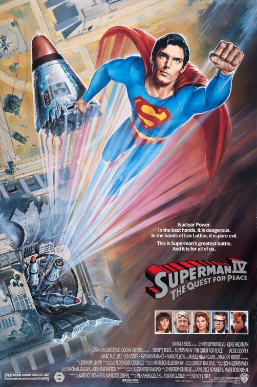
Once again, in honor of Man of Steel coming coming, I thought we'd look back at the Superman movie franchises.  Last time we tackled Superman Returns.  Now we are going to hit the worst of the Superman movies: Superman IV - The Quest for Peace.

For those who haven't seen it, a young boy writes Superman a letter asking him to get rid of all nuclear weapons.  He decides the boy is right, and tells the nations of the world that he will destroy their nuclear stockpiles.  Lex Luthor creates a super villain called Nuclear Man, who happens to be so solar powered that he falls into a coma if he walks into the shade.  That isn't a joke.  Cover this guy in SPF 150 and it would be like kryptonite.  Anyway, Nuclear Man then fights Superman for, I guess, the right to make more nukes.

Now, the DNA of the film is salvageable.  What I mean is that the essential concept is fascinating: what would happen if Superman said "No more nukes?"  However the rest of the film is trash.  Every part of it.  So rather than a usual numbered point-by-point list, I will throw out the whole thing.  I will start with the main plot and try to incorporate as much of the original's ideas as possible.

THE OPENING
Instead of a little boy's letter and a runaway subway as our opening, picture this: two small nations who happen to have nukes declare war.  Superman, who usually does not get involved in geo-political matters, tries to stop mass genocide.  One side launches and the other retaliates.  He is able to stop all the missiles except one.  That missile destroys a heavily populated area killing all the people.  He is only able to find one survivor who is dying from the radiation.  He decides to take that one survivor to the fortress and use his sunstone crystals to heal him.  This goes against the fortresses' programming and warns Superman that effects could be disastrous.  He ignores them and does it anyway.  In the process all of the sunstone crystals are destroyed except for the original green stone from the first film.

THE ULTIMATUM
Superman, shaken by the destruction, decides that nuclear weapons are too dangerous for earthlings to have.  Some, like Jimmy Olson agree.  Others, like army brat Lois Lane, disagree.  This leads to some healthy debate.  But Superman cannot get past the devastation and the two nations are still bristling.  So Superman relieves them of their nukes.  Then he goes to the UN and tells all the nations that he will rid them of their nukes.

This sends the nations of the world into a tailspin.  Superman has now dictated how nations should act. Some respond by sending an army of Braniac-like robots against him.

THE ALLY
While fighting them, Superman gets injured.  But the man he rescued with his sun stone as not only fully recovered, but has developed Krytonian-like powers like Superman, but he has chalky-white skin and his face is scared.  He is a lot like Superman, just a little more "bizarre."  Together, they seek to rid all the nations of their nukes, despite their protest.  And they are successful.

THE CONFLICT
Superman's new ally applies this new philosophy of peace to not only nuclear weapons, but all dictators.  He proceeds to overthrow the dictator who sent nukes to his homeland.  Superman talks him out of killing and holding democratic elections.  The ally agrees, grudgingly.  However, the level of violence by conventional arms around the world escalates and border disputes are becoming more common.  The ally goes to the UN and states that he and Superman will decide the nations borders.  This leads to a philosophical argument between Superman and the ally about the use of power.  Superman says that the people need to make their own choices.  The ally says that he is only following the logical conclusion of Superman's premise that only the two of them are can make the right choices for humanity (thus becoming Nietzschian Supermen).

THE FIGHT
After the dictator who the ally spared is named president in a democratic election.  The ally goes and unceremoniously kills the new president and declares that the people have wasted their one chance to make their own decisions.  Superman goes and confronts him and they have a knock-down, drag out fight, that nearly kills Superman, who slips away, leaving the ally to declare himself dictator of earth, for the good of the world.

THE TRUCE
Superman's life is saved by none other than Lex Luthor.  Luthor still hates him with a passion, but sees the ally as a bigger threat.  The two agree to join forces to defeat him.  Luthor reasons that only way to defeat the ally is to use whatever Kryptonian tech is left in the Fortress of Solitude.

THE FINAL BATTLE
Superman lures the ally there and they fight in spectacular fashion with any and all resources the fortress has.  Superman is able to defeat the ally and almost convinces him to learn from the error of his ways.  He tells him that they cannot place themselves above humanity, but have to remember that even though they have more power, that doesn't make them wiser.  But Luthor double crosses Superman and sets off a trap in the fortress that is meant to kill both super-powered beings.  The ally is killed and Superman is almost killed as well.  But he uses the power of the last remaining sunstone to save his life.  He escapes and finds Luthor and brings him to justice.

THE RESOLUTION
Superman submits himself to the world court for trial, saying he is prepared to accept whatever punishment the people of Earth give him.  However, footage of his fight with the ally in the fortress (filmed by Luthor and obtained by Lois), has spread throughout the world.  They can see that Superman has learned his lesson and was willing to die to make up for it.  They let him go and Superman pledges to put himself above the people of Earth.

The end.

Thoughts?

Monday, June 10, 2013

Dan Harmon Returning to Community

photo by Gage Skidmore
Cool cool cool.

I was at a game night recently when myself and another admirer of the show Community were trying to explain its merits.  But apparently our zeal and affection for this show was so intense, that the person with whom we were speaking said we sounded as if we were in a cult.

I find it hard to imagine anyone watching the first three season and not falling in love with Jeff, Annie, Troy, Abed, Britta, and Shirley (though I'll give a pass to Pierce, Chang, and the Dean).  Those first three seasons are gold.

This past fourth season has been panned by critics and fans alike for its lackluster execution (although a good friend of mine who had not like the show before enjoyed it).  The key ingredient missing from this past season was show creator and showrunner Dan Harmon.

Harmon was unceremoniously fired after a very public dust up with cast member Chevy Chase.  But with Chevy gone and apparently at star Joel McHale's insistence, Dan has returned.

Season 4 of Community was funnier than most stuff on tv, but it couldn't touch the first three seasons.  With Harmon back, I hope the magic will return.

And while you have some standard Hollywood morals, the show has one of the most well-rounded Christian lead characters (Shirley) and it has a fairly strong moral center.  They close the circle very well on Jeff's character who, in the pilot, espouses moral relativism only to reject it at the end of season 3 because he encountered truth and love and friendship.

Check Season 1-3 out on DVD.


The Return of Monday Poetry: Shakespearean Sonnet #1

I know I've been lax in posting Monday Poetry.  But I decided to bring this feature back by bringing the sonnets of William Shakespeare each week.

This first poem is a bit obtuse.  But it is his reflection on how beautiful things and beautiful people have  an obligation to make more beautiful people and beautiful things.  That is because age and death draw us down into darkness, so we have to fill the world with beauty while we can.

SONNET #1

From fairest creatures we desire increase,
That thereby beauty's rose might never die,
But as the riper should by time decease,
His tender heir might bear his memory:
But thou contracted to thine own bright eyes,
Feed'st thy light's flame with self-substantial fuel,
Making a famine where abundance lies,
Thy self thy foe, to thy sweet self too cruel:
Thou that art now the world's fresh ornament,
And only herald to the gaudy spring,
Within thine own bud buriest thy content,
And, tender churl, mak'st waste in niggarding:
   Pity the world, or else this glutton be,
   To eat the world's due, by the grave and thee.

Sunday, June 9, 2013

Film Flash: The Hangover Part III


15 words or less film review (full review to follow soon)

Not the worst Hangover film, but the least funny.  Not bad.  But magic is gone.

Sunday Best: Top Ten Opening Credit Sequences


This was a suggestion from Rick O. He wanted my thoughts as to which movies had the best opening credit sequences. This is not to be confused with an opening scene. The credits sequence tends to be some kind of montage that is interested in getting across the emotional truth of the movie. I've always maintained that the end depends upon the beginning. Usually you know whether or not you like a movie within the first 10 minutes. The opening credit sequence is usually less interested in moving the story forward as it is giving you a sense of the kind of movie you are watching.

There are a lot of great opening sequences. Rick O. was efusive in his praise for the opening credit sequence to Die Another Day. I racked my brain as best I could, so I'm sure there are some that I am missing. Also, there are some, like Star Wars, that have great openings, but that are not opening credit sequences, that have been left off.

Dead Again

-This sequence consists only of credits and newspaper headlines. But director Kenneth Brannagh does 2 things: with his choice of music he creates a palpable air of fear and tension. And the headlines are sufficiently ominous that you can't help but feel the malice in convicted murderer Roman Strauss.

Ted

-A lifetime of friendship is something difficult to capture on screen. But Ted did this beautifully with a collection of movies and still photos of a life that does not feel too far removed from our own, full of fun and nostalgia. By the time the sequence is over, you feel the life-long bond between the two main characters.

Much Ado About Nothing
-There is something epically romantic about the way Brannah shot the opening credits to this Shakespeare adaptation. His use of slow motion, sweeping camera movements, and musical flourishes fill the film with pure pagentry

JFK

-This black and white sequence not only creates an air around our martyred title character, but it sets the tone of parnoia and fear necessary in this epic consipiracy theory

Juno

-Again, opening credit sequences are about tone. And Jason Reitman hit it perfectly with its rotoscoped hyper-stylized reality and quircky soundtrack underneath

Monty Python and the Holy Grail

-This deserves its place just for being so odd and at the same time being so strangely funny.

The Wedding Singer

-Director Franc Coraci capture the feel, music, and color of the 1980's in a way that made it appealing to remember. The musical sequence was toe-tapping fun

Memento
-The opening reverse sequence is so strange, yet so important. It fills you with questions that demand to be answered, taking you backwards from a developed polaroid of a murdered man.

Resevoir Dogs

-The first time I saw this movie, I didn't like (I have since come to love it). But even then I was struck by the title sequence. It had this innate sense of cool that seemed unrehearsed and genuine. It also works in a way that transitions you to the shocking violence of the film.

Goonies

-Pure fun that introduces all of the main characters and sets the tone for fun and adventure.

HONORABLE MENTIONS:


Young Guns
Willow
Watchmen
Untouchables
Arthur 2
Back to the Future
Can't Hardly Wait
Spider-Man 2
Daredevil
Flash Gordon
Forrest Gump
The 40-Year-Old Virgin
Get Smart
Gross Pointe Blank
Jaws
Life is Beautiful
Never Ending Story
Office Space
Swing Kids
Catch Me If You Can

(My wife suggested I also put up Lost in Translation, but I think that was a trap.)